Giergiel Marta, Olejnik Małgorzata, Jabłoński Artur, Posyniak Andrzej
National Veterinary Research Institute, Department of Pharmacology and Toxicology, 24-100 Puławy, Poland.
Nicolaus Copernicus University in Toruń, Faculty of Biological and Veterinary Sciences, Department of Basic and Preclinical Sciences, 87-100 Toruń, Poland.
J Vet Res. 2021 Dec 2;65(4):487-495. doi: 10.2478/jvetres-2021-0065. eCollection 2021 Dec.
The study measured the hormonal and protein markers of acute stress, those of oxidative stress and total antioxidant capacity (TAC) in swine oral fluid, determined which of these parameters would be the most appropriate for future livestock welfare assessment and established the time when the samples should be taken.
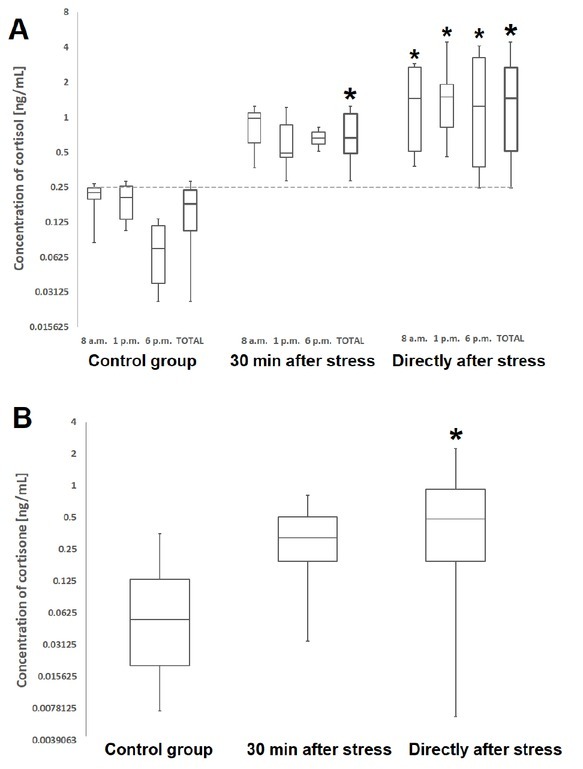
Stress was induced in 7 out of 14 castrated six-week-old Danbred×Duroc pigs by immobilisation on a nasal snare at 8 a.m., 1 p.m., and 6 p.m. and samples were taken both directly after the stressor was applied and 30 min later. The remaining pigs were the control group, which were not immobilised; their samples were taken at the same times. The concentrations of hormones and malondialdehyde (MDA) were measured using liquid chromatography with tandem mass spectrometry, while those of alpha-amylase and TAC were measured using spectrophotometry.
The levels of cortisol and cortisone increased with statistical significance immediately after the acute stress response and 30 min later. A cut-off value set at 0.25 ng/mL cortisol concentration was capable of distinguishing between the stressed and control groups with 100% accuracy in evening samples and 95% accuracy overall. Prednisolone was not present, and the levels of testosterone and corticosterone were low and not distinctive. Alpha-amylase became significantly more concentrated during stress induction and 30 min later. The TAC and MDA levels rose after the stress but without statistical significance.
The most suitable markers of acute stress were cortisol, cortisone and alpha-amylase. Oral fluid is a reliable material for monitoring the level of pigs' stress and should be collected in the evening.
本研究测量了猪口腔液中急性应激的激素和蛋白质标志物、氧化应激标志物及总抗氧化能力(TAC),确定了这些参数中哪些最适合未来的家畜福利评估,并确定了采集样本的时间。
14头六周龄阉割的Danbred×杜洛克猪中,7头于上午8点、下午1点和下午6点通过鼻圈套固定诱导应激,在施加应激源后立即及30分钟后采集样本。其余猪为对照组,不进行固定;在相同时间采集它们的样本。使用液相色谱串联质谱法测量激素和丙二醛(MDA)的浓度,而使用分光光度法测量α-淀粉酶和TAC的浓度。
急性应激反应后立即及30分钟后,皮质醇和可的松水平有统计学意义地升高。将皮质醇浓度临界值设定为0.25 ng/mL时,能够在傍晚样本中以100%的准确率区分应激组和对照组,总体准确率为95%。未检测到泼尼松龙,睾酮和皮质酮水平较低且无明显差异。应激诱导期间及30分钟后,α-淀粉酶浓度显著升高。应激后TAC和MDA水平升高,但无统计学意义。
急性应激最适合的标志物是皮质醇、可的松和α-淀粉酶。口腔液是监测猪应激水平的可靠材料,应在傍晚采集。