Department of Diabetes, Endocrinology and Metabolism and Department of Rheumatology and Clinical Immunology, Gifu University Graduate School of Medicine, Gifu, Japan.
Novo Nordisk A/S, Søborg, Denmark.
J Diabetes Investig. 2022 Jun;13(6):975-985. doi: 10.1111/jdi.13764. Epub 2022 Mar 3.
AIMS/INTRODUCTION: To assess the impact of baseline characteristics on the efficacy and safety of oral semaglutide in Japanese patients with type 2 diabetes.
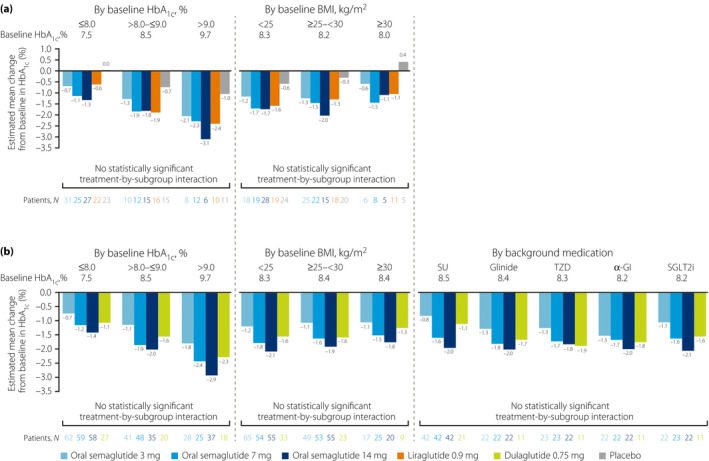
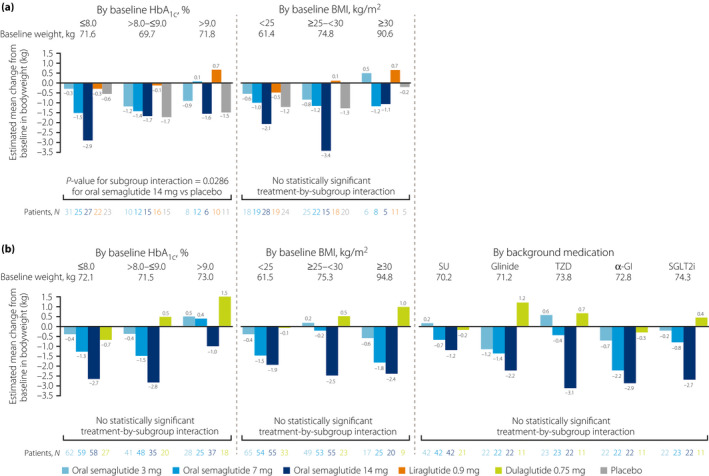
In the Peptide InnOvatioN for Early diabEtes tReatment (PIONEER) 9 and 10 trials, Japanese patients were randomized to once-daily oral semaglutide (3, 7, or 14 mg) or a comparator (placebo or once-daily subcutaneous liraglutide 0.9 mg in PIONEER 9; once-weekly subcutaneous dulaglutide 0.75 mg in PIONEER 10) for 52 weeks, with 5 weeks of follow up. An exploratory analysis grouped patients in each trial according to baseline glycated hemoglobin (HbA ; ≤8.0, >8.0-≤9.0, or >9.0%), body mass index (<25, ≥25-<30, or ≥30 kg/m ) and, for PIONEER 10 only, by background medication (sulfonylurea, glinide, thiazolidinedione, α-glucosidase inhibitor, sodium-glucose cotransporter 2 inhibitor). Efficacy (changes from baseline to week 26 in HbA and bodyweight) and safety were assessed.
Seven hundred and one patients were included (PIONEER 9: N = 243; PIONEER 10: N = 458). In both trials, HbA reductions increased as baseline HbA increased; there were no other apparent patterns between the variables investigated and HbA or bodyweight changes. There was one statistically significant subgroup interaction between baseline HbA and estimated treatment differences in bodyweight change for oral semaglutide 14 mg versus placebo in PIONEER 9 (P = 0.0286). Baseline HbA , baseline body mass index and background medication did not appear to affect the proportions of patients reporting adverse events.
Oral semaglutide is effective across a range of baseline subgroups of Japanese patients with type 2 diabetes, with no unexpected safety findings.
目的/引言:评估基线特征对口服司美格鲁肽在日本 2 型糖尿病患者中的疗效和安全性的影响。
在 Peptide InnOvatioN for Early diabEtes tReatment(PIONEER)9 和 10 项试验中,日本患者被随机分配至每日一次口服司美格鲁肽(3、7 或 14mg)或对照剂(安慰剂或每日一次皮下利拉鲁肽 0.9mg 在 PIONEER 9 中;每周一次皮下度拉糖肽 0.75mg 在 PIONEER 10 中)治疗 52 周,随后进行 5 周随访。一项探索性分析根据基线糖化血红蛋白(HbA;≤8.0、>8.0-≤9.0 或>9.0%)、体重指数(<25、≥25-<30 或≥30kg/m )和(仅在 PIONEER 10 中)背景用药(磺脲类、格列奈类、噻唑烷二酮类、α-葡萄糖苷酶抑制剂、钠-葡萄糖共转运蛋白 2 抑制剂)对每个试验中的患者进行分组。评估疗效(从基线到第 26 周时 HbA 和体重的变化)和安全性。
共纳入 701 例患者(PIONEER 9:N=243;PIONEER 10:N=458)。在两项试验中,随着基线 HbA 的升高,HbA 的降低幅度增加;在研究的变量与 HbA 或体重变化之间没有其他明显的关系。在 PIONEER 9 中,口服司美格鲁肽 14mg 与安慰剂相比,体重变化的估计治疗差异与基线 HbA 之间存在一个具有统计学意义的亚组交互作用(P=0.0286)。基线 HbA、基线体重指数和背景用药似乎并未影响报告不良事件的患者比例。
口服司美格鲁肽在日本 2 型糖尿病患者的一系列基线亚组中均有效,且无意外的安全性发现。