Bispo Paulo J M, Sahm Daniel F, Asbell Penny A
Department of Ophthalmology, Infectious Diseases Institute, Massachusetts Eye and Ear, Harvard Medical School, Boston, MA, USA.
International Health Management Associates Inc, Schaumburg, IL, USA.
Ophthalmol Ther. 2022 Apr;11(2):503-520. doi: 10.1007/s40123-021-00449-9. Epub 2022 Feb 3.
Since 2009, the Antibiotic Resistance Monitoring in Ocular Microorganisms (ARMOR) surveillance study has been assessing in vitro antibiotic resistance for bacterial isolates sourced from ocular infections in the US. The main goal of this systematic review was to compare in vitro resistance data for ocular pathogens from published US studies with the most recently published data from the ARMOR study (2009-2018) and, where possible, to evaluate trends in bacterial resistance over time over all studies.
A literature search was conducted using MEDLINE®, BIOSIS Previews®, and EMBASE databases (1/1/1995-6/30/2021). Data were extracted from relevant studies and antibiotic susceptibility rates for common ocular pathogens (Staphylococcus aureus, coagulase-negative staphylococci [CoNS], Streptococcus pneumoniae, Pseudomonas aeruginosa, and Haemophilus influenzae), longitudinal changes in susceptibility, and multidrug resistance (MDR) were compared descriptively.
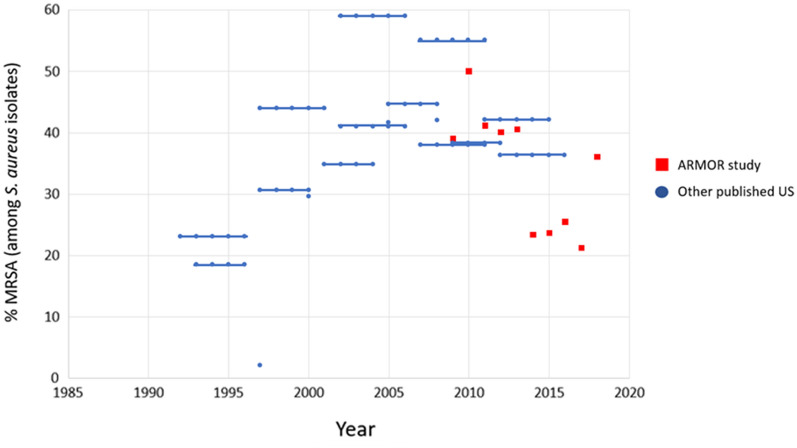
Thirty-two relevant studies were identified. High in vitro resistance was found among S. aureus and CoNS to fluoroquinolones, macrolides, and methicillin/oxacillin across studies, with high rates of MDR noted, specifically among methicillin-resistant staphylococci. Data from studies pre-dating or overlapping the early years of ARMOR reflected increasing rates of S. aureus resistance to fluoroquinolones, macrolides, methicillin/oxacillin, and aminoglycosides, while the ARMOR data suggested slight decreases in resistance to these classes between 2009 and 2018. Overall, methicillin-resistant S. aureus (MRSA) prevalence peaked from 2005 to 2015 with a possible decreasing trend in more recent years.
Data from local and regional US datasets were generally consistent with data from the national ARMOR surveillance study. Continued surveillance of ocular bacterial pathogens is needed to track trends such as methicillin resistance and MDR prevalence and any new emerging antibiotic resistance phenotypes. Susceptibility data from ARMOR can inform initial choice of therapy, especially in practice areas where local antibiograms are unavailable.
自2009年以来,眼部微生物抗生素耐药性监测(ARMOR)研究一直在评估源自美国眼部感染的细菌分离株的体外抗生素耐药性。本系统评价的主要目的是比较美国已发表研究中眼部病原体的体外耐药性数据与ARMOR研究(2009 - 2018年)最近发表的数据,并在可能的情况下评估所有研究中细菌耐药性随时间的变化趋势。
使用MEDLINE®、BIOSIS Previews®和EMBASE数据库(1995年1月1日 - 2021年6月30日)进行文献检索。从相关研究中提取数据,并对常见眼部病原体(金黄色葡萄球菌、凝固酶阴性葡萄球菌[CoNS]、肺炎链球菌、铜绿假单胞菌和流感嗜血杆菌)的抗生素敏感性率、敏感性的纵向变化以及多重耐药性(MDR)进行描述性比较。
共确定了32项相关研究。在各项研究中,金黄色葡萄球菌和CoNS对氟喹诺酮类、大环内酯类以及甲氧西林/苯唑西林表现出较高的体外耐药性,且多重耐药率较高,尤其是耐甲氧西林葡萄球菌。ARMOR研究早期之前或与之重叠的研究数据反映出金黄色葡萄球菌对氟喹诺酮类、大环内酯类、甲氧西林/苯唑西林和氨基糖苷类的耐药率不断上升,而ARMOR数据表明2009年至2018年间对这些类别的耐药性略有下降。总体而言,耐甲氧西林金黄色葡萄球菌(MRSA)患病率在2005年至2015年达到峰值,近年来可能呈下降趋势。
美国本地和区域数据集的数据通常与全国ARMOR监测研究的数据一致。需要持续监测眼部细菌病原体,以跟踪诸如甲氧西林耐药性和多重耐药患病率等趋势以及任何新出现的抗生素耐药表型。ARMOR的敏感性数据可为初始治疗选择提供参考,特别是在无法获得当地抗菌谱的实践领域。