
多嘧啶 tract 结合蛋白 PTBP1 和 PTBP2 在剪接条件下与不同的蛋白质相互作用。
Polypyrimidine tract binding proteins PTBP1 and PTBP2 interact with distinct proteins under splicing conditions.
机构信息
Department of Chemistry and Biochemistry, California State University Fullerton, Fullerton, CA, United States of America.
Department of Biological Sciences, California State University Fullerton, Fullerton, CA, United States of America.
出版信息
PLoS One. 2022 Feb 3;17(2):e0263287. doi: 10.1371/journal.pone.0263287. eCollection 2022.
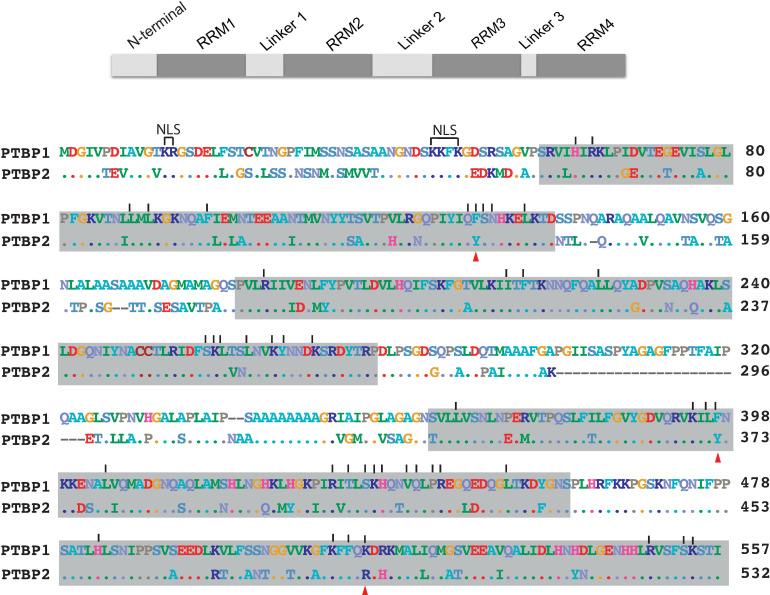
RNA binding proteins play an important role in regulating alternative pre-mRNA splicing and in turn cellular gene expression. Polypyrimidine tract binding proteins, PTBP1 and PTBP2, are paralogous RNA binding proteins that play a critical role in the process of neuronal differentiation and maturation; changes in the concentration of PTBP proteins during neuronal development direct splicing changes in many transcripts that code for proteins critical for neuronal differentiation. How the two related proteins regulate different sets of neuronal exons is unclear. The distinct splicing activities of PTBP1 and PTBP2 can be recapitulated in an in vitro splicing system with the differentially regulated N1 exon of the c-src pre-mRNA. Here, we conducted experiments under these in vitro splicing conditions to identify PTBP1 and PTBP2 interacting partner proteins. Our results highlight that both PTBPs interact with proteins that participate in chromatin remodeling and transcription regulation. Our data reveal that PTBP1 interacts with many proteins involved in mRNA processing including splicing regulation while PTBP2 does not. Our results also highlight enzymes that can serve as potential "writers" and "erasers" in adding chemical modifications to the PTB proteins. Overall, our study highlights important differences in protein-protein interactions between the PTBP proteins under splicing conditions and supports a role for post-translational modifications in dictating their distinct splicing activities.
RNA 结合蛋白在调节选择性前体 mRNA 剪接中发挥着重要作用,进而影响细胞基因表达。多嘧啶 tract 结合蛋白(PTBP1 和 PTBP2)是具有相似功能的 RNA 结合蛋白,在神经元分化和成熟过程中起着关键作用;神经元发育过程中 PTBP 蛋白浓度的变化指导许多编码对神经元分化至关重要的蛋白质的转录本发生剪接变化。两种相关蛋白如何调节不同的神经元外显子尚不清楚。PTBP1 和 PTBP2 的不同剪接活性可以在体外剪接系统中通过 c-src 前体 mRNA 的差异调控 N1 外显子来重现。在这里,我们在这些体外剪接条件下进行实验,以鉴定 PTBP1 和 PTBP2 的相互作用蛋白。我们的结果强调,这两种 PTBP 都与参与染色质重塑和转录调控的蛋白相互作用。我们的数据表明,PTBP1 与许多参与 mRNA 加工的蛋白质相互作用,包括剪接调节,而 PTBP2 则没有。我们的结果还突出了可以作为潜在“写入器”和“擦除器”的酶,它们可以向 PTB 蛋白添加化学修饰。总的来说,我们的研究强调了在剪接条件下,PTBP 蛋白之间的蛋白-蛋白相互作用存在重要差异,并支持翻译后修饰在决定它们不同剪接活性中的作用。



 Zotero 插件