Liu Mengnan, Lin Chunyu, Liu Fang, Cao Qinghua
Department of Pathology, The First Affiliated Hospital of Sun Yat-sen University, Guangzhou, China.
Department of Oncology, Nanfang Hospital, Southern Medical University, Guangzhou, China.
Transl Cancer Res. 2022 Aug;11(8):2660-2670. doi: 10.21037/tcr-22-303.
Polypyrimidine tract binding protein 1 (PTBP1) is a member of heterogeneous nuclear ribonucleoprotein (hnRNP) family and has recently been reported to contribute to development and progression of various tumors. However, the clinicopathological significance and prognostic value of PTBP1 in gastric cancer have not been sufficiently elucidated.
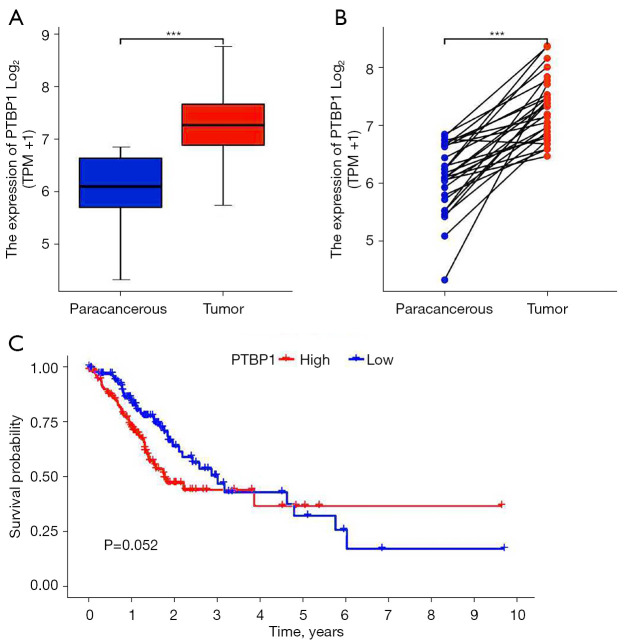
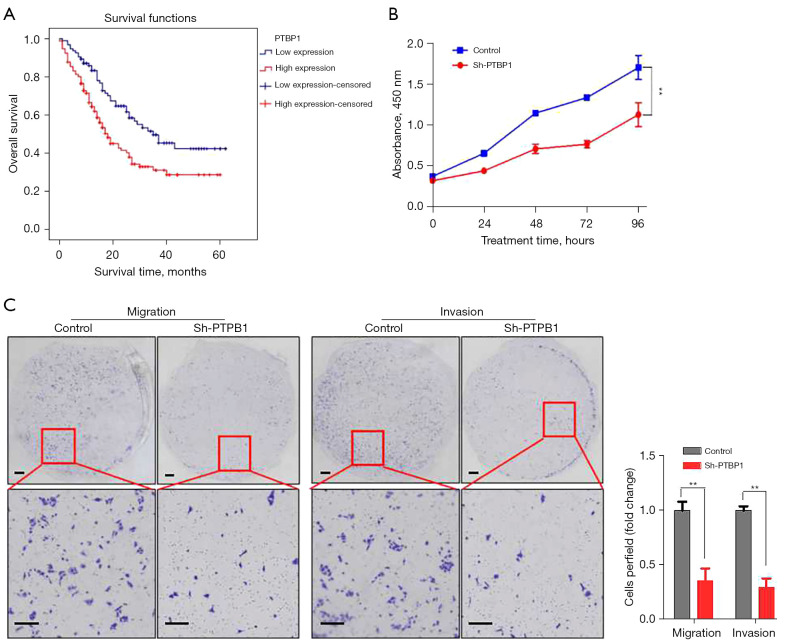
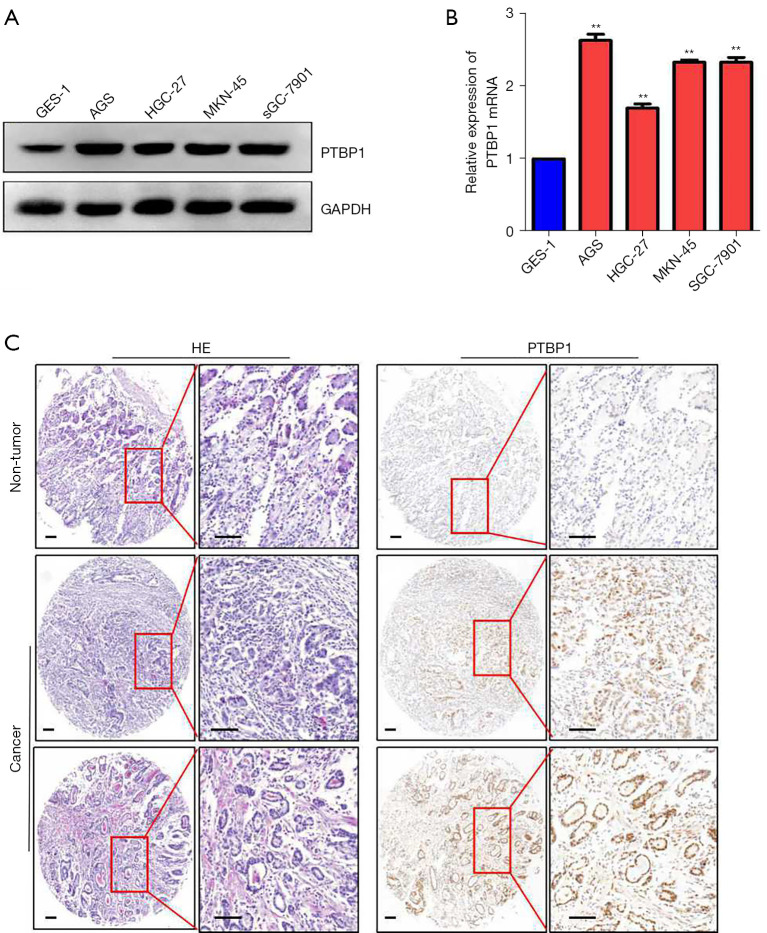
Bioinformatic analysis of The Cancer Genome Atlas (TCGA) data were employed to analyze the expression of PTBP1 mRNA and its prognostic value in gastric cancer. The expression type of PTBP1 in gastric cancer cells was further confirmed through reverse transcription polymerase chain reaction (RT-PCR) and western blot assay. Then, the association between PTBP1 protein expression and clinicopathological features was analyzed based on immunohistochemical staining results in gastric cancer tissue microarray including 311 cases. The prognostic value of PTBP1 protein was explored through univariate and multivariate analyses. Additionally, cell count and transwell assay were performed to detect the biological role of PTBP1 in gastric cancer cells .
PTBP1 was highly expressed in gastric cancer cells and tissues at mRNA and protein level. High expression of PTBP1 was closely related to several clinicopathological features, including gender, age at surgery, histological type, TNM stage and lymph node metastasis. Moreover, high expression PTBP1 predicts poor prognosis, and may be an independent prognostic factor for overall survival in gastric cancer patients. Knockdown of PTBP1 substantially suppressed the proliferation, migration and invasion of gastric cancer cells .
PTBP1 is up-regulated and predicts poor prognosis in gastric cancer. PTBP1 may serve as a biomarker of poor prognosis and a novel target in treating gastric cancer.
多嘧啶序列结合蛋白1(PTBP1)是异质性核糖核蛋白(hnRNP)家族的成员,最近有报道称其与多种肿瘤的发生发展有关。然而,PTBP1在胃癌中的临床病理意义和预后价值尚未得到充分阐明。
利用癌症基因组图谱(TCGA)数据进行生物信息学分析,以分析PTBP1 mRNA在胃癌中的表达及其预后价值。通过逆转录聚合酶链反应(RT-PCR)和蛋白质免疫印迹法进一步证实胃癌细胞中PTBP1的表达类型。然后,基于对311例胃癌组织芯片的免疫组织化学染色结果,分析PTBP1蛋白表达与临床病理特征之间的关联。通过单因素和多因素分析探讨PTBP1蛋白的预后价值。此外,进行细胞计数和Transwell实验以检测PTBP1在胃癌细胞中的生物学作用。
PTBP1在胃癌细胞和组织中的mRNA和蛋白质水平均高表达。PTBP1的高表达与多种临床病理特征密切相关,包括性别、手术年龄、组织学类型、TNM分期和淋巴结转移。此外,PTBP1高表达预示着预后不良,可能是胃癌患者总生存的独立预后因素。敲低PTBP1可显著抑制胃癌细胞的增殖、迁移和侵袭。
PTBP1在胃癌中上调并预示预后不良。PTBP1可能作为预后不良的生物标志物及治疗胃癌的新靶点。