Department of Radiation Oncology, University of California Los Angeles, Los Angeles, California, USA
Department of Biostatistics, UCLA, Los Angeles, California, USA.
J Immunother Cancer. 2022 Feb;10(2). doi: 10.1136/jitc-2021-003625.
There is great interest in finding ways to identify patients who will develop toxicity to cancer therapies. This has become especially pressing in the era of immune therapy, where toxicity can be long-lasting and life-altering, and primarily comes in the form of immune-related adverse effects (irAEs). Treatment with the first drugs in this class, anti-programmed death 1 (anti-PD1)/programmed death-ligand 1 (PDL1) checkpoint therapies, results in grade 2 or higher irAEs in up to 25%-30% of patients, which occur most commonly within the first 6 months of treatment and can include arthralgias, rash, pruritus, pneumonitis, diarrhea and/or colitis, hepatitis, and endocrinopathies. We tested the hypothesis that germline microRNA pathway functional variants, known to predict altered systemic stress responses to cancer therapies, would predict irAEs in patients across cancer types.
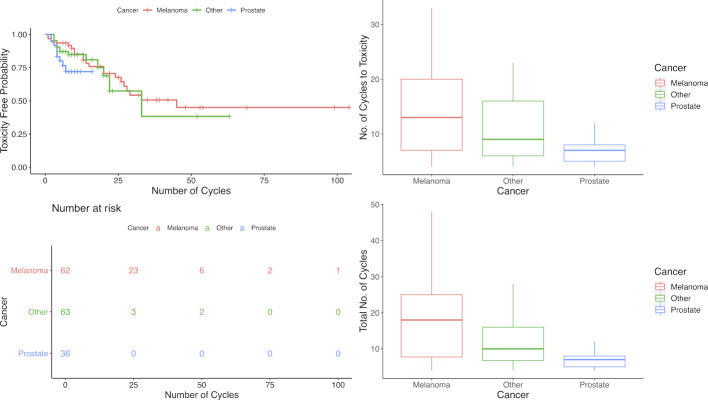
MicroRNA pathway variants were evaluated for an association with grade 2 or higher toxicity using four classifiers on 62 patients with melanoma, and then the panel's performance was validated on 99 patients with other cancer types. Trained classifiers included classification trees, LASSO-regularized logistic regression, boosted trees, and random forests. Final performance measures were reported on the training set using leave-one-out cross validation and validated on held-out samples. The predicted probability of toxicity was evaluated for its association, if any, with response categories to anti-PD1/PDL1 therapy in the melanoma cohort.
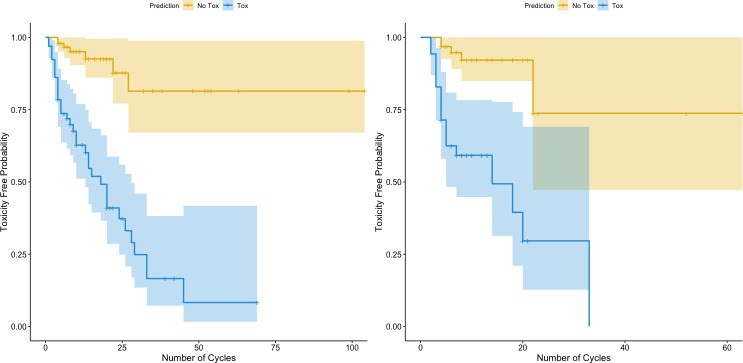
A biomarker panel was identified that predicts toxicity with 80% accuracy (F1=0.76, area under the curve (AUC)=0.82) in the melanoma training cohort and 77.6% accuracy (F1=0.621, AUC=0.778) in the pan-cancer validation cohort. In the melanoma cohort, the predictive probability of toxicity was not associated with response categories to anti-PD1/PDL1 therapy (p=0.70). In the same cohort, the most significant biomarker of toxicity in , predicting a greater than ninefold increased risk of toxicity (p<0.001), was also not associated with response to anti-PD1/PDL1 therapy (p=0.151).
A germline microRNA-based biomarker signature predicts grade 2 and higher irAEs to anti-PD1/PDL1 therapy, regardless of tumor type, in a pan-cancer manner. These findings represent an important step toward personalizing checkpoint therapy, the use of which is growing rapidly.
人们对寻找识别癌症治疗毒性的方法非常感兴趣。在免疫治疗时代,这种需求变得尤为迫切,因为毒性可能持续存在且改变生活,主要表现为免疫相关不良反应(irAEs)。使用该类药物的首个治疗药物,抗程序性死亡 1(anti-PD1)/程序性死亡配体 1(PDL1)检查点抑制剂,高达 25%-30%的患者出现 2 级或更高的 irAEs,最常见于治疗的前 6 个月内,可包括关节痛、皮疹、瘙痒、肺炎、腹泻和/或结肠炎、肝炎和内分泌病变。我们假设种系 microRNA 通路功能变体可预测癌症治疗后全身应激反应的改变,从而预测跨癌症类型患者的 irAEs,并对此假说进行了检验。
在 62 名黑色素瘤患者中,使用 4 种分类器评估 microRNA 通路变体与 2 级或更高毒性的相关性,然后在 99 名患有其他癌症类型的患者中验证该面板的性能。训练分类器包括分类树、LASSO 正则化逻辑回归、增强树和随机森林。使用留一法交叉验证在训练集上报告最终性能指标,并在保留样本上进行验证。在黑色素瘤队列中,评估毒性预测概率与抗 PD1/PDL1 治疗反应类别的关联(如果有)。
在黑色素瘤训练队列中,确定了一个预测毒性的生物标志物面板,其准确率为 80%(F1=0.76,曲线下面积(AUC)=0.82),在泛癌验证队列中的准确率为 77.6%(F1=0.621,AUC=0.778)。在黑色素瘤队列中,毒性预测概率与抗 PD1/PDL1 治疗反应类别无关(p=0.70)。在同一队列中,毒性的最显著生物标志物,预测毒性风险增加九倍以上(p<0.001),也与抗 PD1/PDL1 治疗反应无关(p=0.151)。
一种基于种系 microRNA 的生物标志物特征可以预测抗 PD1/PDL1 治疗的 2 级及以上 irAEs,无论肿瘤类型如何,都具有泛癌特征。这些发现代表着朝着个性化检查点治疗迈进的重要一步,这种治疗方法的应用正在迅速增长。