Wang Yuning, Hong Tianyu, Chen Linbao, Chu Chuanmin, Zhu Jiangbo, Zhang Jing, Wang Chao, Zheng Jingcun, Jiang Ning, Cui Xingang
Ningxia Medical University, Yinchuan, Ningxia, China.
Department of Urinary Surgery, Gongli Hospital, Second Military Medical University (Naval Medical University), Shanghai, China.
Transl Cancer Res. 2020 Dec;9(12):7550-7561. doi: 10.21037/tcr-20-1864.
The pervasive progression of renal cell carcinoma (RCC) after treatment demands more effective drugs with few side effects. In the present study, we determined whether degalactotigonin (DGT) extracted from L. could exert antitumoral effects on RCC and examined the related molecular mechanisms.
The effects of DGT on RCC cells were assessed by cell counting kit-8 (CCK-8) assay, flow cytometry, invasion and migration assays and subcutaneous tumor xenograft experiments in nude mice. The related molecular mechanisms were delineated by RNA sequencing (RNA-seq), real-time polymerase chain reaction (PCR), western blotting, coimmunoprecipitation (co-IP) and plasmid transfection.
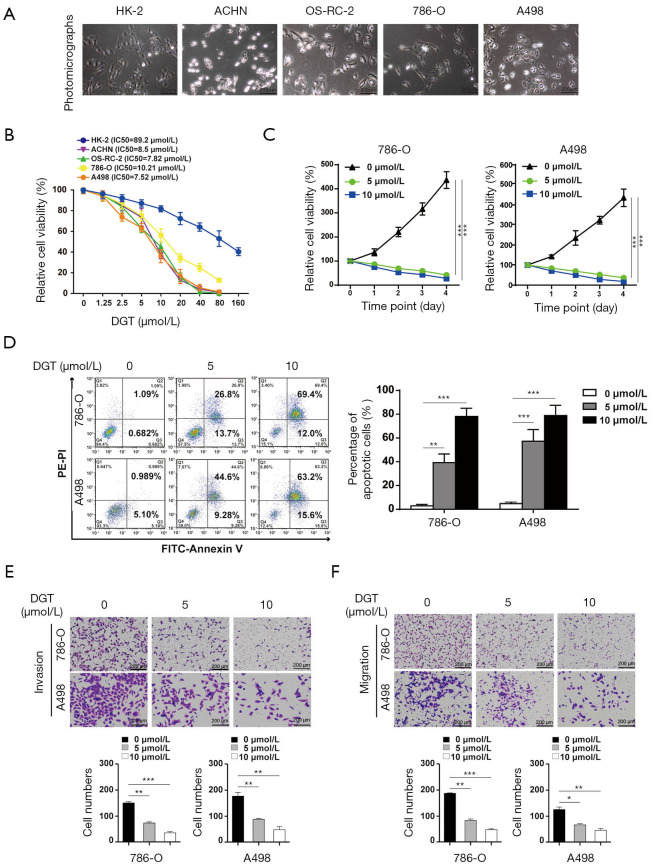
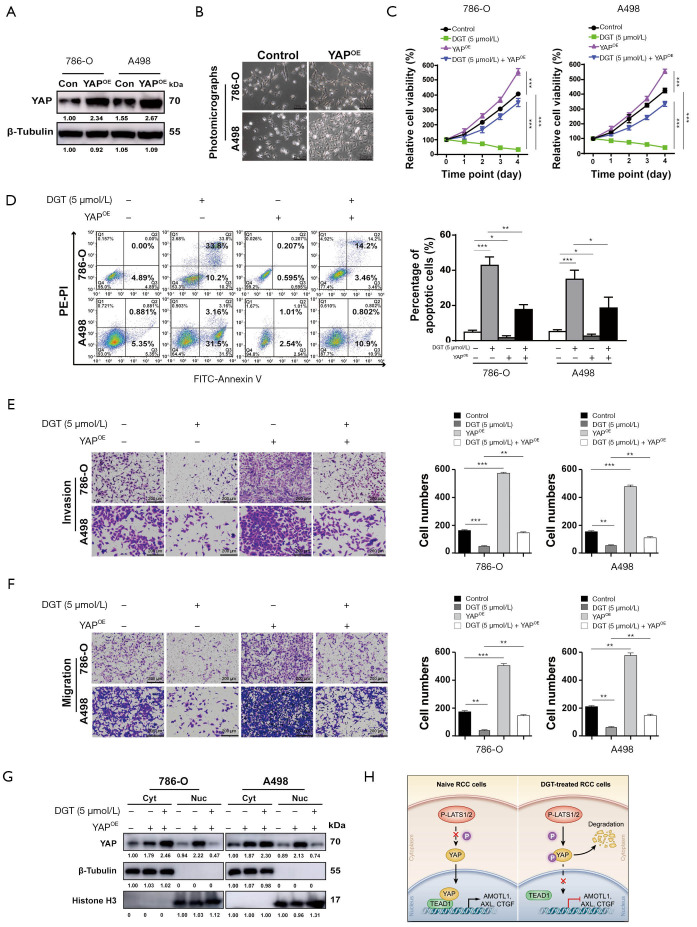
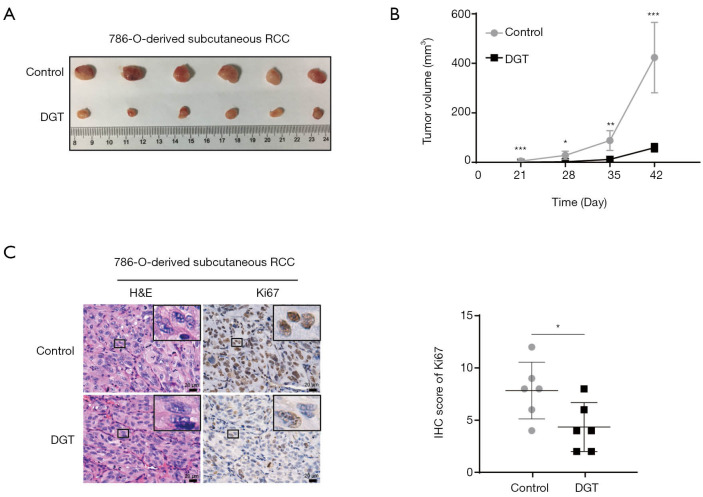
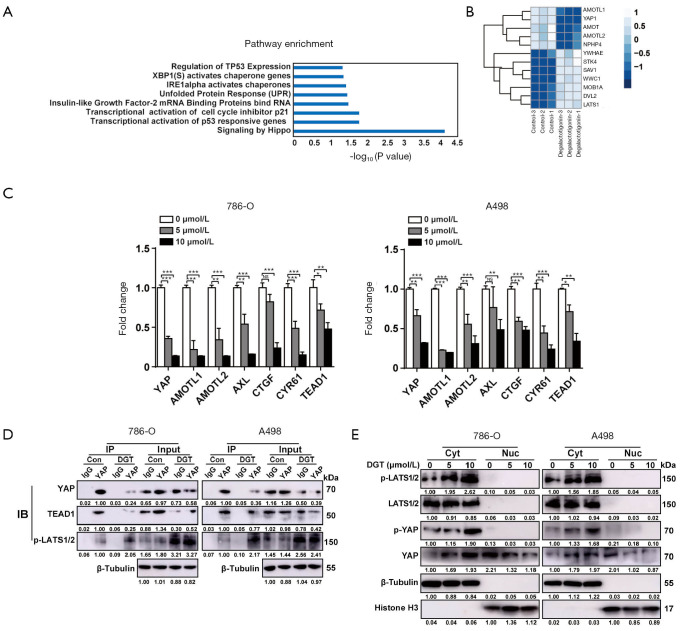
DGT induced apoptosis and suppressed the proliferation, invasion, migration, and tumorigenicity of RCC cells. Mechanistically, yes-associated protein (YAP) signaling was inactivated, and the expression of YAP and its target genes was reduced in degalactotigonin-treated RCC cells. Additionally, DGT activated phosphorylated large tumor suppressor 1/2 (p-LATS1/2) to phosphorylate YAP, which increased YAP retention in the cytoplasm but decreased the amount of YAP that entered the nuclei of RCC cells. Moreover, DGT impaired the increased aggressive features of RCC cells induced by YAP overexpression.
DGT is an effective therapeutic agent, which facilitates the apoptosis and inhibits the proliferation, invasion, migration, and tumorigenicity of RCC cells in a YAP-dependent manner.
肾细胞癌(RCC)治疗后普遍进展,需要更有效且副作用少的药物。在本研究中,我们确定从[植物名称未给出]中提取的去半乳糖替告宁(DGT)是否能对肾细胞癌发挥抗肿瘤作用,并研究相关分子机制。
通过细胞计数试剂盒-8(CCK-8)检测、流式细胞术、侵袭和迁移实验以及裸鼠皮下肿瘤异种移植实验评估DGT对肾细胞癌细胞的作用。通过RNA测序(RNA-seq)、实时聚合酶链反应(PCR)、蛋白质免疫印迹法、免疫共沉淀(co-IP)和质粒转染来阐明相关分子机制。
DGT诱导肾细胞癌细胞凋亡,并抑制其增殖、侵袭、迁移和致瘤性。机制上,Yes相关蛋白(YAP)信号通路失活,在经去半乳糖替告宁处理的肾细胞癌细胞中YAP及其靶基因的表达降低。此外,DGT激活磷酸化的大肿瘤抑制因子1/2(p-LATS1/2)使YAP磷酸化,这增加了YAP在细胞质中的滞留,但减少了进入肾细胞癌细胞核的YAP量。而且,DGT削弱了YAP过表达诱导的肾细胞癌细胞增强的侵袭性特征。
DGT是一种有效的治疗剂,它以YAP依赖的方式促进肾细胞癌细胞凋亡并抑制其增殖、侵袭、迁移和致瘤性。