Yu Lili, Wu Meng, Zhu Gaoyang, Xu Yang
Key Laboratory of Cancer Prevention and Intervention, Department of Medical Oncology, Ministry of Education, The Second Affiliated Hospital, Zhejiang University School of Medicine, Hangzhou, China.
Cancer Center, Zhejiang University, Hangzhou, China.
Front Cell Dev Biol. 2022 Jan 18;9:762742. doi: 10.3389/fcell.2021.762742. eCollection 2021.
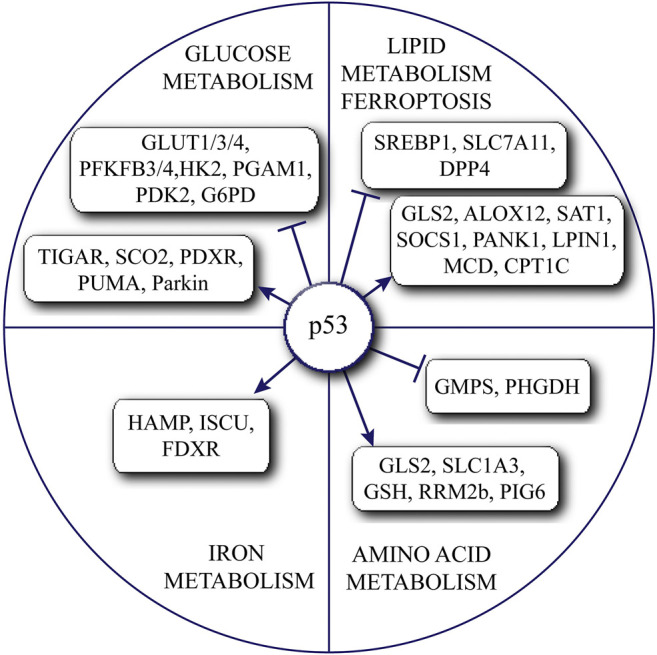
Metabolism plays critical roles in maintaining the homeostasis of cells. Metabolic abnormalities are often considered as one of the main driving forces for cancer progression, providing energy and substrates of biosynthesis to support neoplastic proliferation effectively. The tumor suppressor p53 is well known for its roles in inducing cell cycle arrest, apoptosis, senescence and ferroptosis. Recently, emerging evidence has shown that p53 is also actively involved in the reprogramming of cellular metabolism. In this review, we focus on recent advances in our understanding of the interplay between p53 and metabolism of glucose, fatty acid as well as amino acid, and discuss how the deregulation of p53 in these processes could lead to cancer.
新陈代谢在维持细胞内环境稳定中起着关键作用。代谢异常通常被认为是癌症进展的主要驱动力之一,它能有效提供生物合成所需的能量和底物以支持肿瘤增殖。肿瘤抑制因子p53以其在诱导细胞周期停滞、凋亡、衰老和铁死亡中的作用而闻名。最近,新出现的证据表明,p53也积极参与细胞代谢重编程。在本综述中,我们重点关注了我们对p53与葡萄糖、脂肪酸以及氨基酸代谢之间相互作用的最新认识进展,并讨论了在这些过程中p53失调如何导致癌症。