Zong Yan, Cheng Chao, Li Kunke, Xue Ran, Chen Ziyan, Liu Xiuping, Wu Kaili
Zhongshan Ophthalmic Center, State Key Laboratory of Ophthalmology, Sun Yat-sen University, Guangdong Provincial Clinical Research Center for Ocular Diseases, Guangzhou, China.
Front Med (Lausanne). 2022 Jan 18;8:797630. doi: 10.3389/fmed.2021.797630. eCollection 2021.
Superior limbic keratoconjunctivitis (SLK) is a bilateral, chronic inflammatory disease that recurs for up to several years; however, the fundamental processes involved in its pathogenic mechanisms remain unknown. We aimed to investigate the metabolomic alterations in the tear fluids of patients with superior limbic keratoconjunctivitis (SLK) compared with those of healthy volunteers (Ctrl group).
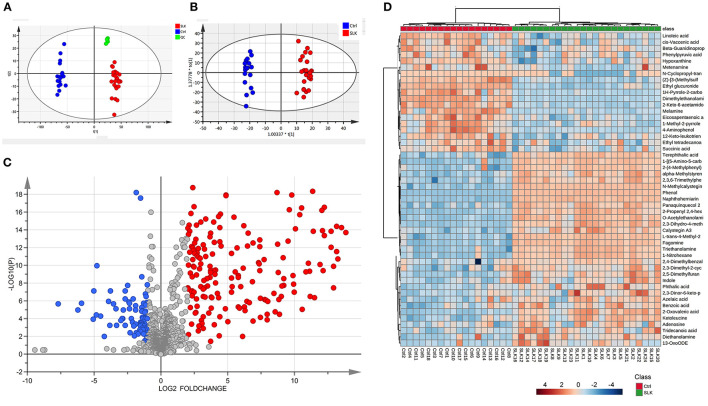
We performed a cross-sectional study involving 42 subjects. Tear fluid was taken from one eye of 24 SLK patients (40.13 ± 14.55 years, 83.33% female) and 18 healthy volunteers (Ctrl, 39.89 ± 9.2 years, 72.22% female) using Schirmer strips. After the liquid extraction of tear metabolites, samples were infused into the QE HFX Orbitrap mass spectrometer in both positive and negative ion mode. Metabolites were quantitatively analyzed and matched with entries in the HMDB database. Metabolic differences between the SLK group and the control group were identified based on multivariate statistical analysis. Open database sources, including SMPDB and MetaboAnalyst, were used to identify metabolic pathways.
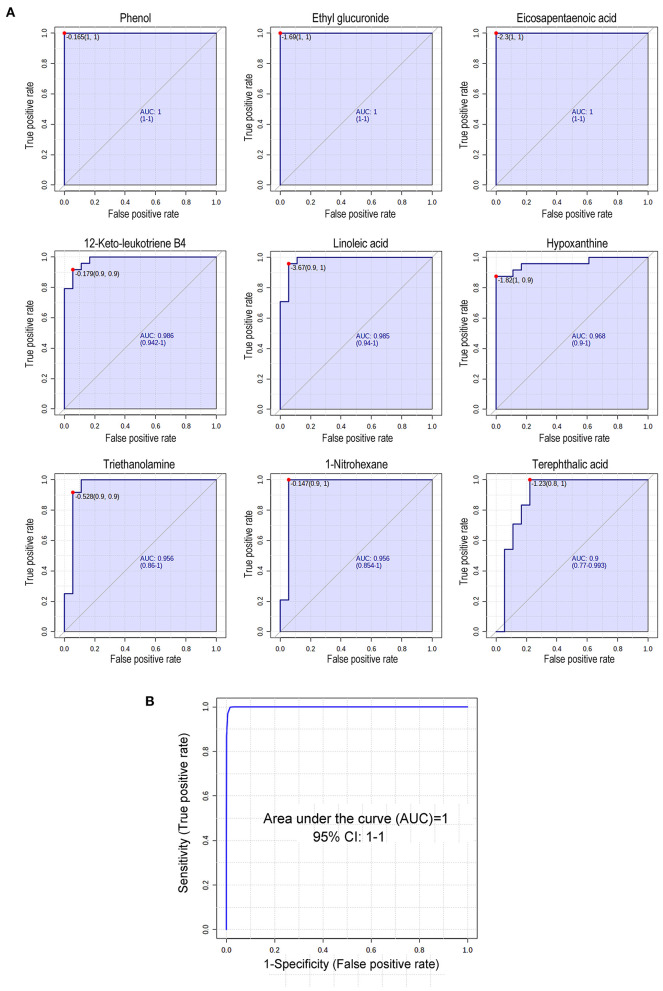
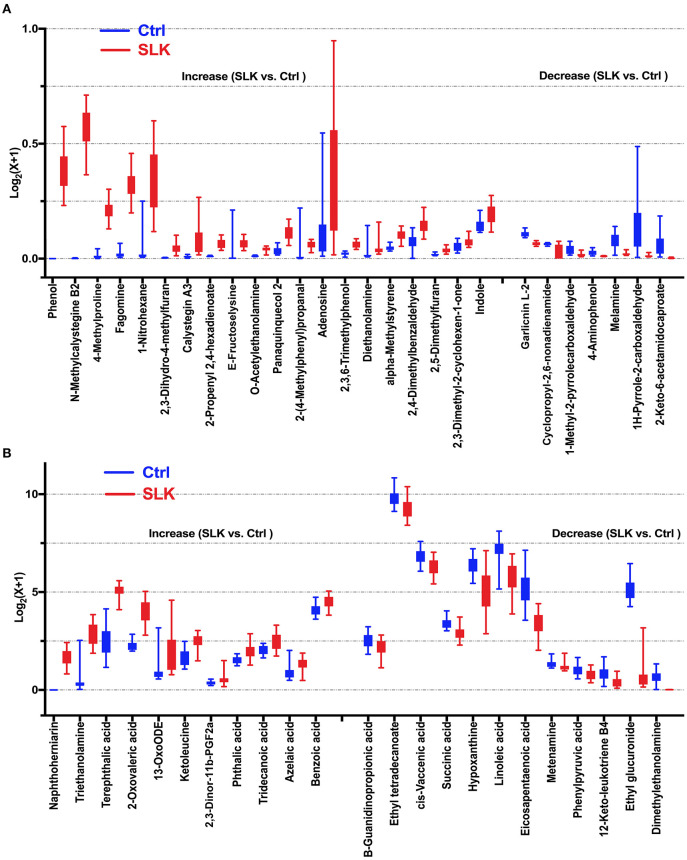
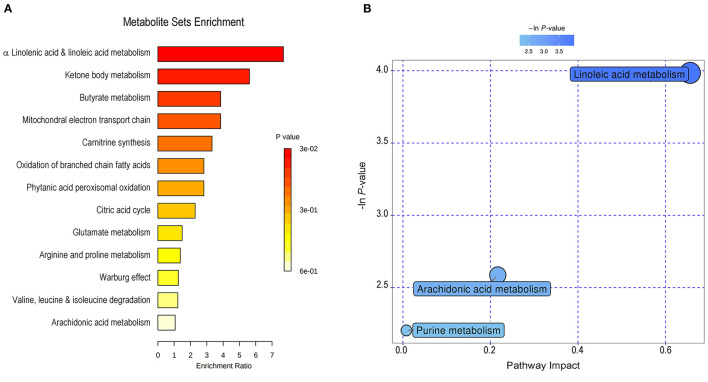
Among 179 metabolites retained for annotation, 133 metabolites were finally identified, among which 50 were found to be significantly changed in SLK patients. Of these 50 metabolites, 31 metabolites significantly increased and 19 metabolites decreased in SLK patients. The altered metabolites are mainly involved in α linolenic acid and linoleic acid metabolism, ketone body metabolism, butyrate metabolism, mitochondrial electron transport chain, carnitine synthesis, and so on. The most significantly changed pathway was linoleic acid metabolism. To explore the utility of tear biomarkers, a model combining 9 metabolites (phenol, ethyl glucuronide, eicosapentaenoic acid, 12-keto-leukotriene B4, linoleic acid, hypoxanthine, triethanolamine, 1-nitrohexane, and terephthalic acid) was selected as a candidate biomarker.
The results reveal that SLK has a specific metabolomic profile, of which some key elements can serve as potential biomarkers of SLK for diagnostic and prognostic purposes. The findings of this study are novel and provide a basis for further investigations of the mechanism of SLK.
上睑缘角结膜炎(SLK)是一种双侧慢性炎症性疾病,可持续复发数年;然而,其致病机制所涉及的基本过程仍不清楚。我们旨在研究与健康志愿者(对照组)相比,上睑缘角结膜炎(SLK)患者泪液中的代谢组学变化。
我们进行了一项横断面研究,涉及42名受试者。使用泪液试纸从24名SLK患者(40.13±14.55岁,83.33%为女性)和18名健康志愿者(对照组,39.89±9.2岁,72.22%为女性)的一只眼睛中采集泪液。在对泪液代谢物进行液体提取后,将样品以正离子和负离子模式注入QE HFX轨道阱质谱仪。对代谢物进行定量分析,并与HMDB数据库中的条目进行匹配。基于多变量统计分析确定SLK组和对照组之间的代谢差异。使用包括SMPDB和MetaboAnalyst在内的开放数据库来源来识别代谢途径。
在保留用于注释的179种代谢物中,最终鉴定出133种代谢物,其中50种在SLK患者中显著变化。在这50种代谢物中,SLK患者中有31种代谢物显著增加,19种代谢物减少。改变的代谢物主要涉及α-亚麻酸和亚油酸代谢、酮体代谢、丁酸代谢、线粒体电子传递链、肉碱合成等。变化最显著的途径是亚油酸代谢。为了探索泪液生物标志物的效用,选择了一种结合9种代谢物(苯酚、乙基葡萄糖醛酸、二十碳五烯酸、12-酮白三烯B4、亚油酸、次黄嘌呤、三乙醇胺、1-硝基己烷和对苯二甲酸)的模型作为候选生物标志物。
结果表明,SLK具有特定的代谢组学特征,其中一些关键成分可作为SLK诊断和预后的潜在生物标志物。本研究结果具有创新性,为进一步研究SLK的发病机制提供了依据。