Department of Health Science and Biostatistics, Swinburne University of Technology, Hawthorn, Victoria, Australia.
Department of Mathematics, Faculty of Science and Engineering, Nusa Cendana University, Kupang, NTT, Indonesia.
PLoS One. 2022 Feb 4;17(2):e0263178. doi: 10.1371/journal.pone.0263178. eCollection 2022.
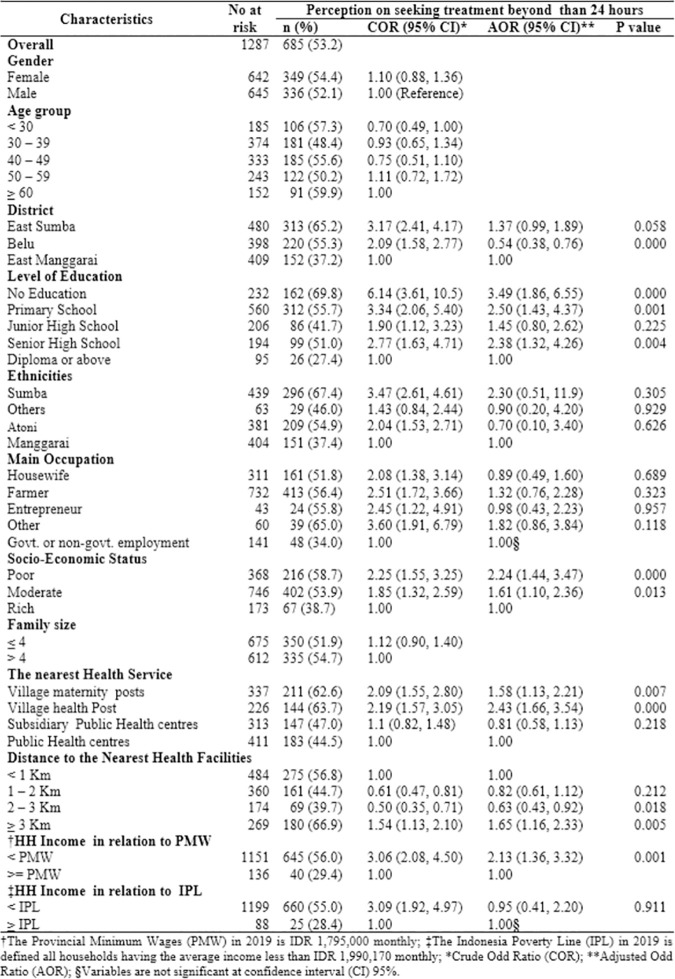
The World Health Organization recommends seeking medical treatment within 24 hours after transmission of malaria to reduce the risk of severe complications and its onwards spread. However, in some parts of Indonesia, including East Nusa Tenggara Province (ENTP), this adherence is not achieved for a range of reasons including delays in visiting health centres. This study aims to determine factors related to the poor understanding of appropriate malaria treatment-seeking behaviour (AMTSB) of rural adults in ENTP. AMTSB was defined as seeking treatment at professional health facilities within 24 hours of the onset of malaria symptoms.
A cross-sectional study was conducted in the East Sumba, Belu, and East Manggarai district of ENTP between October and December 2019. A multi-stage cluster sampling procedure was applied to enrol 1503 participants aged between 18 and 89 years of age. Data were collected through face-to-face interviews. Multivariable logistic regression analyses were used to assess significant factors associated with the poor understanding of AMTSB.
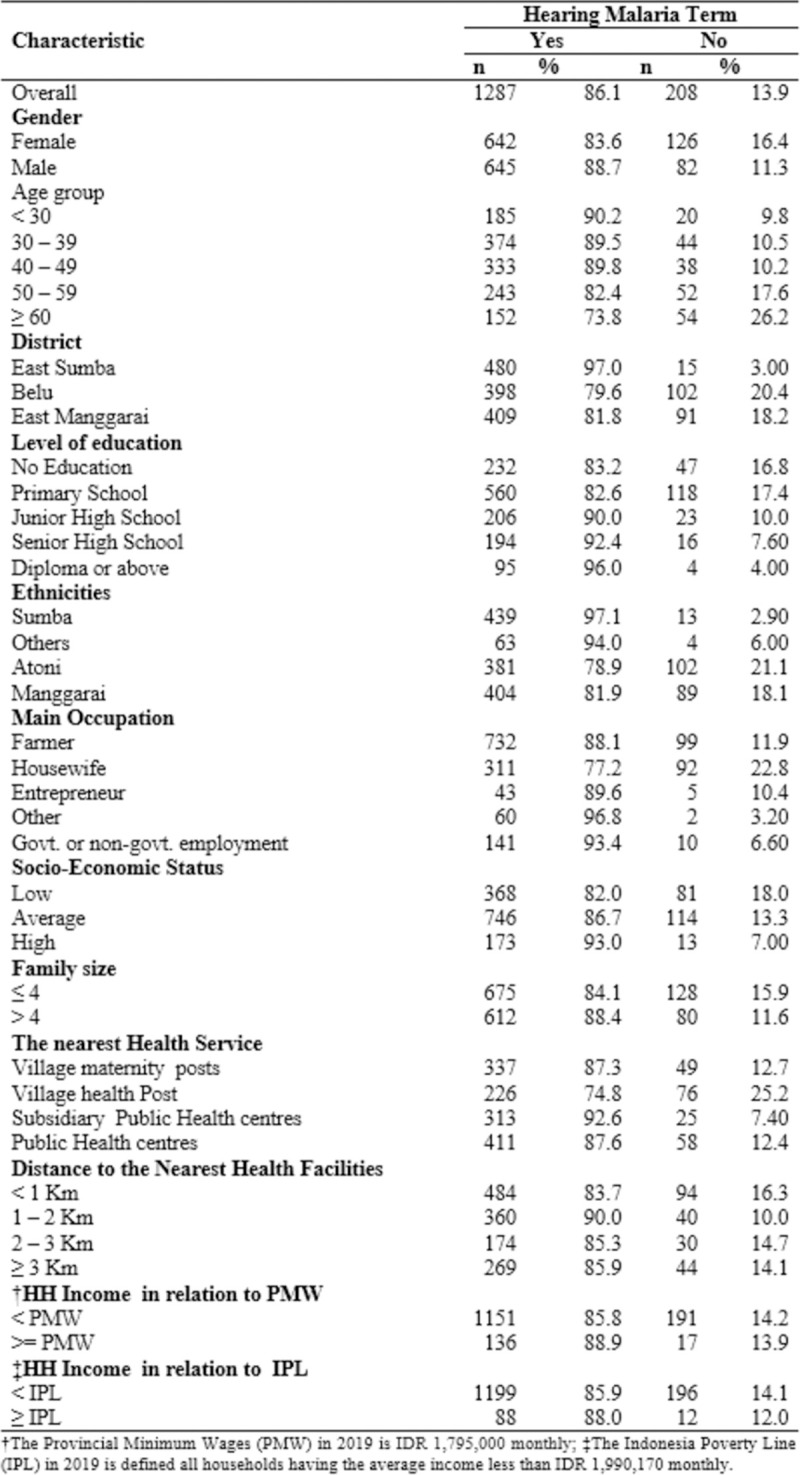
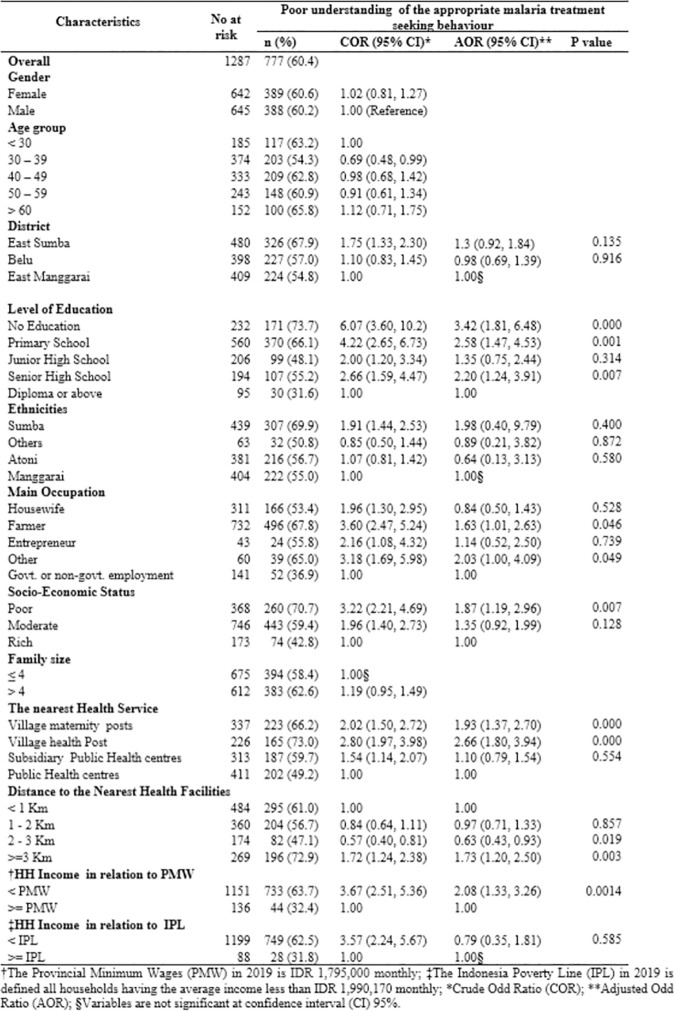
Eighty-six percent of participants were found to be familiar with the term malaria. However, poor understanding level of AMTSB in rural adults of ENTP achieved 60.4% with a 95% confidence interval (CI): 56.9-63.8. Poor understanding of AMTSB was significantly higher for adults with no education (adjusted odds ratio (AOR) 3.42, 95% CI: 1.81, 6.48) compared to those with a diploma or above education level; having low SES (AOR: 1.87, 95% CI: 1.19, 2.96) compared to those having high SES; residing at least three kilometres (km) away from the nearest health facilities (AOR: 1.73, 95% CI: 1.2, 2.5) compared to those living within one km from the nearest health service; and working as farmer (AOR: 1.63, 95% CI: 1.01-2.63) compared to those working at government or non-government sector. Whilst, other factors such as ethnicity and family size were not associated with the poor understanding of AMTSB.
The proportion of rural adults having a poor understanding of AMTSB was high leading to ineffective implementation of artemisinin-based combination therapies as the method to treat malaria in ENTP. Improving awareness of AMTSB for rural adults having low level education, low SES, working as a farmer, and living at least three km from the nearest health facilities is critical to support the efficacy of malaria treatment in ENTP. This method will support the Indonesian government's objective to achieve malaria elimination by 2030.
引言:世界卫生组织建议在疟疾传播后 24 小时内就医,以降低发生严重并发症和传播的风险。然而,在印度尼西亚的一些地区,包括东努沙登加拉省(ENTP),由于各种原因,包括延迟前往卫生中心,这种做法并未得到实施。本研究旨在确定与 ENTP 农村成年人对适当疟疾治疗寻求行为(AMTSB)理解不佳相关的因素。AMTSB 被定义为在疟疾症状出现后 24 小时内到专业医疗机构就诊。
方法:2019 年 10 月至 12 月,在东松巴哇、贝鲁和东芒格莱雷区进行了一项横断面研究。采用多阶段聚类抽样程序,招募了 1503 名年龄在 18 至 89 岁之间的参与者。通过面对面访谈收集数据。采用多变量逻辑回归分析评估与 AMTSB 理解不佳相关的显著因素。
结果:86%的参与者熟悉疟疾一词。然而,ENTP 农村成年人对 AMTSB 的理解程度不佳,达到 60.4%,95%置信区间(CI)为 56.9-63.8。与具有大专或以上学历的成年人相比,未受过教育的成年人对 AMTSB 的理解程度明显更高(调整后的优势比(AOR)为 3.42,95%CI:1.81,6.48);与社会经济地位较高的成年人相比,社会经济地位较低的成年人(AOR:1.87,95%CI:1.19,2.96);与距离最近的卫生设施至少 3 公里(km)的成年人相比,居住在距离最近的卫生服务 1 公里以内的成年人(AOR:1.73,95%CI:1.2,2.5);与从事农民工作的成年人相比,从事政府或非政府部门工作的成年人(AOR:1.63,95%CI:1.01-2.63)。而,族裔和家庭规模等其他因素与对 AMTSB 的理解不佳无关。
结论:ENTP 农村成年人中对 AMTSB 理解程度不佳的比例较高,导致青蒿素为基础的联合疗法作为治疗疟疾的方法无法有效实施。提高低教育水平、低社会经济地位、从事农民工作和居住在距离最近的卫生设施至少 3 公里的农村成年人对 AMTSB 的认识,对于支持 ENTP 疟疾治疗的效果至关重要。这种方法将支持印度尼西亚政府到 2030 年实现消除疟疾的目标。