Kinshasa School of Public Health, University of Kinshasa, Kinshasa, Democratic Republic of the Congo.
Swiss Tropical and Public Health Institute, Allschwil, Switzerland.
Malar J. 2023 Oct 13;22(1):308. doi: 10.1186/s12936-023-04737-6.
Malaria remains a major public health issue in the Democratic Republic of the Congo (DRC), accounting for 44% deaths among outpatient visits in children < 5 years of age, and 22% of facility deaths. Understanding determinants of caregivers' treatment-seeking patterns and decision-making is crucial in reducing the malaria burden.
In the frame of the Community Access to Rectal Artesunate for Malaria (CARAMAL) project, cross-sectional household surveys that randomly sampled villages and households were carried-out in three rural DRC health zones prior to the rollout of pre-referral Rectal Artesunate (RAS) and then 9 and 19 months after RAS rollout (post-RAS). Data were captured electronically through face-to-face interviews with the main caregivers of children < 5 years. Capillary blood samples of the children were tested for malaria and anaemia. The main study outcome was whether caregiver "sought treatment outside home" when the child had fever. Multilevel mixed effects logistic regression models using village as random effect and health zone as a fixed effect was performed to assess treatment-seeking predictors.
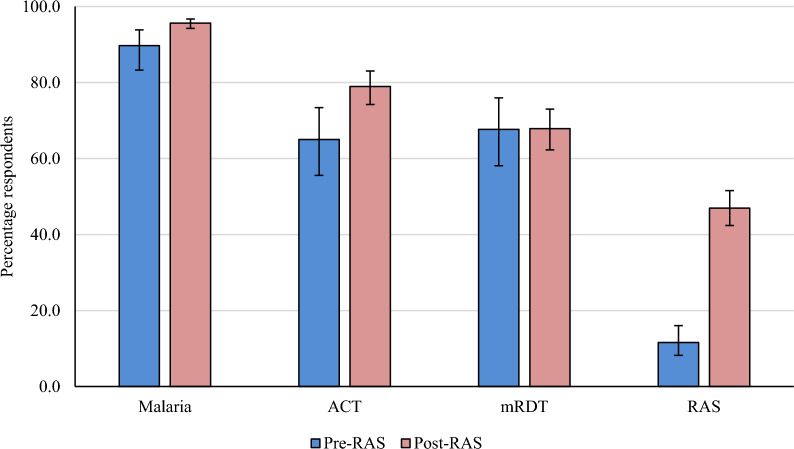
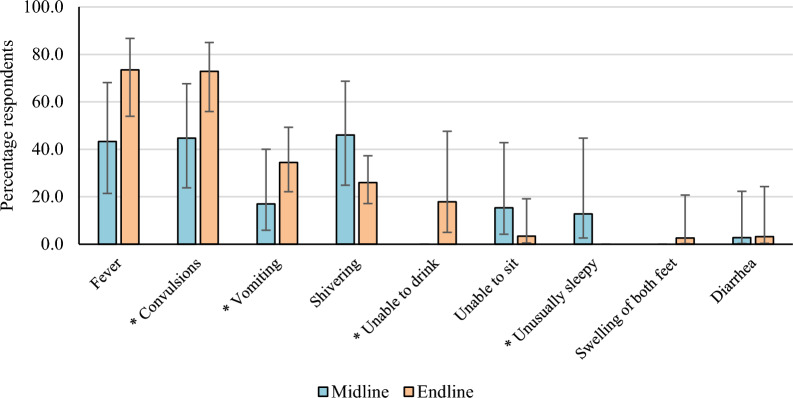
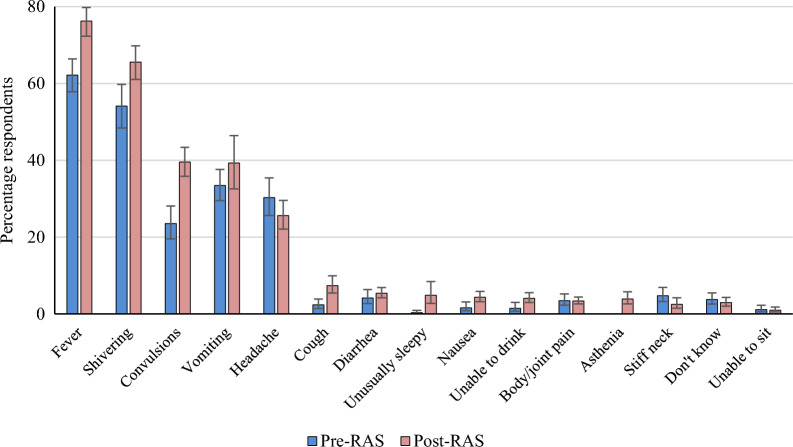
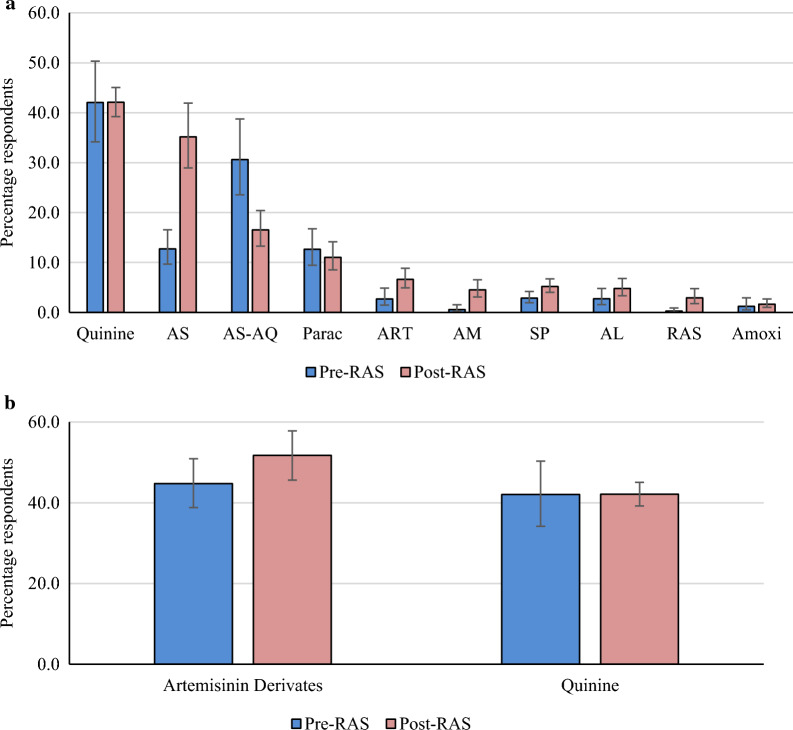
2439 household interviews were completed (pre-RAS 888 and post-RAS 1551), including 316 and 653 treatment-seeking interviews. Overall, 3499 children < 5 years were tested for malaria and anaemia (pre-RAS 1,315 and post-RAS 2184). Caregiver's recognition of severe malaria signs was poor, while knowledge of symptoms of uncomplicated malaria seemed high. Despite this, danger signs significantly increased the odds of seeking treatment (aOR = 2.12, 95%CI 1.03-4.38), the same was found for the "least poor" quintile (aOR = 3.01, 95%CI 1.03-8.82), as well as residents of Kingandu (aOR = 2.78, 95%CI 1.01-7.65). "Doing something at home" against fever negatively affected treatment-seeking in both study phases. RAS acceptance was high, at almost 100%. Malaria prevalence was higher post-RAS (45.2%) compared to pre-RAS (34.4%), p = 0.003, but anaemia, although high (≥ 75%), was similar in both study phases (p = 0.92).
In remote communities with high malaria prevalence in the DRC, malaria remains a major problem. Improving the recognition of danger signs of severe disease and introducing pre-referral RAS may improve treatment-seeking and contribute to reducing malaria-related mortality among children-if quality of care can be guaranteed.
疟疾仍是刚果民主共和国(DRC)的一个主要公共卫生问题,在 5 岁以下儿童门诊就诊中,疟疾占 44%的死亡病例,在医疗机构死亡的病例中占 22%。了解照顾者寻求治疗的模式和决策的决定因素对于减轻疟疾负担至关重要。
在社区获得直肠青蒿琥酯治疗疟疾(CARAMAL)项目的框架内,在直肠青蒿琥酯(RAS)推出之前和推出后 9 个月和 19 个月,在三个农村 DRC 卫生区进行了随机抽取村庄和家庭的横断面家庭调查。数据通过面对面访谈主要照顾者的方式进行电子收集,这些主要照顾者的孩子年龄均小于 5 岁。对儿童的毛细血管血样进行疟疾和贫血检测。主要研究结果是当孩子发热时,照顾者是否“到家中以外的地方寻求治疗”。使用村庄作为随机效应和卫生区作为固定效应的多水平混合效应逻辑回归模型来评估治疗选择的预测因素。
完成了 2439 户家庭访谈(RAS 推出前 888 户,RAS 推出后 1551 户),包括 316 次和 653 次治疗选择访谈。总体而言,3499 名年龄小于 5 岁的儿童接受了疟疾和贫血检测(RAS 推出前 1315 名,RAS 推出后 2184 名)。照顾者对严重疟疾症状的认识很差,而对无并发症疟疾症状的认识似乎很高。尽管如此,危险症状显著增加了寻求治疗的几率(优势比[aOR] = 2.12,95%置信区间[CI] 1.03-4.38),“最不贫困”五分位数(aOR = 3.01,95%CI 1.03-8.82)和金杜安居民(aOR = 2.78,95%CI 1.01-7.65)也是如此。在两个研究阶段,“在家中采取措施”对发热的治疗选择均产生负面影响。RAS 的接受率很高,几乎达到 100%。疟疾的患病率在 RAS 推出后(45.2%)高于推出前(34.4%),p = 0.003,但贫血的患病率虽然很高(≥75%),但在两个研究阶段相似(p = 0.92)。
在刚果民主共和国疟疾流行率较高的偏远社区,疟疾仍然是一个主要问题。提高对严重疾病危险症状的认识,并引入预转诊青蒿琥酯,可能会改善治疗选择,并有助于降低儿童的疟疾相关死亡率——如果能够保证医疗质量的话。