Telethon Institute of Genetics and Medicine (TIGEM), Pozzuoli, 80078 Naples, Italy.
Telethon Institute of Genetics and Medicine (TIGEM), Pozzuoli, 80078 Naples, Italy; Department of Medical and Translational Science, Federico II University, 80131 Naples, Italy.
Mol Ther. 2022 Apr 6;30(4):1432-1450. doi: 10.1016/j.ymthe.2022.01.037. Epub 2022 Feb 2.
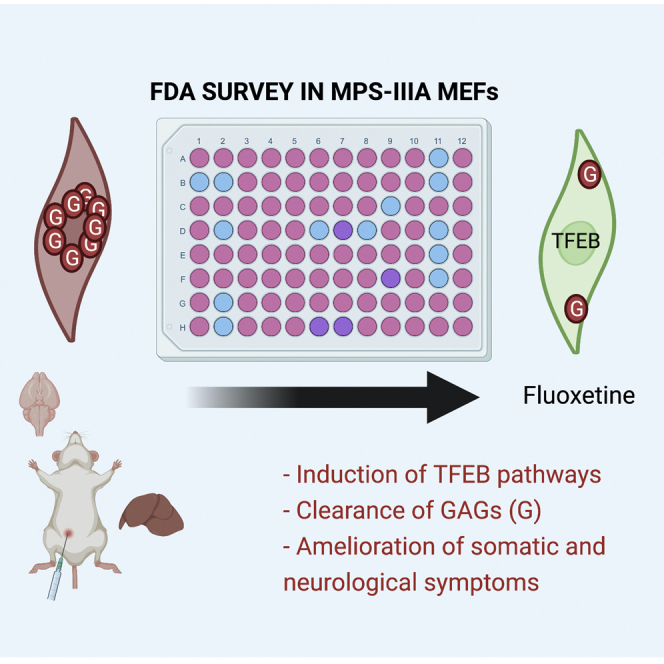
Mucopolysaccharidosis type IIIA (MPS-IIIA) is an autosomal recessive disorder caused by mutations in SGSH involved in the degradation of heparan sulfate. MPS-IIIA presents severe neurological symptoms such as progressive developmental delay and cognitive decline, for which there is currently no treatment. Brain targeting represents the main challenge for therapeutics to treat MPS-IIIA, and the development of small-molecule-based treatments able to reach the CNS could be a relevant advance for therapy. Using cell-based high content imaging to survey clinically approved drugs in MPS-IIIA cells, we identified fluoxetine, a selective serotonin reuptake inhibitor. Fluoxetine increases lysosomal and autophagic functions via TFEB activation through a RagC-dependent mechanism. Mechanistically, fluoxetine increases lysosomal exocytosis in mouse embryonic fibroblasts from MPS-IIIA mice, suggesting that this process may be responsible for heparan sulfate clearance. In vivo, fluoxetine ameliorates somatic and brain pathology in a mouse model of MPS-IIIA by decreasing the accumulation of glycosaminoglycans and aggregated autophagic substrates, reducing inflammation, and slowing down cognitive deterioration. We repurposed fluoxetine for potential therapeutics to treat human MPS-IIIA disease.
黏多糖贮积症 IIIA 型(MPS-IIIA)是一种常染色体隐性遗传病,由参与硫酸乙酰肝素降解的 SGSH 基因突变引起。MPS-IIIA 表现出严重的神经症状,如进行性发育迟缓、认知能力下降,目前尚无治疗方法。脑靶向治疗是治疗 MPS-IIIA 的主要挑战,开发能够到达中枢神经系统的基于小分子的治疗方法可能是治疗的一个重要进展。我们使用基于细胞的高内涵成像技术在 MPS-IIIA 细胞中筛选临床批准的药物,发现了氟西汀,一种选择性 5-羟色胺再摄取抑制剂。氟西汀通过 RagC 依赖性机制通过 TFEB 激活增加溶酶体和自噬功能。在机制上,氟西汀增加了来自 MPS-IIIA 小鼠的胚胎成纤维细胞中的溶酶体胞吐作用,表明该过程可能负责硫酸乙酰肝素的清除。在体内,氟西汀通过减少糖胺聚糖和聚集的自噬底物的积累、减轻炎症和减缓认知恶化,改善了 MPS-IIIA 小鼠的躯体和脑部病理。我们重新利用氟西汀作为治疗人类 MPS-IIIA 疾病的潜在治疗药物。