Lehner Uta, Zaretsky Eugen, Goeze Almut, Wermter Laura, Stuck Boris A, Birk Richard, Neff Andreas, Fischer Ingo, Ghanaati Shahram, Sader Robert, Hey Christiane
Abteilung für Phoniatrie und Pädaudiologie, HNO, Universitätsklinikum Gießen und Marburg GmbH, Standort Marburg, Philipps-Universität Marburg, Baldingerstr. 1, 35043, Marburg, Deutschland.
Klinik für Hals‑, Nasen- und Ohrenheilkunde, Universitätsklinikum Gießen und Marburg GmbH, Standort Marburg, Philipps-Universität Marburg, Marburg, Deutschland.
HNO. 2022 Jul;70(7):533-539. doi: 10.1007/s00106-021-01128-8. Epub 2022 Feb 4.
The swallowing and nutritional status of head-and-neck cancer patients after oncological therapy have been extensively researched. However, the same topics are seldom scrutinized before the onset of oncological therapy, although they can influence treatment success in the long term.
This study focusses on a systematic assessment of swallowing function and nutritional status in head-and-neck cancer patients prior to oncological therapy.
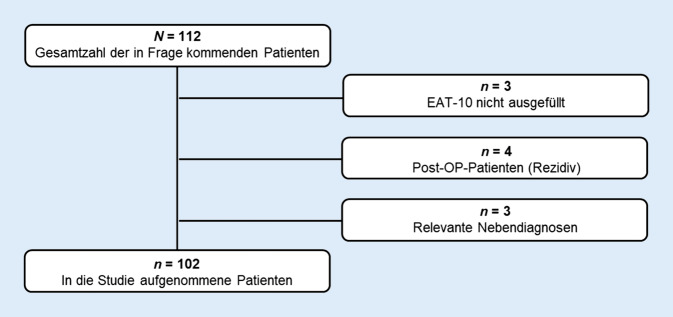
In 102 patients, penetration/aspiration (PA scale), limitations of oral intake (Functional Oral Intake Scale, FOIS), and the need for further intervention (NFI) were endoscopically assessed to objectively quantify swallowing function. The subjective evaluation of swallowing function was carried out with the gEAT-10 (German EAT-10) questionnaire, nutritional status was assessed by body mass index (BMI). Possible impact factors for swallowing function and BMI were analyzed by univariate and multivariate methods.
PAS, FOIS, and NFI values were abnormal in ≤ 15% of patients. BMI was more often too high than too low. Objectively assessed swallowing functions depended predominantly on tumor stage and showed moderate correlations with gEAT-10. The latter mostly yielded a "fail" result. The nutritional status depended on the patients' biological sex and NFI.
In the pre-treatment setting, neither dysphagia nor malnutrition were found in most patients. Impaired swallowing was associated with higher tumor stages, malnutrition with female sex and NFI. A systematic pre-treatment assessment of swallowing and nutritional status in head-and-neck cancer patients appears necessary for modern oncological therapy and optimal patient outcome.
头颈癌患者在肿瘤治疗后的吞咽和营养状况已得到广泛研究。然而,尽管这些问题可能会长期影响治疗效果,但在肿瘤治疗开始前却很少受到审视。
本研究聚焦于对头颈癌患者在肿瘤治疗前的吞咽功能和营养状况进行系统评估。
对102例患者进行内镜检查,评估其渗透/误吸情况(PA量表)、经口进食限制情况(功能性经口进食量表,FOIS)以及进一步干预需求(NFI),以客观量化吞咽功能。采用德国版EAT-10(gEAT-10)问卷对吞咽功能进行主观评估,通过体重指数(BMI)评估营养状况。采用单因素和多因素方法分析吞咽功能和BMI的可能影响因素。
≤15%的患者PA、FOIS和NFI值异常。BMI偏高的情况比偏低更为常见。客观评估的吞咽功能主要取决于肿瘤分期,与gEAT-10呈中度相关。后者大多得出“不合格”结果。营养状况取决于患者的生物学性别和NFI。
在治疗前阶段,大多数患者未发现吞咽困难或营养不良。吞咽功能受损与较高的肿瘤分期相关,营养不良与女性性别和NFI相关。对头颈癌患者进行系统的治疗前吞咽和营养状况评估对于现代肿瘤治疗和实现最佳患者预后似乎是必要的。