Anwar Fareeha, Saleem Uzma, Rehman Atta Ur, Ahmad Bashir, Ismail Tariq, Mirza Muhammad Usman, Ahmad Sarfraz
Riphah Institute of Pharmaceutical Sciences, Riphah International University, Lahore, Pakistan.
Riphah Institute of Pharmaceutical Sciences, Faculty of Pharmaceutical Sciences, Riphah International University, Islamabad, Pakistan.
Front Pharmacol. 2022 Jan 20;12:810704. doi: 10.3389/fphar.2021.810704. eCollection 2021.
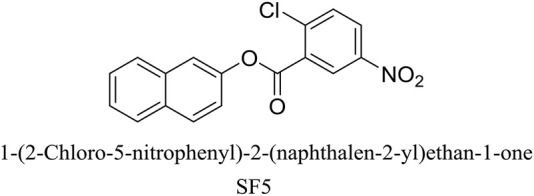
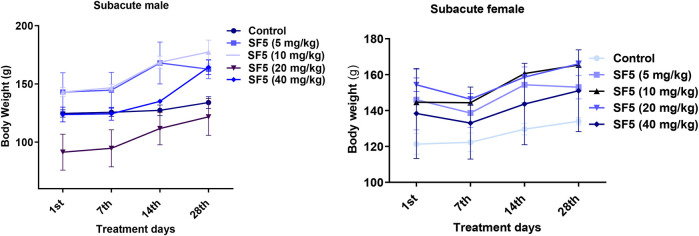
The U.S. National Research Council (NRC) introduced new approaches to report toxicity studies. The NRC vision is to explore the toxicity pathways leading to the adverse effects in intact organisms by the exposure of the chemicals. This study examines the toxicity profiling of the naphthalene-2-yl 2-chloro-5-dinitrobenzoate (SF5) by adopting the vision of NRC that moves from traditional animal studies to the cellular pathways. Acute, subacute, and developmental toxicity studies were assayed according to the Organization for Economic Cooperation and Development (OECD) guidelines. The stress response pathway, toxicity pathway, and adverse effects outcome parameters were analyzed by using their standard protocols. The results showed that the acute toxicity study increases the liver enzyme levels. In a subacute toxicity study, alkaline phosphatase (ALP) levels were raised in both male and female animals. SF5 significantly increases the normal sperm count in the male animals corresponding to a decrease in the abnormality count. Developmental toxicity showed the normal skeletal and morphological parameters, except little hydrocephalus was observed in developmental toxicity. Doses of 20 mg/kg in males and 4 mg/kg in females showed decreased glutathione (GSH) levels in the kidney and liver. MDA levels were also increased in the kidney and liver. However, histopathological studies did not show any cellular change in these organs. No statistical difference was observed in histamine levels, testosterone, nuclear factor erythroid two-related factor-2 (Nrf2), and nuclear factor-kappa B (NF-κB), which showed no initiation of the stress response, toxicity, and adverse effect pathways. Immunomodulation was observed at low doses in subacute toxicity studies. It was concluded that SF5 did not produce abrupt and high-toxicity levels in organs and biochemical parameters. So, it is safe for further studies.
美国国家研究委员会(NRC)引入了报告毒性研究的新方法。NRC的愿景是通过化学物质暴露来探索导致完整生物体产生不良反应的毒性途径。本研究采用NRC从传统动物研究转向细胞途径的愿景,对2-氯-5-二硝基苯甲酸萘-2-酯(SF5)进行毒性分析。根据经济合作与发展组织(OECD)指南进行急性、亚急性和发育毒性研究。通过使用其标准方案分析应激反应途径、毒性途径和不良反应结果参数。结果表明,急性毒性研究增加了肝酶水平。在亚急性毒性研究中,雄性和雌性动物的碱性磷酸酶(ALP)水平均升高。SF5显著增加雄性动物的正常精子数量,同时异常精子数量相应减少。发育毒性显示骨骼和形态参数正常,只是在发育毒性中观察到有轻微脑积水。雄性剂量为20mg/kg、雌性剂量为4mg/kg时,肾脏和肝脏中的谷胱甘肽(GSH)水平降低。肾脏和肝脏中的丙二醛(MDA)水平也升高。然而,组织病理学研究未显示这些器官有任何细胞变化。组胺水平、睾酮、核因子红细胞2相关因子2(Nrf2)和核因子κB(NF-κB)未观察到统计学差异,表明应激反应、毒性和不良反应途径未启动。在亚急性毒性研究中,低剂量时观察到免疫调节作用。得出的结论是,SF5在器官和生化参数方面未产生突然的高毒性水平。因此,进一步研究是安全的。