Cançado Guilherme Grossi Lopes, Couto Cláudia Alves, Guedes Laura Vilar, Braga Michelle Harriz, Terrabuio Débora Raquel Benedita, Cançado Eduardo Luiz Rachid, Ferraz Maria Lucia Gomes, Villela-Nogueira Cristiane Alves, Nardelli Mateus Jorge, Faria Luciana Costa, de Oliveira Elze Maria Gomes, Rotman Vivian, Mazo Daniel Ferraz de Campos, Borges Valéria Ferreira de Almeida E, Mendes Liliana Sampaio Costa, Codes Liana, Pessoa Mario Guimarães, Signorelli Izabelle Venturini, Levy Cynthia, Bittencourt Paulo Lisboa
Instituto Alfa de Gastroenterologia, Hospital das Clínicas da Universidade Federal de Minas Gerais, Belo Horizonte, Brazil.
Hospital da Polícia Militar de Minas Gerais, Belo Horizonte, Brazil.
Front Pharmacol. 2022 Jan 20;12:818089. doi: 10.3389/fphar.2021.818089. eCollection 2021.
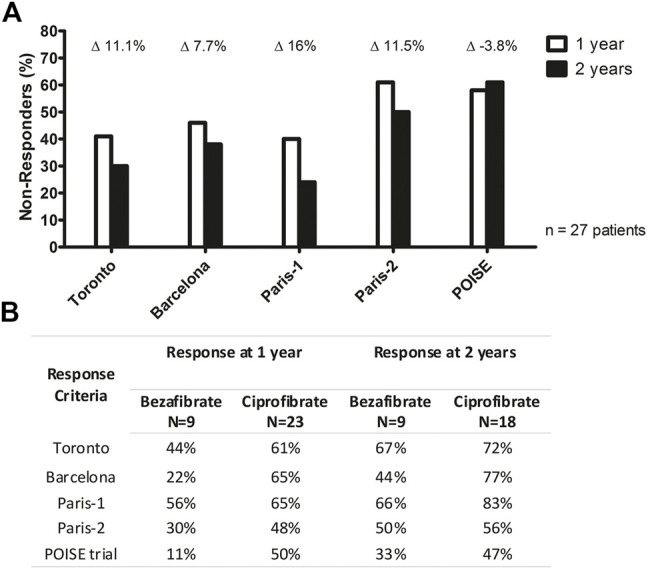
Up to 40% of patients with primary biliary cholangitis (PBC) will have a suboptimal biochemical response to ursodeoxycholic acid (UDCA), which can be improved by the addition of fibrates. This exploratory study aims to evaluate the long-term real-life biochemical response of different fibrates, including ciprofibrate, in subjects with UDCA-unresponsive PBC. The Brazilian Cholestasis Study Group multicenter database was reviewed to assess the response rates to UDCA plus fibrates in patients with UDCA-unresponsive PBC 1 and 2 years after treatment initiation by different validated criteria. In total, 27 patients (100% women, mean age 48.9 ± 9.2 years) with PBC were included. Overall response rates to fibrates by each validated criterion varied from 39 to 60% and 39-76% at 12 and 24 months after treatment combination, respectively. Combination therapy resulted in a significant decrease in ALT and ALP only after 2 years, while GGT significantly improved in the first year of treatment. Treatment response rates at 1 and 2 years appear to be comparable between ciprofibrate and bezafibrate using all available criteria. Our findings endorse the efficacy of fibrate add-on treatment in PBC patients with suboptimal response to UDCA. Ciprofibrate appears to be at least as effective as bezafibrate and should be assessed in large clinical trials as a possibly new, cheaper, and promising option for treatment of UDCA-unresponsive PBC patients.
高达40%的原发性胆汁性胆管炎(PBC)患者对熊去氧胆酸(UDCA)的生化反应欠佳,添加贝特类药物可改善这种情况。这项探索性研究旨在评估不同贝特类药物(包括环丙贝特)对UDCA反应不佳的PBC患者的长期实际生化反应。回顾了巴西胆汁淤积研究组的多中心数据库,以根据不同的验证标准评估治疗开始后1年和2年时,UDCA反应不佳的PBC患者对UDCA加贝特类药物的反应率。总共纳入了27例PBC患者(均为女性,平均年龄48.9±9.2岁)。根据各验证标准,联合治疗后12个月和24个月时,贝特类药物的总体反应率分别为39%至60%和39%至76%。联合治疗仅在2年后导致ALT和ALP显著降低,而在治疗的第一年GGT显著改善。使用所有可用标准,环丙贝特和苯扎贝特在1年和2年时的治疗反应率似乎相当。我们的研究结果证实了贝特类药物附加治疗对UDCA反应欠佳的PBC患者的疗效。环丙贝特似乎至少与苯扎贝特一样有效,应在大型临床试验中作为治疗UDCA反应不佳的PBC患者的一种可能的新的、更便宜且有前景的选择进行评估。