Bruninx Anke, Scheenstra Bart, Dekker Andre, Maessen Jos, van 't Hof Arnoud, Kietselaer Bas, Bermejo Iñigo
Department of Radiation Oncology (MAASTRO), GROW School for Oncology and Developmental Biology, Maastricht University Medical Centre+, Maastricht, the Netherlands.
Department of Cardiothoracic Surgery, Maastricht University Medical Centre+, Maastricht, the Netherlands.
Prev Med Rep. 2021 Dec 16;25:101672. doi: 10.1016/j.pmedr.2021.101672. eCollection 2022 Feb.
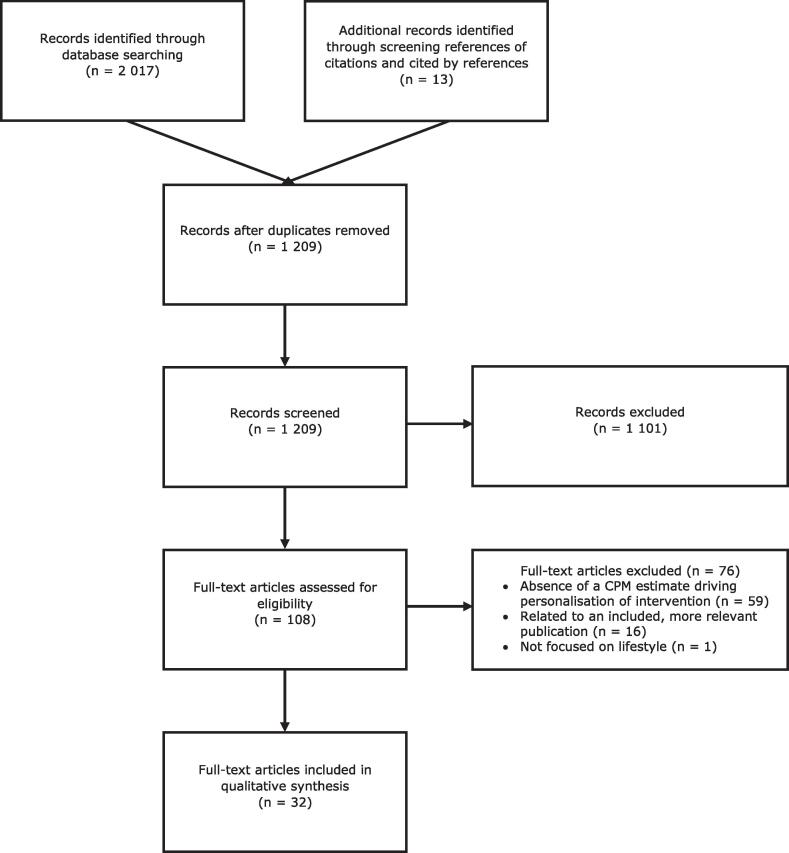
This study aimed to systematically review the use of clinical prediction models (CPMs) in personalised lifestyle interventions for the prevention of cardiovascular disease. We searched PubMed and PsycInfo for articles describing relevant studies published up to August 1, 2021. These were supplemented with items retrieved via screening references of citations and cited by references. In total, 32 studies were included. Nineteen different CPMs were used to guide the intervention. Most frequently, a version of the Framingham risk score was used. The CPM was used to inform the intensity of the intervention in five studies (16 %), and the intervention's type in 31 studies (97 %). The CPM was supplemented with relative risk estimates for additional risk factors in three studies (9 %), and relative risk estimates for intervention effects in four (13 %). In addition to the estimated risk, the personalisation was determined using criteria based on univariable risk factors in 18 studies (56 %), a lifestyle score in three (9 %), and a physical examination index in one (3 %). We noted insufficient detail in reporting regarding the CPM's use in 20 studies (63 %). In 15 studies (47 %), the primary outcome was a CPM estimate. A statistically significant effect favouring the intervention to the comparator arm was reported in four out of eight analyses (50 %), and a statistically significant improvement compared to baseline in five out of seven analyses (71 %). Due to the design of the included studies, the effect of the use of CPMs is still unclear. Therefore, we see a need for future research.
本研究旨在系统评价临床预测模型(CPMs)在预防心血管疾病的个性化生活方式干预中的应用。我们在PubMed和PsycInfo数据库中检索了截至2021年8月1日发表的描述相关研究的文章。这些文章还补充了通过筛选引文参考文献和被参考文献引用的文献所检索到的条目。总共纳入了32项研究。使用了19种不同的CPMs来指导干预。最常用的是弗明汉风险评分的一个版本。在5项研究(16%)中,CPM用于告知干预强度,在31项研究(97%)中用于告知干预类型。在3项研究(9%)中,CPM补充了其他危险因素的相对风险估计,在4项研究(13%)中补充了干预效果的相对风险估计。除了估计风险外,在18项研究(56%)中,个性化是根据单变量危险因素的标准确定的,在3项研究(9%)中是根据生活方式评分确定的,在1项研究(3%)中是根据体格检查指标确定的。我们注意到,在20项研究(63%)中,关于CPM使用的报告细节不足。在15项研究(47%)中,主要结局是CPM估计值。在八项分析中有四项(50%)报告了干预组相对于对照臂有统计学显著效果,在七项分析中有五项(71%)报告了相对于基线有统计学显著改善。由于纳入研究的设计,CPMs使用的效果仍不清楚。因此,我们认为未来有必要进行研究。