Veterans Affairs Puget Sound Health Care System, Seattle, Washington.
Division of Metabolism, Endocrinology & Nutrition, Department of Medicine, University of Washington, Seattle, Washington.
Am J Physiol Endocrinol Metab. 2022 Mar 1;322(3):E307-E318. doi: 10.1152/ajpendo.00234.2021. Epub 2022 Feb 7.
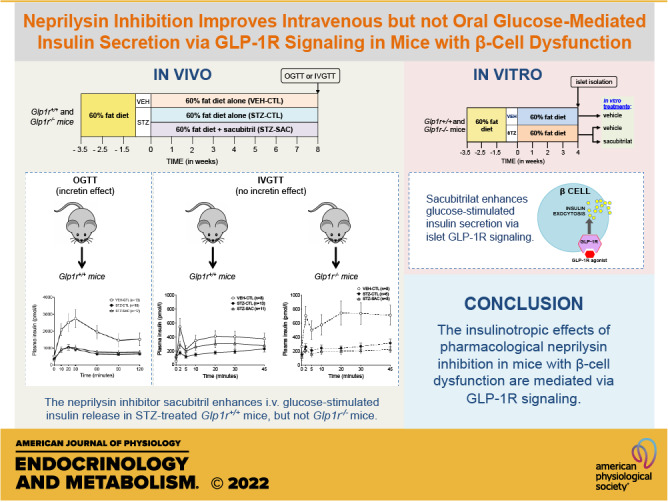
Type 2 diabetes is associated with the upregulation of neprilysin, a peptidase capable of cleaving glucoregulatory peptides such as glucagon-like peptide-1 (GLP-1). In humans, use of the neprilysin inhibitor sacubitril in combination with an angiotensin II receptor blocker was associated with increased plasma GLP-1 levels and improved glycemic control. Whether neprilysin inhibition per se is mediating these effects remains unknown. We sought to determine whether pharmacological neprilysin inhibition on its own confers beneficial effects on glycemic status and β-cell function in a mouse model of reduced insulin secretion, and whether any such effects are dependent on GLP-1 receptor (GLP-1R) signaling. High-fat-fed male wild-type () and GLP-1R knockout () mice were treated with low-dose streptozotocin (STZ) to recapitulate type 2 diabetes-associated β-cell dysfunction, or vehicle as control. Mice were continued on high-fat diet alone or supplemented with the neprilysin inhibitor sacubitril for 8 wk. At the end of the study period, β-cell function was assessed by oral or intravenous glucose-tolerance test. Fasting and fed glucose were significantly lower in wild-type mice treated with sacubitril, although active GLP-1 levels and insulin secretion during oral glucose challenge were unchanged. In contrast, insulin secretion in response to intravenous glucose was significantly enhanced in sacubitril-treated wild-type mice, and this effect was blunted in mice. Similarly, sacubitril enhanced insulin secretion in vitro in islets from STZ-treated but not mice. Together, our data suggest the insulinotropic effects of pharmacological neprilysin inhibition in a mouse model of β-cell dysfunction are mediated via intra-islet GLP-1R signaling. The neprilysin inhibitor, sacubitril, improves glycemic status in a mouse model of reduced insulin secretion. Sacubitril enhances intravenous but not oral glucose-mediated insulin secretion. The increased glucose-mediated insulin secretion is GLP-1 receptor-dependent. Neprilysin inhibition does not raise postprandial circulating active GLP-1 levels.
2 型糖尿病与脑啡肽酶的上调有关,脑啡肽酶是一种能够切割糖调节肽的肽酶,如胰高血糖素样肽-1(GLP-1)。在人类中,使用脑啡肽酶抑制剂沙库巴曲与血管紧张素 II 受体阻滞剂联合使用,可增加血浆 GLP-1 水平并改善血糖控制。尚不清楚脑啡肽酶抑制本身是否介导这些作用。我们试图确定单独使用药理学脑啡肽酶抑制是否会对胰岛素分泌减少的小鼠模型的血糖状态和β细胞功能产生有益影响,以及任何此类作用是否依赖于 GLP-1 受体(GLP-1R)信号。高脂喂养的雄性野生型()和 GLP-1R 敲除()小鼠用低剂量链脲佐菌素(STZ)处理以重现 2 型糖尿病相关的β细胞功能障碍,或用载体作为对照。小鼠继续单独给予高脂饮食或补充脑啡肽酶抑制剂沙库巴曲 8 周。在研究结束时,通过口服或静脉葡萄糖耐量试验评估β细胞功能。尽管口服葡萄糖刺激时的活性 GLP-1 水平和胰岛素分泌没有改变,但用沙库巴曲治疗的野生型小鼠的空腹和进食后葡萄糖明显降低。相比之下,沙库巴曲处理的野生型小鼠对静脉葡萄糖的胰岛素分泌显著增强,而在 小鼠中这种作用减弱。同样,沙库巴曲增强了来自 STZ 处理的 但不是 小鼠的胰岛中的胰岛素分泌。总之,我们的数据表明,在β细胞功能障碍的小鼠模型中,药理学脑啡肽酶抑制的胰岛素促分泌作用是通过胰岛内 GLP-1R 信号介导的。脑啡肽酶抑制剂沙库巴曲可改善胰岛素分泌减少的小鼠模型的血糖状态。沙库巴曲增强静脉但不增强口服葡萄糖介导的胰岛素分泌。增加的葡萄糖介导的胰岛素分泌依赖于 GLP-1 受体。脑啡肽酶抑制不会提高餐后循环中活性 GLP-1 水平。