Anhui Medical University, Hefei, China.
State Key Laboratory of Pathogen and Biosecurity, Beijing Institute of Microbiology and Epidemiology, Beijing, China.
PLoS Negl Trop Dis. 2022 Feb 7;16(2):e0010204. doi: 10.1371/journal.pntd.0010204. eCollection 2022 Feb.
Culex pipiens quinquefasciatus Say (Cx. quinquefasciatus) and Culex pipiens form molestus Forskal (Cx. molestus) in the Culex pipiens complex group show considerable differences in host seeking, blood feeding, mating behavior and in vector competence. Blood-feeding mosquito behaviors are closely related to their olfactory gene expression and olfactory gene repertoire composition. Comparing olfactory genes between these two subspecies with significantly different blood-feeding behaviors can support further research on the molecular mechanism of the Culex pipiens complex olfactory sensory system, providing a new approach for determining candidate attractant or repellent compounds.
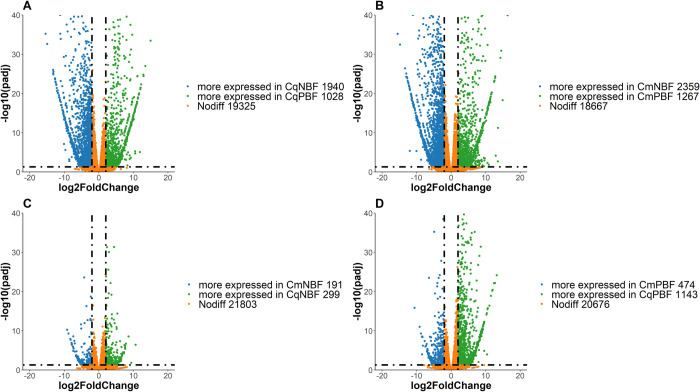
Non-blood-feeding (NBF) and post-blood-feeding (PBF) olfactory system transcriptomes of the two subspecies were sequenced, and the biological functions of their differentially expressed genes were described by bioinformatics analysis. A quantitative polymerase chain reaction (qPCR) was applied to validate the RNA-seq data. The roles of particular olfactory receptors in Cx. quinquefasciatus blood-feeding behaviors were evaluated by RNAi.
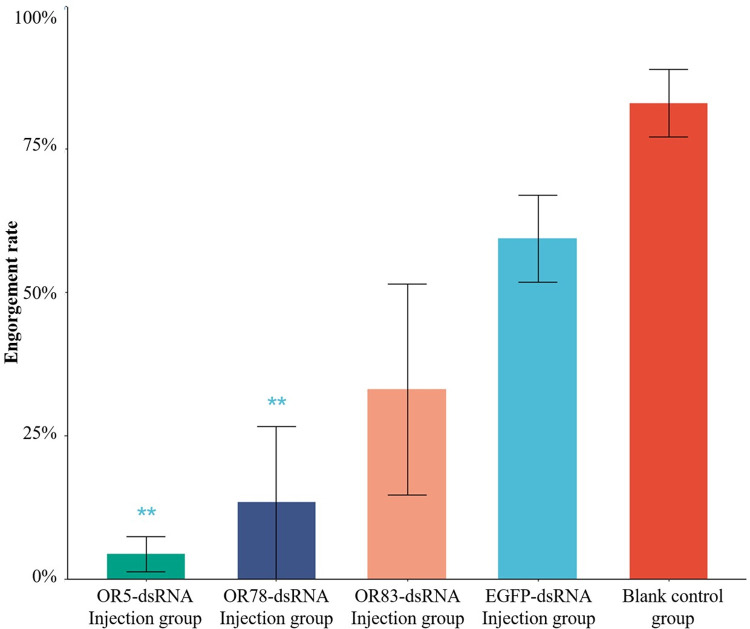
Five, 7, 24, and 3 Cx. quinquefasciatus-specific OBPs, Cx. molestus-specific OBPs, Cx. quinquefasciatus-specific ORs and Cx. molestus-specific ORs were identified, respectively. The majority of selected ORs were consistent with the predicted transcriptome sequencing results after qRT-PCR validation. OR5 was expressed only in Cx. quinquefasciatus, and OR65 was the only gene upregulated after blood feeding in Cx. molestus. The blood-feeding rates of the OR5 and OR78 dsRNA groups were significantly lower (4.3%±3.1% and 13.3%±11.5%) than those of the enhanced green fluorescence protein (EGFP) group (64.5%±8.7%).
Most OBPs and ORs were expressed in both subspecies but showed divergence in expression level. OR5 and OR65 might be species-specific expressed genes that regulate the olfactory behaviors of Cx. quinquefasciatus and Cx. molestus, respectively. The RNA interference of OR5 and OR78 could inhibit the blood-feeding behavior of Cx. quinquefasciatus, providing new targets for screening effective repellent compounds to control mosquito-borne diseases effectively and efficiently.
库蚊复合体中的致倦库蚊(Culex pipiens quinquefasciatus Say,Cx. quinquefasciatus)和骚扰库蚊(Culex pipiens form molestus Forskal,Cx. molestus)在宿主寻找、吸血、交配行为和媒介效能方面表现出相当大的差异。吸血蚊子的行为与它们的嗅觉基因表达和嗅觉基因库组成密切相关。比较这两个亚种之间的嗅觉基因,它们具有明显不同的吸血行为,可以支持对库蚊复合体嗅觉感觉系统的分子机制的进一步研究,为确定候选引诱或驱避化合物提供新的方法。
对两个亚种的非吸血(NBF)和吸血后(PBF)嗅觉系统转录组进行测序,并通过生物信息学分析描述其差异表达基因的生物学功能。应用定量聚合酶链反应(qPCR)验证 RNA-seq 数据。通过 RNAi 评估特定嗅觉受体在致倦库蚊吸血行为中的作用。
分别鉴定了 5 个、7 个、24 个和 3 个致倦库蚊特异性 OBPs、骚扰库蚊特异性 OBPs、致倦库蚊特异性 ORs 和骚扰库蚊特异性 ORs。大多数选择的 ORs 在 qRT-PCR 验证后与预测的转录组测序结果一致。OR5 仅在致倦库蚊中表达,OR65 是骚扰库蚊吸血后唯一上调的基因。OR5 和 OR78 dsRNA 组的吸血率明显低于增强型绿色荧光蛋白(EGFP)组(4.3%±3.1%和 13.3%±11.5%)(64.5%±8.7%)。
大多数 OBPs 和 ORs 在两个亚种中都有表达,但表达水平存在差异。OR5 和 OR65 可能是分别调节致倦库蚊和骚扰库蚊嗅觉行为的种特异性表达基因。OR5 和 OR78 的 RNA 干扰可以抑制致倦库蚊的吸血行为,为筛选有效驱避剂控制蚊媒疾病提供新的靶点,从而有效、高效地控制蚊媒疾病。