Department of Cardiology Herlev & Gentofte Hospital University of Copenhagen Denmark.
Department of Medicine Cardiovascular Medicine Division Brigham and Women's Hospital Harvard Medical School Boston MA.
J Am Heart Assoc. 2022 Mar 15;11(6):e021715. doi: 10.1161/JAHA.121.021715. Epub 2022 Feb 8.
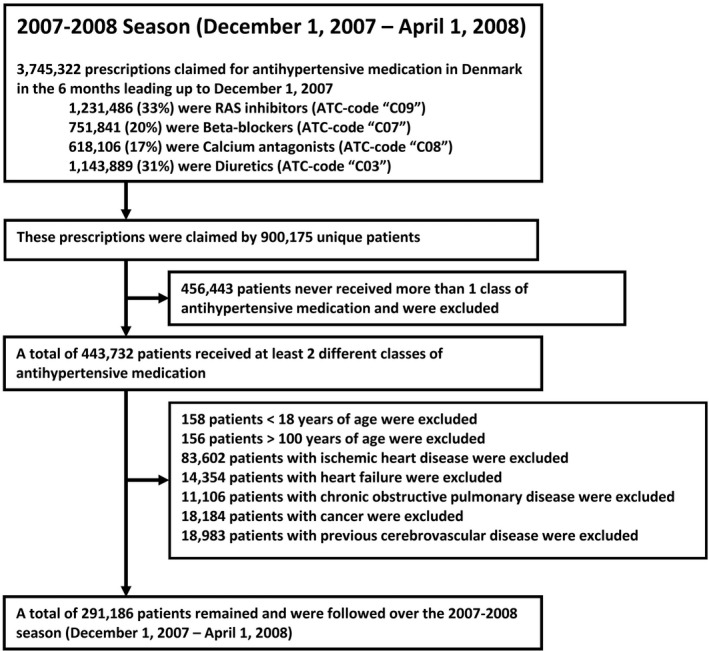
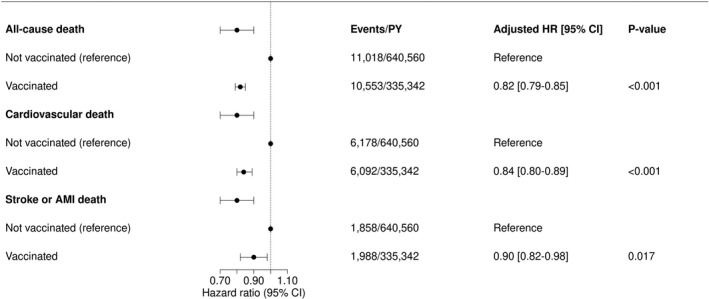
Background Influenza infection may increase the risk of stroke and acute myocardial infarction (AMI). Whether influenza vaccination may reduce mortality in patients with hypertension is currently unknown. Methods and Results We performed a nationwide cohort study including all patients with hypertension in Denmark during 9 consecutive influenza seasons in the period 2007 to 2016 who were prescribed at least 2 different classes of antihypertensive medication (renin-angiotensin system inhibitors, diuretics, calcium antagonists, or beta-blockers). We excluded patients who were aged <18 years, >100 years, had ischemic heart disease, heart failure, chronic obstructive lung disease, cancer, or cerebrovascular disease. The exposure to influenza vaccination was assessed before each influenza season. The end points were defined as death from all-causes, from cardiovascular causes, or from stroke or AMI. For each influenza season, patients were followed from December 1 until April 1 the next year. We included a total of 608 452 patients. The median follow-up was 5 seasons (interquartile range, 2-8 seasons) resulting in a total follow-up time of 975 902 person-years. Vaccine coverage ranged from 26% to 36% during the study seasons. During follow-up 21 571 patients died of all-causes (3.5%), 12 270 patients died of cardiovascular causes (2.0%), and 3846 patients died of AMI/stroke (0.6%). After adjusting for confounders, vaccination was significantly associated with reduced risks of all-cause death (HR, 0.82; <0.001), cardiovascular death (HR, 0.84; <0.001), and death from AMI/stroke (HR, 0.90; =0.017). Conclusions Influenza vaccination was significantly associated with reduced risks of death from all-causes, cardiovascular causes, and AMI/stroke in patients with hypertension. Influenza vaccination might improve outcome in hypertension.
流感感染可能会增加中风和急性心肌梗死(AMI)的风险。目前尚不清楚流感疫苗接种是否可以降低高血压患者的死亡率。
我们进行了一项全国性队列研究,纳入了 2007 年至 2016 年期间丹麦的所有高血压患者,这些患者在连续 9 个流感季节期间至少服用了 2 种不同类别的降压药物(肾素-血管紧张素系统抑制剂、利尿剂、钙拮抗剂或β受体阻滞剂)。我们排除了年龄<18 岁、>100 岁、患有缺血性心脏病、心力衰竭、慢性阻塞性肺病、癌症或脑血管疾病的患者。流感疫苗接种的暴露情况在每个流感季节之前进行评估。终点定义为全因死亡、心血管原因死亡或中风或 AMI 死亡。对于每个流感季节,患者从当年 12 月 1 日至次年 4 月 1 日进行随访。我们共纳入了 608452 名患者。中位随访时间为 5 个季节(四分位间距,2-8 个季节),总随访时间为 975902 人年。研究期间疫苗接种率在 26%至 36%之间。随访期间,共有 21571 名患者死于全因(3.5%),12270 名患者死于心血管原因(2.0%),3846 名患者死于 AMI/中风(0.6%)。在调整混杂因素后,疫苗接种与全因死亡风险降低显著相关(HR,0.82;<0.001)、心血管死亡风险(HR,0.84;<0.001)和 AMI/中风死亡风险(HR,0.90;=0.017)。
流感疫苗接种与高血压患者全因死亡、心血管原因死亡和 AMI/中风死亡风险降低显著相关。流感疫苗接种可能改善高血压患者的预后。