Department of Cardiology, The Second Affiliated Hospital, Zhejiang University School of Medicine, Hangzhou, China.
Department of Cardiology, Ningbo First Hospital, Ningbo, China.
J Clin Endocrinol Metab. 2022 May 17;107(6):e2572-e2580. doi: 10.1210/clinem/dgac048.
Observational studies have suggested associations between adipokines and cardiovascular disease (CVD), but the roles of certain adipokines remain controversial, and these associations have not yet been ascertained causally.
To investigate whether circulating adipokines causally affect the risk of CVD using 2-sample Mendelian randomization (MR).
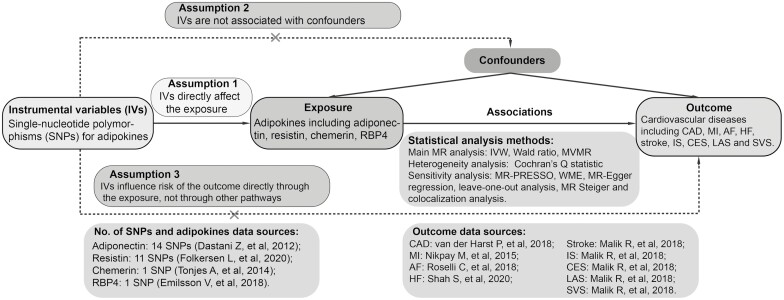
Independent genetic variants strongly associated with adiponectin, resistin, chemerin, and retinol binding protein 4 (RBP4) were selected from public genome-wide association studies. Summary-level statistics for CVD, including coronary artery disease (CAD), myocardial infarction, atrial fibrillation (AF), heart failure (HF), and stroke and its subtypes were collected. The inverse-variance weighted and Wald ratio methods were used for the MR estimates. The MR pleiotropy residual sum and outlier, weighted median, MR-Egger, leave-one-out analysis, MR Steiger, and colocalization analyses were used in the sensitivity analysis.
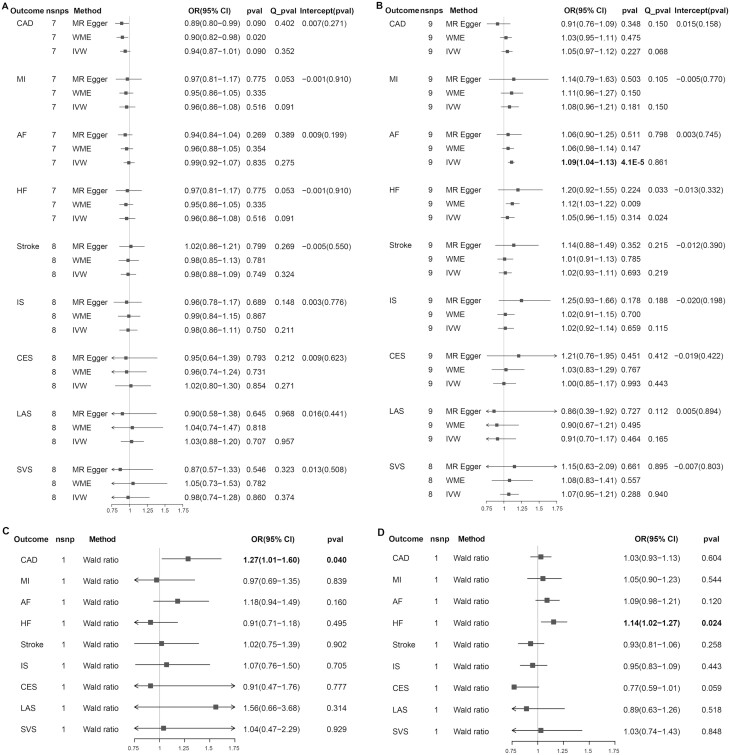
Genetically predicted resistin levels were positively associated with AF risk (odds ratio [OR] 1.09; 95% confidence interval [CI], 1.04-1.13; P = 4.1 × 10⁻⁵), which was attenuated to null after adjusting for blood pressure. We observed suggestive associations between higher genetically predicted chemerin levels and an increased risk of CAD (OR 1.27; 95% CI, 1.01-1.60; P = 0.040), higher genetically predicted RBP4 levels and an increased risk of HF (OR 1.14; 95% CI, 1.02-1.27; P = 0.024). There was no causal association between genetically predicted adiponectin levels and CVD risk.
Our findings reveal the causal association between resistin and AF, probably acting through blood pressure, and suggest potential causal associations between chemerin and CAD, RBP4, and HF.
观察性研究表明,脂肪因子与心血管疾病(CVD)之间存在关联,但某些脂肪因子的作用仍存在争议,并且这些关联尚未确定为因果关系。
使用两样本 Mendelian 随机化(MR)研究循环脂肪因子是否会导致 CVD 的风险。
从公共全基因组关联研究中选择与脂联素、抵抗素、趋化素和视黄醇结合蛋白 4(RBP4)强相关的独立遗传变异。收集 CVD 的汇总水平统计数据,包括冠心病(CAD)、心肌梗死、心房颤动(AF)、心力衰竭(HF)和中风及其亚型。使用逆方差加权和 Wald 比法进行 MR 估计。使用 MR 偏倚残差和异常值、加权中位数、MR-Egger、单样本剔除分析、MR Steiger 和共定位分析进行敏感性分析。
遗传预测的抵抗素水平与 AF 风险呈正相关(优势比[OR] 1.09;95%置信区间[CI],1.04-1.13;P = 4.1 × 10⁻⁵),但在调整血压后减弱至无统计学意义。我们观察到较高的遗传预测趋化素水平与 CAD 风险增加之间存在提示性关联(OR 1.27;95% CI,1.01-1.60;P = 0.040),较高的遗传预测 RBP4 水平与 HF 风险增加之间存在关联(OR 1.14;95% CI,1.02-1.27;P = 0.024)。遗传预测脂联素水平与 CVD 风险之间没有因果关系。
我们的研究结果揭示了抵抗素与 AF 之间的因果关系,这可能是通过血压起作用的,并且提示了趋化素与 CAD、RBP4 和 HF 之间可能存在因果关系。