Center for Language and Brain, Shenzhen Institute of Neuroscience, Shenzhen, China; Department of Psychology, University of Maryland, College Park, MD, USA; Neuroscience and Cognitive Science Program, University of Maryland, College Park, MD, USA.
Department of Psychology, University of Maryland, College Park, MD, USA; Neuroscience and Cognitive Science Program, University of Maryland, College Park, MD, USA.
Dev Cogn Neurosci. 2022 Apr;54:101079. doi: 10.1016/j.dcn.2022.101079. Epub 2022 Jan 31.
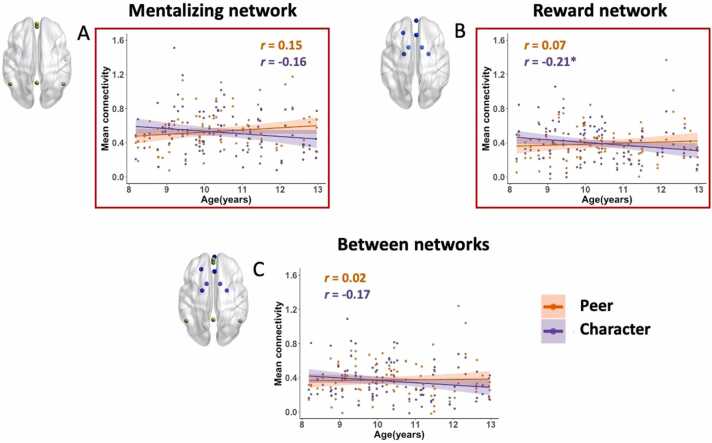
The transition from childhood to adolescence is marked by significant changes in peer interactions. However, limited research has examined the brain systems (e.g., mentalizing and reward networks) involved in direct peer interaction, particularly during childhood and early adolescence. Here, we analyzed fMRI data from 50 children aged 8-12 years while they participated in a task in which they chatted with a peer (Peer) or answered questions about a story character (Character). Using a beta-series correlation analysis, we investigated how social interaction modulates functional connectivity within and between mentalizing and reward networks and whether this modulation changes with age. We observed effects of social interaction on functional connectivity were modulated by age within the mentalizing and reward networks. Further, greater connectivity within and between these networks during social interaction was related to faster reaction time to the Peer versus Character condition. Similar effects were found in the salience and mirror neuron networks. These findings provide insights into age-related differences in how the brain supports social interaction, and thus have the potential to advance our understanding of core social difficulties in social-communicative disorders, such as autism spectrum disorder.
从儿童期到青春期的过渡阶段,同伴互动会发生显著变化。然而,很少有研究探讨直接同伴互动中涉及的大脑系统(例如,心理化和奖励网络),特别是在儿童期和青春期早期。在这里,我们分析了 50 名 8-12 岁儿童的 fMRI 数据,这些儿童在参与与同伴(Peer)聊天或回答有关故事人物(Character)的问题的任务时。使用 beta 系列相关分析,我们研究了社会互动如何调节心理化和奖励网络内和网络间的功能连接,以及这种调节是否随年龄而变化。我们发现,社会互动对心理化和奖励网络内和网络间功能连接的影响受年龄调节。此外,在社会互动过程中,这些网络内和网络间的连接越强,对同伴与人物条件的反应时间就越快。在突显和镜像神经元网络中也发现了类似的效果。这些发现提供了有关大脑如何支持社会互动的年龄相关差异的见解,因此有可能增进我们对社交交流障碍(例如自闭症谱系障碍)中核心社交困难的理解。