Division of Oral Diagnostics and Rehabilitation, Department of Dental Medicine, Karolinska Institutet, Huddinge, Sweden.
Department of Oral and Maxillofacial Surgery, Eastmaninstitutet, Folktandvården Stockholms Län AB, Folktandvården Eastmaninstitutet, Stockholm, Sweden.
Clin Infect Dis. 2022 Sep 30;75(7):1171-1178. doi: 10.1093/cid/ciac095.
A few years after the publication of the British guidelines, national recommendations were published by the Swedish Medical Products Agency in October 2012, promoting the cessation of antibiotic prophylaxis in dentistry for the prevention of infective endocarditis (IE). The aim of this study was to evaluate whether the incidence of oral streptococcal IE increased among high-risk individuals after October 2012.
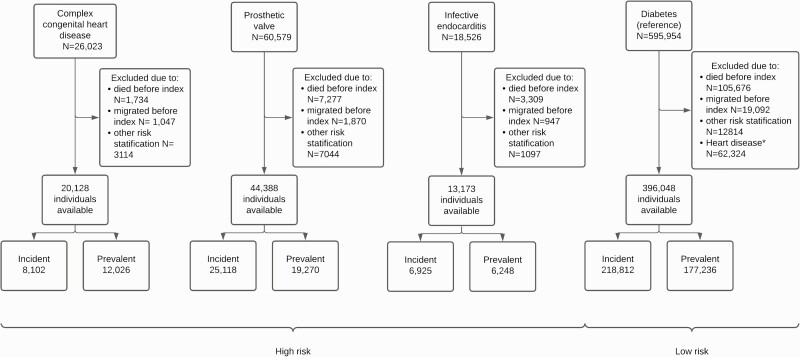
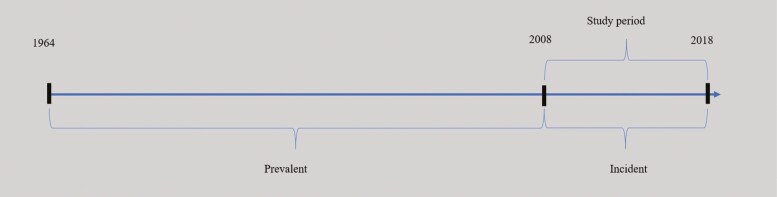
This nationwide cohort study included all adult individuals (>17 years) living in Sweden from January 2008 to January 2018, with a diagnose code or surgical procedure code indicating high risk of IE. Cox proportional hazard models were performed to calculate adjusted ratios of oral streptococcal IE before and after October 2012 between high-risk individuals and references.
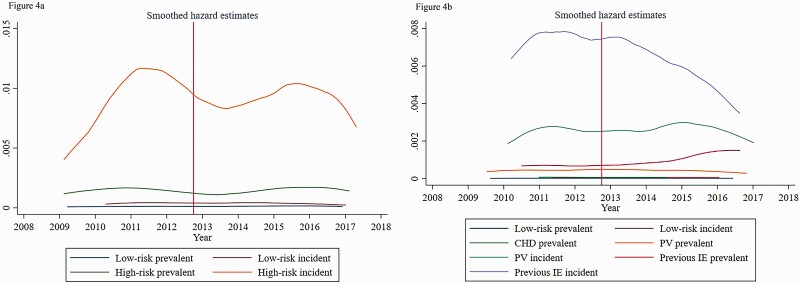
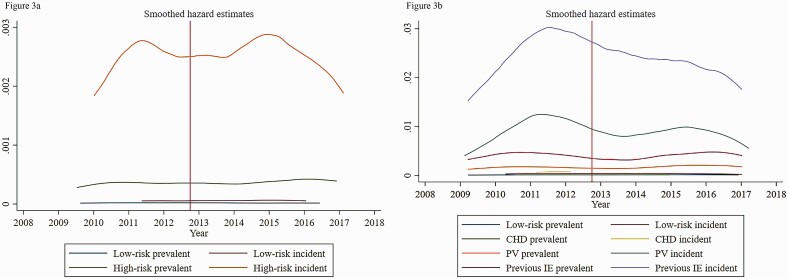
This study found no increased incidence of oral streptococcal IE among high-risk individuals during the 5 years after the cessation, compared with before. Hazard rate ratios were 15.4 (95% confidence interval [CI]: 8.3-28.5) before and 20.7 (95% CI: 10.0-42.7) after October 2012 for prevalent high-risk individuals. Corresponding ratios for incident high-risk individuals were 66.8 (95% CI: 28.7-155.6) and 44.6 (95% CI: 22.9-86.9). Point estimates for interaction with time period were 1.4 (95% CI: .6-3.5) and 0.8 (95% CI: .5-1.3) for prevalent and incident high-risk individuals, respectively.
The results suggest that the current Swedish recommendation not to administer antibiotic prophylaxis for the prevention of IE in dentistry has not led to an increased incidence of oral streptococcal IE among high-risk individuals.
在英国指南发布几年后,瑞典药品管理局于 2012 年 10 月发布了国家建议,提倡停止在牙科预防感染性心内膜炎(IE)中使用抗生素预防。本研究的目的是评估 2012 年 10 月后,高危人群中口腔链球菌性 IE 的发病率是否增加。
这项全国性的队列研究包括所有 2008 年 1 月至 2018 年 1 月期间居住在瑞典的成年个体(>17 岁),诊断代码或手术程序代码表明存在 IE 的高风险。采用 Cox 比例风险模型计算高危人群和参照人群在 2012 年 10 月前后口腔链球菌性 IE 的调整比值。
在停止使用抗生素预防后的 5 年内,本研究未发现高危人群口腔链球菌性 IE 的发病率增加。发病前和发病后高风险个体的流行率比值分别为 15.4(95%置信区间 [CI]:8.3-28.5)和 20.7(95% CI:10.0-42.7)。对于新发病例高风险个体,相应比值分别为 66.8(95% CI:28.7-155.6)和 44.6(95% CI:22.9-86.9)。时间期的交互作用的点估计值分别为 1.4(95% CI:.6-3.5)和 0.8(95% CI:.5-1.3),用于流行和新发病例高风险个体。
结果表明,目前瑞典不建议在牙科预防 IE 中使用抗生素预防的建议并未导致高危人群中口腔链球菌性 IE 的发病率增加。