School of Mechanical Engineering, Dongguan University of Technology, Dongguan, Guangdong, People's Republic of China.
Structure and Motion Laboratory, Royal Veterinary College, North Mymms, Hatfield, UK.
J R Soc Interface. 2022 Feb;19(187):20210710. doi: 10.1098/rsif.2021.0710. Epub 2022 Feb 9.
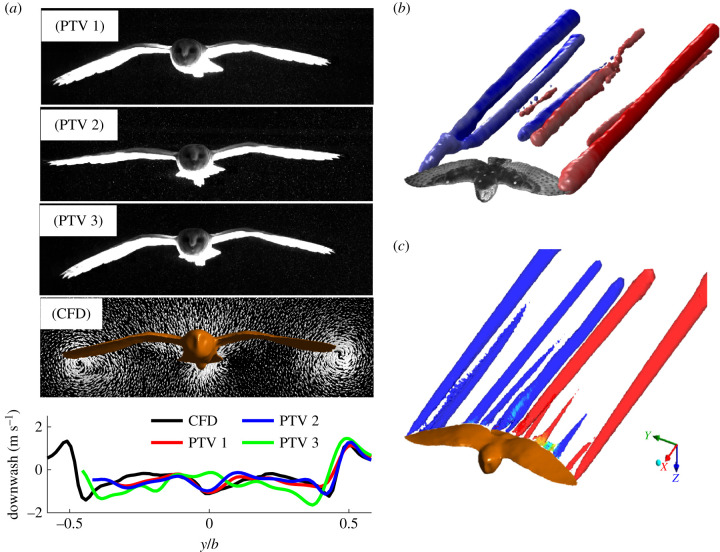
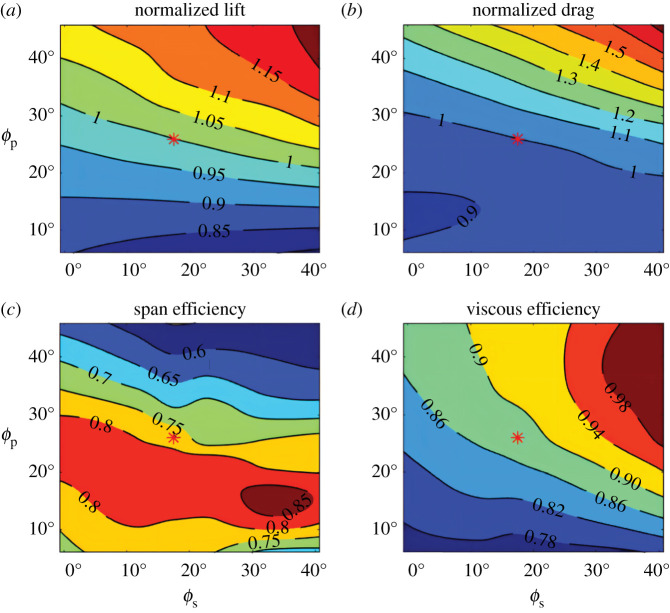
Aerodynamic functions of the avian tail have been studied previously using observations of bird flight, physical models in wind tunnels, theoretical modelling and flow visualization. However, none of these approaches has provided rigorous, quantitative evidence concerning tail functions because (i) appropriate manipulation and controls cannot be achieved using live animals and (ii) the aerodynamic interplay between the wings and body challenges reductive theoretical or physical modelling approaches. Here, we have developed a comprehensive analytical drag model, calibrated by high-fidelity computational fluid dynamics (CFD), and used it to investigate the aerodynamic action of the tail by virtually manipulating its posture. The bird geometry used for CFD was reconstructed previously using stereo-photogrammetry of a freely gliding barn owl () and we validated the CFD simulations against wake measurements. Using this CFD-calibrated drag model, we predicted the drag production for 16 gliding flights with a range of tail postures. These observed postures are set in the context of a wider parameter sweep of theoretical postures, where the tail spread and elevation angles were manipulated independently. The observed postures of our gliding bird corresponded to near minimal total drag.
鸟类尾部的空气动力学功能此前已经通过观察鸟类飞行、风洞中的物理模型、理论建模和流动可视化等方式进行了研究。然而,由于以下原因,这些方法都没有提供关于尾部功能的严格、定量的证据:(i) 使用活体动物无法实现适当的操作和控制,以及 (ii) 翅膀和身体之间的空气动力学相互作用挑战了简化的理论或物理建模方法。在这里,我们开发了一种全面的分析阻力模型,通过高保真计算流体动力学 (CFD) 进行了校准,并通过虚拟操纵其姿势来利用它研究尾部的空气动力学作用。用于 CFD 的鸟类几何形状是以前使用自由滑翔的仓鸮的立体摄影测量法重建的,并且我们通过尾流测量对 CFD 模拟进行了验证。使用这个经过 CFD 校准的阻力模型,我们预测了 16 次滑翔飞行中尾部姿势的阻力产生情况。这些观察到的姿势是在理论姿势的更广泛参数扫描的背景下设置的,其中独立操纵了尾巴的张开和仰角。我们观察到的滑翔鸟类的姿势对应于接近最小总阻力。