Dobrykh Dmitry, Yusupov Ildar, Ginzburg Pavel, Slobozhanyuk Alexey, Filonov Dmitry
School of Electrical Engineering, Tel Aviv University, 69978, Tel Aviv, Israel.
School of Physics and Engineering, ITMO University, 197101, Saint Petersburg, Russia.
Sci Rep. 2022 Feb 8;12(1):2140. doi: 10.1038/s41598-022-06061-6.
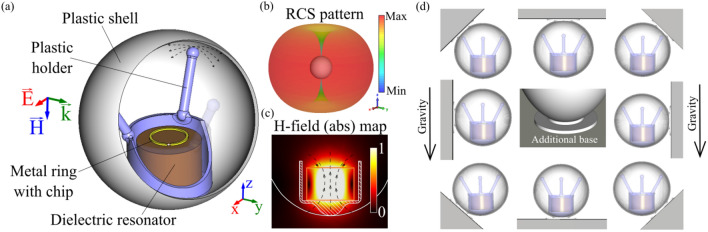
Radio frequency identification (RFID) is a mature technology that allows contactless data readout via a wireless communication link. While numerous passive RFID tags are available on the market, accurate alignment between tags and readers is required in a vast majority of cases to mitigate polarization mismatches. We show that enhancing electromagnetic designs with additional mechanical degrees of freedom allows bypassing fundamental limitations and approach ideal performances. Here, we demonstrate a new miniature tag, accessible from any direction and immune to rotations in space. Our tag is made of a high permittivity ceramic resonator, inductively coupled to a metal ring, which contains an RFID chip. The structure is placed inside a spherical plastic holder. In this architecture, the ceramic resonator serves several functions. First, it allows reducing the device footprint without significant bandwidth degradation. Second, it acts as a bob, aligning the electromagnetic structure parallel to the ground, regardless of its initial orientation in space. The bob is designed to slide inside the plastic holder. This roly-poly effect relaxes the constraint on a mutual tag-reader orientation, including the polarization mismatch, and provides next to perfect long-range operation. Being only 55 mm in diameter, our device can be interrogated from a 12 m distance, regardless of the tag's orientation in space. Introducing mechanical degrees of freedom into electromagnetic designs allows obtaining new functionalities, contributing to applications where a mutual orientation between transvers is required.
射频识别(RFID)是一项成熟的技术,它允许通过无线通信链路进行非接触式数据读取。虽然市场上有大量的无源RFID标签,但在绝大多数情况下,标签与读取器之间需要精确对齐,以减轻极化失配。我们表明,通过增加机械自由度来增强电磁设计,可以绕过基本限制并接近理想性能。在这里,我们展示了一种新型微型标签,它可以从任何方向访问,并且不受空间旋转的影响。我们的标签由高介电常数陶瓷谐振器制成,通过电感耦合到一个包含RFID芯片的金属环上。该结构放置在一个球形塑料支架内。在这种架构中,陶瓷谐振器具有多种功能。首先,它可以在不显著降低带宽的情况下减小设备尺寸。其次,它充当一个摆锤,使电磁结构与地面平行,而不管其在空间中的初始方向如何。摆锤设计为可在塑料支架内滑动。这种不倒翁效应放宽了对标签与读取器相互方向的限制,包括极化失配,并提供了近乎完美的远距离操作。我们的设备直径仅为55毫米,无论标签在空间中的方向如何,都可以在12米的距离进行询问。将机械自由度引入电磁设计可以获得新的功能,有助于在需要横向相互定向的应用中发挥作用。