Department of Anatomy and Physiology, Kansas State University College of Veterinary Medicine, Manhattan, KS 66506, USA.
Department of Clinical Sciences, Kansas State University College of Veterinary Medicine, Manhattan, KS 66506, USA.
J Anim Sci. 2022 Mar 1;100(3). doi: 10.1093/jas/skac038.
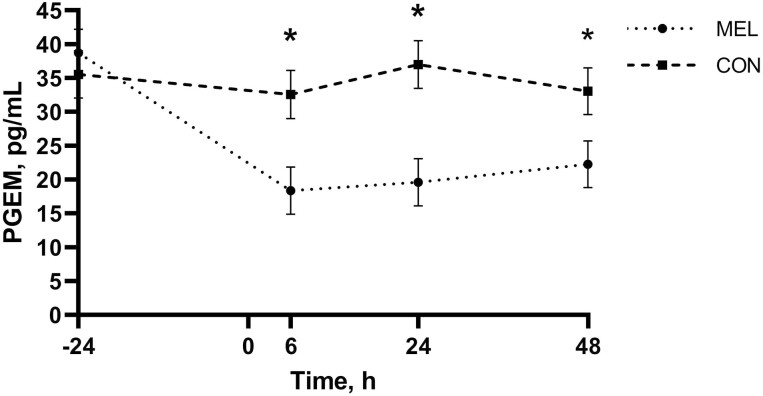
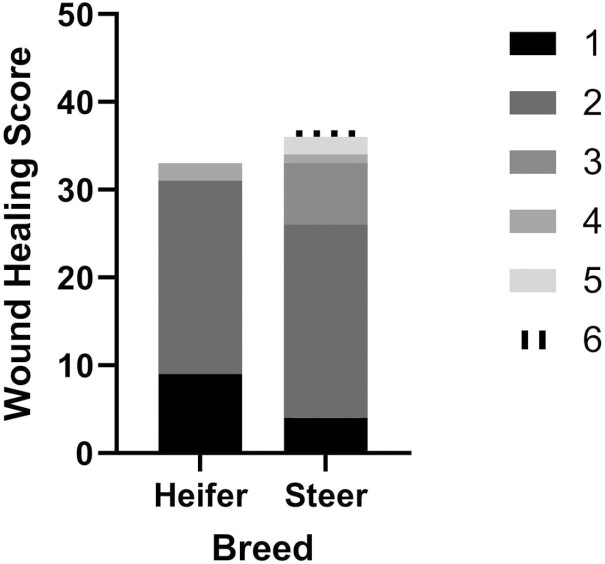
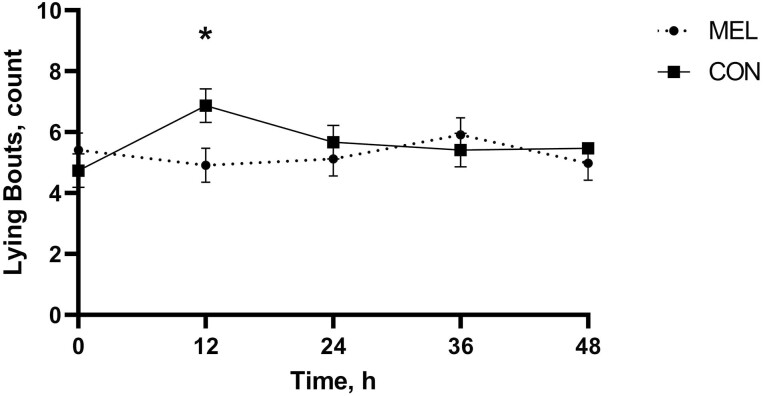
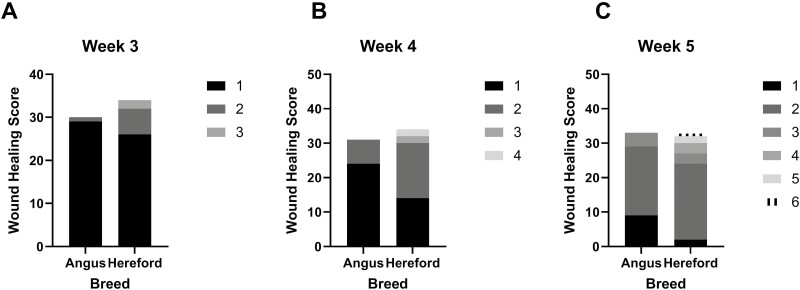
Hot-iron branding uses thermal injury to permanently identify cattle causing painful tissue damage. The primary objective was to examine the physiological and behavioral effects of oral meloxicam (MEL), compared to a control, administered at the time of hot-iron branding in Angus and Hereford steers and heifers. The secondary objectives were to investigate breed and sex effects on pain biomarkers. A total of 70 yearlings, consisting of 35 heifers and 35 steers (Angus, Hereford, or Angus × Hereford), were enrolled in the study. Animals were blocked by sex, randomized across weight, and assigned to receive MEL (1 mg/kg) or a placebo (CON). Biomarkers were assessed for 48 h after branding and included infrared thermography (IRT), mechanical nociceptive threshold (MNT), accelerometry and a visual analog scale (VAS), and serum cortisol and prostaglandin E2 metabolites (PGEM). Wound healing was assessed for 12 wk. Hair samples to quantify cortisol levels were taken prior to and 30 d post-branding. Responses were analyzed using repeated measures with calf nested in treatment as a random effect, and treatment, time, treatment by time interaction, breed, and sex as fixed effects. There was a treatment by time interaction for PGEM (P < 0.01) with MEL having lower values than CON at 6, 24, and 48 h (MEL: 18.34 ± 3.52, 19.61 ± 3.48, and 22.24 ± 3.48 pg/mL, respectively; CON: 32.57 ± 3.58, 37.00 ± 3.52, and 33.07 ± 3.48 pg/mL; P < 0.01). MEL showed less of a difference in maximum IRT values between the branded (2.27 ± 0.29 °C) and control site (3.15 ± 0.29 °C; P < 0.01). MEL took fewer lying bouts at 0-12 h (4.91 bouts ± 0.56) compared with CON (6.87 bouts ± 0.55; P < 0.01). Compared with Hereford calves, Angus calves exhibited greater serum but lower hair cortisol, greater PGEM, more lying bouts, and less healed wound scores at 3, 4, and 5 wk. Compared with heifers, steers exhibited lower PGEM, lower branding site and ocular IRT, higher MNT, and lower plasma meloxicam levels. Steers spent more time lying, took more lying bouts and had greater VAS pain, and more healed wound scores at 5 wk than heifers. Meloxicam administration at branding reduced branding and control site temperature differences and reduced lying bouts for the first 12 h. Breed and sex effects were observed across many biomarkers. Changes from baseline values for IRT, MNT, lying time, step count, VAS pain, and wound scoring all support that branding cattle is painful.
热铁烙痕使用热损伤来永久性地识别牛,从而导致组织疼痛。主要目的是检查口服美洛昔康(MEL)与对照相比,在安格斯和海弗福德牛和小母牛进行热铁烙痕时的生理和行为影响。次要目的是研究品种和性别对疼痛生物标志物的影响。共有 70 头小牛,包括 35 头小母牛和 35 头公牛(安格斯、海弗福德或安格斯×海弗福德),参与了这项研究。动物按性别分组,按体重随机分组,并接受 MEL(1mg/kg)或安慰剂(CON)。在烙痕后 48 小时评估生物标志物,包括红外热成像(IRT)、机械痛觉阈值(MNT)、加速度计和视觉模拟量表(VAS)以及皮质醇和前列腺素 E2 代谢物(PGEM)。伤口愈合情况在 12 周内进行评估。在烙痕前和烙痕后 30 天采集毛发样本以定量皮质醇水平。使用重复测量分析响应,小牛嵌套在处理中作为随机效应,处理、时间、处理与时间相互作用、品种和性别作为固定效应。PGEM 存在处理与时间的相互作用(P < 0.01),MEL 在 6、24 和 48 小时的数值低于 CON(MEL:18.34 ± 3.52、19.61 ± 3.48 和 22.24 ± 3.48 pg/mL,分别;CON:32.57 ± 3.58、37.00 ± 3.52 和 33.07 ± 3.48 pg/mL;P < 0.01)。MEL 在品牌化(2.27 ± 0.29°C)和对照部位(3.15 ± 0.29°C;P < 0.01)之间的最大 IRT 值差异较小。与 CON(4.91 次/ ± 0.56 次)相比,MEL 在 0-12 小时内的卧姿次数更少(6.87 次/ ± 0.55 次;P < 0.01)。与海弗福德小牛相比,安格斯小牛的血清皮质醇水平更高,毛发皮质醇水平更低,PGEM 水平更高,卧姿次数更多,伤口愈合评分在 3、4 和 5 周时更低。与小母牛相比,公牛的 PGEM 水平更低,烙痕部位和眼部 IRT 更低,MNT 更高,血浆美洛昔康水平更低。与小母牛相比,公牛在 5 周时的卧姿时间更长,卧姿次数更多,VAS 疼痛程度更高,伤口愈合评分更高。烙痕时给予美洛昔康可降低烙痕和对照部位的温差,并减少前 12 小时的卧姿次数。在许多生物标志物中观察到品种和性别效应。IRT、MNT、卧姿时间、步数、VAS 疼痛和伤口评分的基线值变化均支持烙印牛是痛苦的。