Department of Anaesthesia and Intensive Care Medicine, Sahlgrenska University Hospital, Gothenburg, Sweden.
Department of Anaesthesia and Intensive Care Medicine, Institute of Clinical Sciences, Sahlgrenska Academy, University of Gothenburg, Gothenburg, Sweden.
Eur J Appl Physiol. 2022 Apr;122(4):993-1005. doi: 10.1007/s00421-022-04892-9. Epub 2022 Feb 10.
It is speculated that diving might be harmful to the nervous system. The aim of this study was to determine if established markers of neuronal injury were increased in the blood after diving.
Thirty-two divers performed two identical dives, 48 h apart, in a water-filled hyperbaric chamber pressurized to an equivalent of 42 m of sea water for 10 min. After one of the two dives, normobaric oxygen was breathed for 30 min, with air breathed after the other. Blood samples were obtained before and at 30-45 and 120 min after diving. Concentrations of glial fibrillary acidic, neurofilament light, and tau proteins were measured using single molecule array technology. Doppler ultrasound was used to detect venous gas emboli.
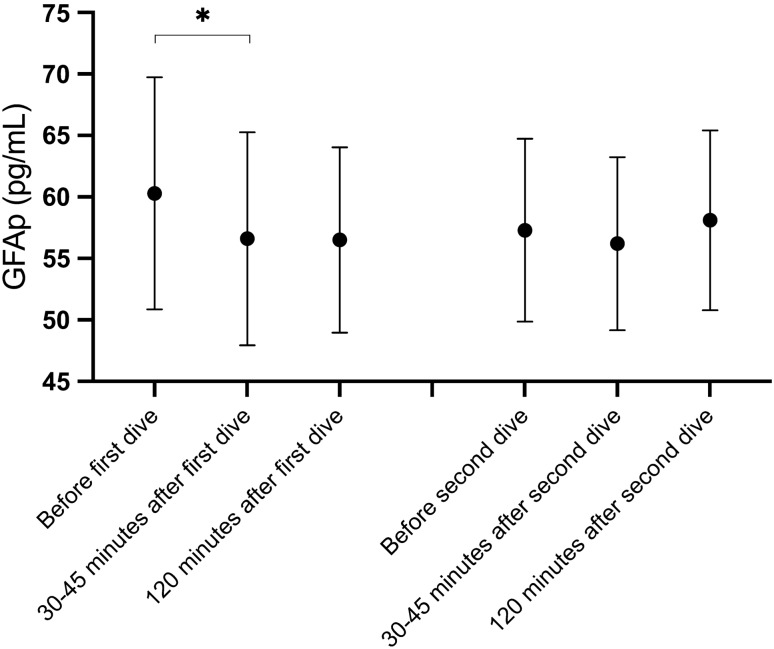
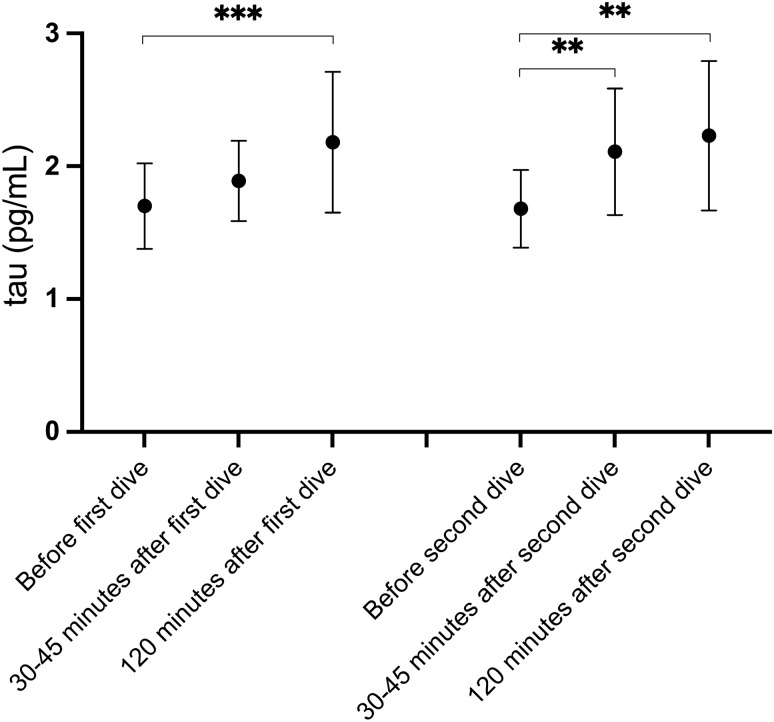
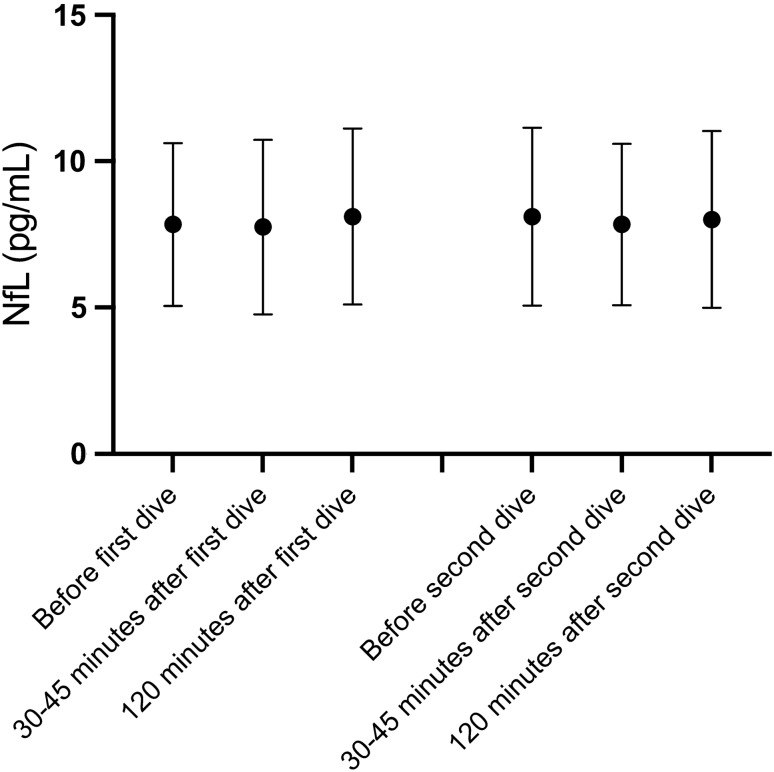
Tau was significantly increased at 30-45 min after the second dive (p < 0.0098) and at 120 min after both dives (p < 0.0008/p < 0.0041). Comparison of matching samples showed that oxygen breathing after diving did not influence tau results. There was no correlation between tau concentrations and the presence of venous gas emboli. Glial fibrillary acidic protein was decreased 30-45 min after the first dive but at no other point. Neurofilament light concentrations did not change.
Tau seems to be a promising marker of dive-related neuronal stress, which is independent of the presence of venous gas emboli. Future studies could validate these results and determine if there is a quantitative relationship between dive exposure and change in tau blood concentration.
潜水可能对神经系统有害,这一假说备受关注。本研究旨在确定潜水后血液中是否存在神经元损伤的标志物。
32 名潜水员在加压至相当于 42 米海水深度的加压水舱中进行了两次相同的潜水,两次潜水间隔 48 小时,每次潜水时间为 10 分钟。两次潜水中的一次后,潜水员呼吸 30 分钟常压氧气,另一次潜水后呼吸空气。在潜水前和潜水后 30-45 分钟和 120 分钟采集血液样本。使用单分子阵列技术测量神经胶质纤维酸性蛋白、神经丝轻链和 tau 蛋白的浓度。使用多普勒超声检测静脉气体栓塞。
第二次潜水后 30-45 分钟 tau 显著升高(p<0.0098),两次潜水后 120 分钟 tau 也显著升高(p<0.0008/p<0.0041)。对匹配样本的比较表明,潜水后呼吸氧气不会影响 tau 结果。tau 浓度与静脉气体栓塞的存在之间无相关性。GFAP 在第一次潜水后 30-45 分钟降低,但在其他时间点无变化。神经丝轻链浓度无变化。
tau 似乎是潜水相关神经元应激的一个有前途的标志物,与静脉气体栓塞的存在无关。未来的研究可以验证这些结果,并确定潜水暴露与 tau 血液浓度变化之间是否存在定量关系。