Centre of Reproductive Medicine and Andrology (CeRA), University of Münster, Münster, Germany.
Central Animal Facility of the Faculty of Medicine, University of Münster, Münster, Germany.
PLoS One. 2022 Feb 10;17(2):e0263793. doi: 10.1371/journal.pone.0263793. eCollection 2022.
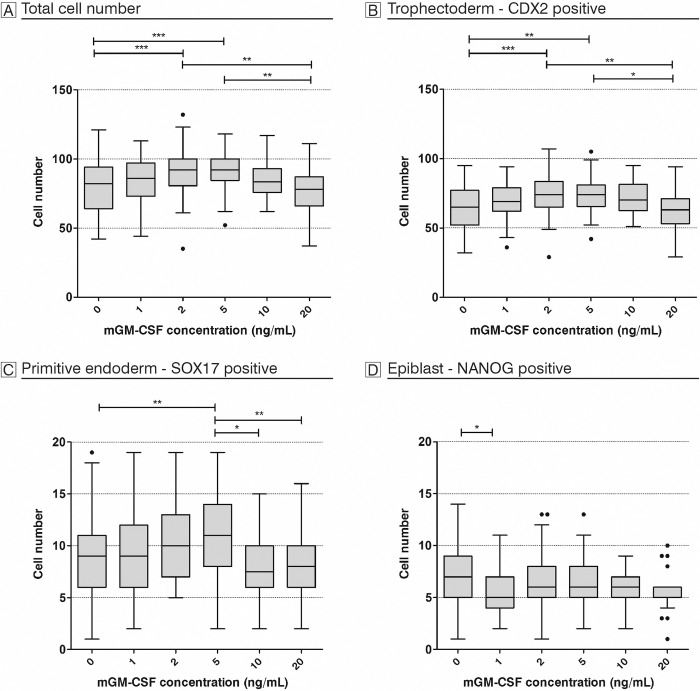
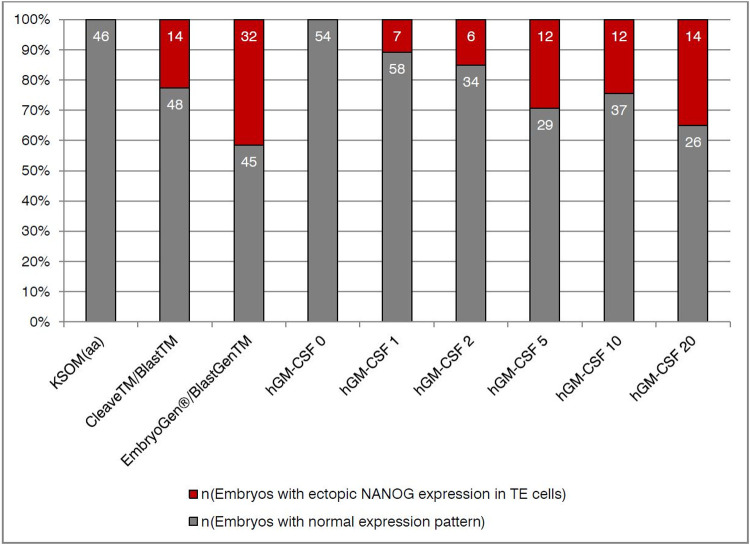
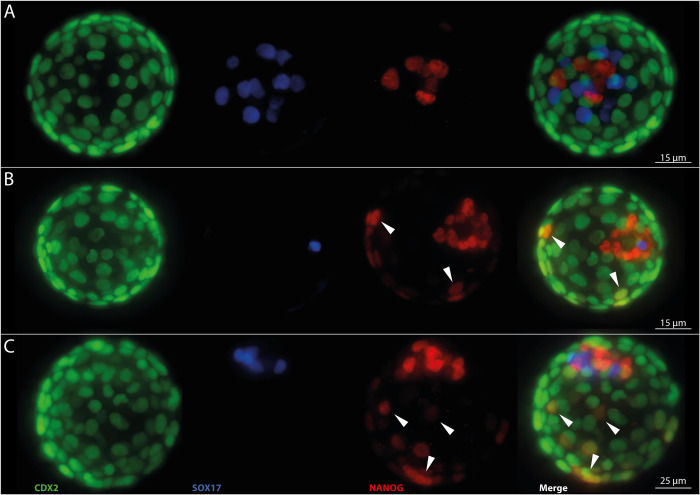
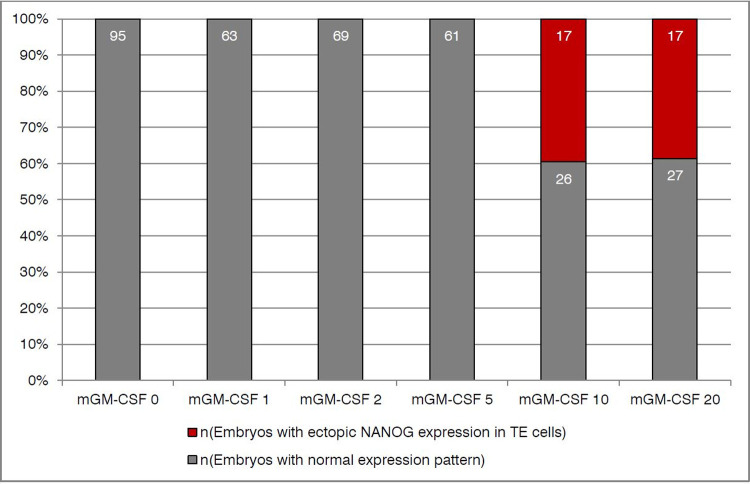
Growth factors became attractive candidates for medium supplementation to further improve the quality of embryo culture and to mimic in vivo nutrition. Granulocyte macrophage colony-stimulating factor (GM-CSF) is a cytokine influencing the maternal-fetal interface and supporting placental development in mouse and human. It is expressed in epithelial cells of the endometrium under the regulation of estrogens. The factor is already in clinical use and a large clinical trial showed that, if supplemented to an embryo culture medium, it leads to increased survival of embryos, especially in women with previous miscarriages. Animal and cell culture studies on isolated trophectoderm cells support an effect mainly on cellular expansion. Aim of this study was to investigate, if the supplementation of GM-CSF either in a human ART medium or in a mouse optimized medium, leads to a change in cell number and cell lineages in the early pre-implantation mouse embryo. Our data shows that mouse GM-CSF increased total cell numbers with increasing concentrations. This increase of cell number has not been found in embryos cultured in ART media with or without human GM-CSF (hGM-CSF) or in a mouse medium supplemented with different concentrations of hGM-CSF. The changes were caused by a marked difference in TE and primitive endoderm cell numbers but not due to a change in epiblast cell numbers. Additionally, results show an ectopic expression of NANOG among trophectoderm cells in both, human ART media (with and without GM-CSF) and at increasing concentrations in the mouse and the human GM-CSF supplemented media. In conclusion, we could show that GM-CSF has an effect on cell identity in mice, which might probably also occur in the human. Therefore, we would like to rare awareness that the use of supplements without proper research could bare risks for the embryo itself and probably also in the post-implantation phase.
生长因子成为中添加物的有吸引力的候选物,以进一步提高胚胎培养的质量,并模拟体内营养。粒细胞巨噬细胞集落刺激因子(GM-CSF)是一种影响母体-胎儿界面并支持小鼠和人类胎盘发育的细胞因子。它在雌激素的调节下在子宫内膜的上皮细胞中表达。该因子已在临床应用中,一项大型临床试验表明,如果将其添加到胚胎培养基中,可提高胚胎的存活率,特别是在有先前流产史的女性中。对分离的滋养外胚层细胞的动物和细胞培养研究支持其主要对细胞扩增的作用。本研究的目的是研究 GM-CSF 无论是在人 ART 培养基中还是在优化的小鼠培养基中添加,是否会导致早期植入前小鼠胚胎中的细胞数量和细胞谱系发生变化。我们的数据表明,随着浓度的增加,GM-CSF 增加了总细胞数。在含有或不含有 hGM-CSF(人 GM-CSF)的 ART 培养基或添加不同浓度 hGM-CSF 的小鼠培养基中培养的胚胎中未发现这种细胞数增加。这些变化是由滋养外胚层细胞和原始内胚层细胞数量的明显差异引起的,而不是由胚胎细胞数量的变化引起的。此外,结果表明,在人 ART 培养基(含或不含 GM-CSF)和在小鼠和添加 GM-CSF 的人培养基中,GM-CSF 的浓度增加,滋养外胚层细胞中 NANOG 的异位表达。总之,我们可以证明 GM-CSF 对小鼠的细胞特性有影响,而在人类中也可能发生这种情况。因此,我们希望引起人们的关注,即在没有适当研究的情况下使用补充剂可能会对胚胎本身以及可能在植入后阶段带来风险。