Department of Cardiology, Nanfang Hospital, Southern Medical University, No. 1838, Guangzhou Avenue North, Guangzhou, 510515, China.
Department of Cardiology, Zhengcheng Branch of Nanfang Hospital, Zengcheng District, Guangzhou, China.
BMC Nephrol. 2022 Feb 10;23(1):62. doi: 10.1186/s12882-022-02696-9.
To develop a reliable model to predict rapid kidney function decline (RKFD) among population at risk of cardiovascular disease.
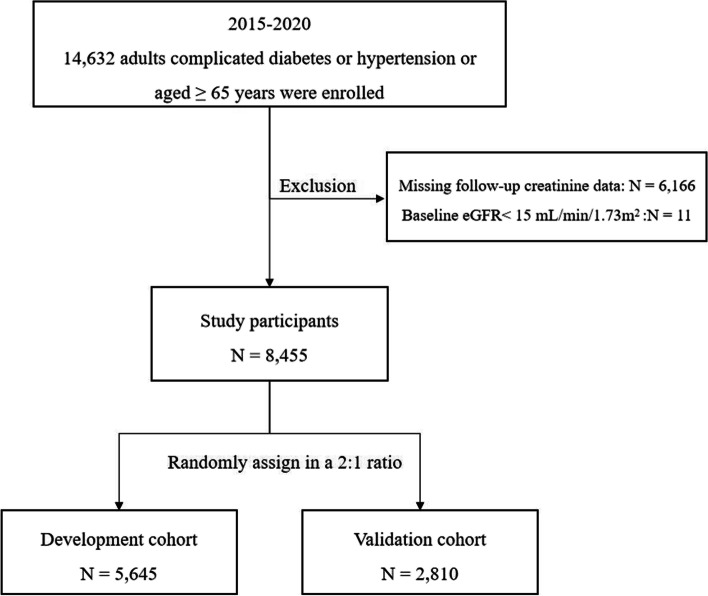
In this retrospective study, key monitoring residents including the elderly, and patients with hypertension or diabetes of China National Basic Public Health Service who underwent community annual physical examinations from January 2015 to December 2020 were included. Healthy records were extracted from regional chronic disease management platform. RKFD was defined as the reduction of estimated glomerular filtration rate (eGFR) ≥ 40% during follow-up period. The entire cohort were randomly assigned to a development cohort and a validation cohort in a 2:1 ratio. Cox regression analysis was used to identify the independent predictors. A nomogram was established based on the development cohort. The concordance index (C-index) and calibration plots were calculated. Decision curve analysis was applied to evaluate the clinical utility.
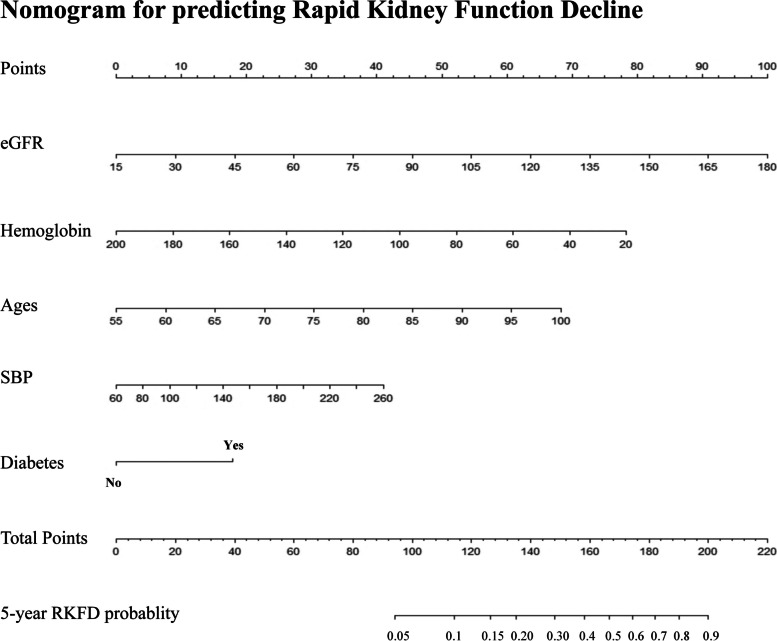
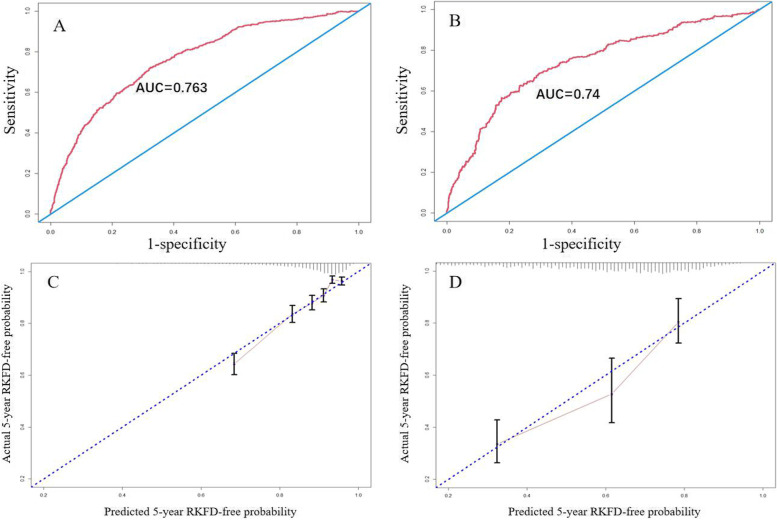
A total of 8455 subjects were included. During the median follow-up period of 3.72 years, the incidence of RKFD was 11.96% (n = 1011), 11.98% (n = 676) and 11.92% (n = 335) in the entire cohort, development cohort and validation cohort, respectively. Age, eGFR, hemoglobin, systolic blood pressure, and diabetes were identified as predictors for RKFD. Good discriminating performance was observed in both the development (C-index, 0.73) and the validation (C-index, 0.71) cohorts, and the AUCs for predicting 5-years RKFD was 0.763 and 0.740 in the development and the validation cohort, respectively. Decision curve analysis further confirmed the clinical utility of the nomogram.
Our nomogram based on five readily accessible variables (age, eGFR, hemoglobin, systolic blood pressure, and diabetes) is a useful tool to identify high risk patients for RKFD among population at risk of cardiovascular disease in primary care. Whereas, further external validations are needed before clinical generalization.
为了开发一种可靠的模型,以预测心血管疾病高危人群的肾功能快速下降(RKFD)。
在这项回顾性研究中,纳入了 2015 年 1 月至 2020 年 12 月期间在中国国家基本公共卫生服务项目中接受社区年度体检的关键监测居民,包括老年人、高血压或糖尿病患者。健康记录从区域慢性病管理平台中提取。RKFD 定义为随访期间估计肾小球滤过率(eGFR)下降≥40%。整个队列按 2:1 的比例随机分配到发展队列和验证队列。采用 Cox 回归分析确定独立预测因素。基于发展队列建立了一个列线图。计算一致性指数(C 指数)和校准图。应用决策曲线分析评估临床实用性。
共纳入 8455 名受试者。在中位随访 3.72 年期间,整个队列、发展队列和验证队列的 RKFD 发生率分别为 11.96%(n=1011)、11.98%(n=676)和 11.92%(n=335)。年龄、eGFR、血红蛋白、收缩压和糖尿病被确定为 RKFD 的预测因素。在发展队列(C 指数,0.73)和验证队列(C 指数,0.71)中均观察到良好的区分性能,预测 5 年 RKFD 的 AUC 分别为 0.763 和 0.740。决策曲线分析进一步证实了列线图的临床实用性。
我们基于五个易于获得的变量(年龄、eGFR、血红蛋白、收缩压和糖尿病)的列线图是一种有用的工具,可以识别初级保健中心血管疾病高危人群的 RKFD 高危患者。然而,在临床推广之前,还需要进一步的外部验证。