University of North Carolina Kidney Center, University of North Carolina Kidney Center School of Medicine, Chapel Hill, North Carolina.
Providence Medical Research Center, Providence Health Care, Spokane, Washington; Department of Medicine, University of Washington School of Medicine, Seattle, Washington.
Am J Kidney Dis. 2022 Apr;79(4):457-479. doi: 10.1053/j.ajkd.2021.09.010. Epub 2022 Feb 7.
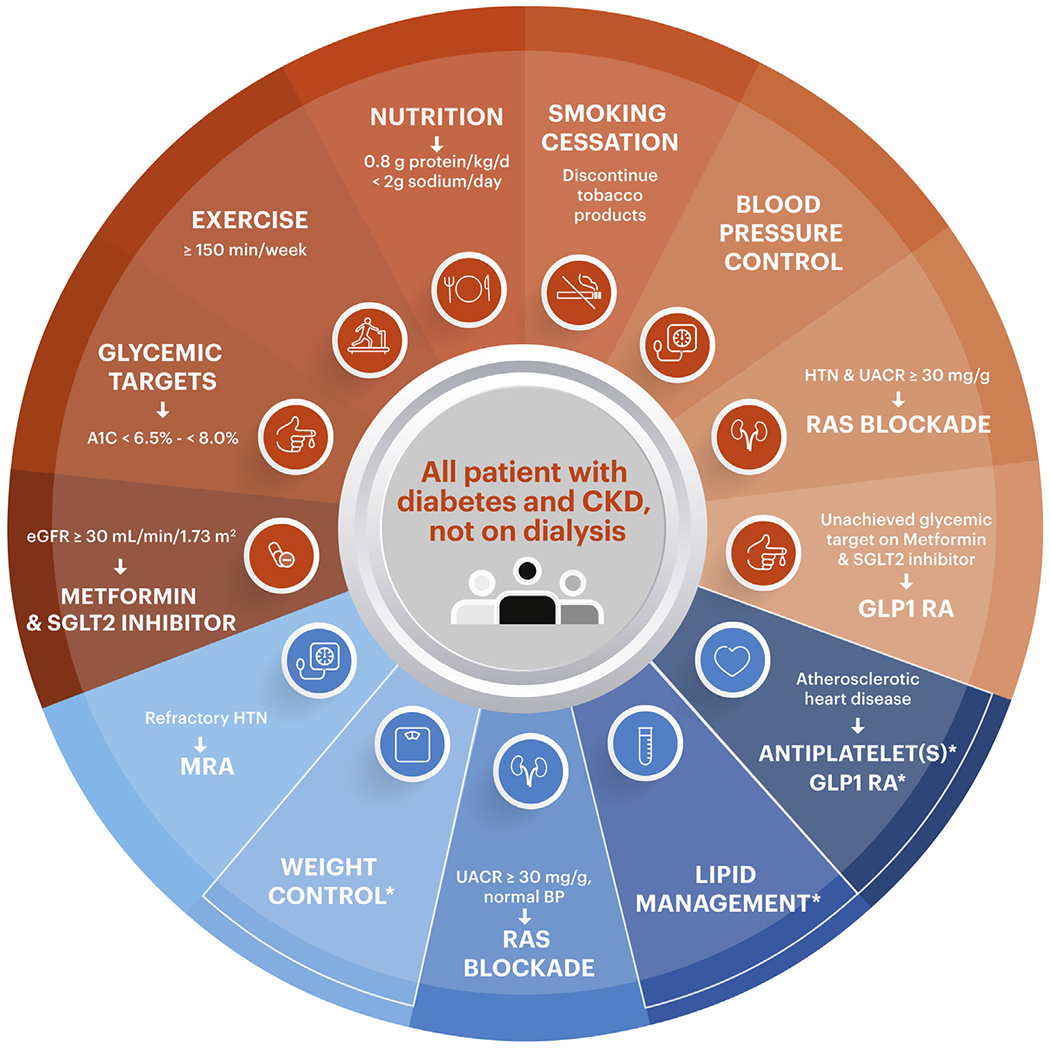
In October 2020, KDIGO (Kidney Disease: Improving Global Outcomes) published its first clinical practice guideline directed specifically to the care of patients with diabetes and chronic kidney disease (CKD). This commentary presents the views of the KDOQI (Kidney Disease Outcomes Quality Initiative) work group for diabetes in CKD, convened by the National Kidney Foundation to provide an independent expert perspective on the new guideline. The KDOQI work group believes that the KDIGO guideline takes a major step forward in clarifying glycemic targets and use of specific antihyperglycemic agents in diabetes and CKD. The purpose of this commentary is to carry forward the conversation regarding optimization of care for patients with diabetes and CKD. Recent developments for prevention of CKD progression and cardiovascular events in people with diabetes and CKD, particularly related to sodium/glucose cotransporter 2 (SGLT2) inhibitors, have filled a longstanding gap in nephrology's approach to the care of persons with diabetes and CKD. The multifaceted benefits of SGLT2 inhibitors have facilitated interactions between nephrology, cardiology, endocrinology, and primary care, underscoring the need for innovative approaches to multidisciplinary care in these patients. We now have more interventions to slow kidney disease progression and prevent or delay kidney failure in patients with diabetes and kidney disease, but methods to streamline their implementation and overcome barriers in access to care, particularly cost, are essential to ensuring all patients may benefit.
2020 年 10 月,KDIGO(肾脏病:改善全球预后)发布了其首个专门针对糖尿病和慢性肾脏病(CKD)患者护理的临床实践指南。本评论介绍了由国家肾脏基金会召集的 CKD 糖尿病 KDOQI(肾脏病结果质量倡议)工作组的观点,旨在为新指南提供独立的专家意见。KDOQI 工作组认为,KDIGO 指南在明确糖尿病和 CKD 患者的血糖目标和特定抗高血糖药物的使用方面迈出了重要一步。本评论的目的是推进有关糖尿病和 CKD 患者护理优化的对话。最近在预防糖尿病和 CKD 患者的 CKD 进展和心血管事件方面取得的进展,特别是与钠/葡萄糖共转运蛋白 2(SGLT2)抑制剂相关的进展,填补了肾脏病在糖尿病和 CKD 患者护理方面的长期空白。SGLT2 抑制剂的多方面益处促进了肾脏病学、心脏病学、内分泌学和初级保健之间的互动,强调了在这些患者中需要创新的多学科护理方法。我们现在有更多的干预措施可以减缓肾脏病的进展,预防或延迟糖尿病和肾脏病患者的肾衰竭,但需要简化其实施并克服获得护理的障碍(特别是费用)的方法,以确保所有患者都能从中受益。