Fujimoto Daichi, Miura Satoru, Yoshimura Kenichi, Wakuda Kazushige, Oya Yuko, Haratani Koji, Itoh Shoichi, Uemura Takehiro, Morinaga Ryotaro, Takahama Takayuki, Nakashima Kazuhisa, Tachihara Motoko, Saito Go, Tanizaki Junko, Otsubo Kohei, Ikeda Satoshi, Matsumoto Hirotaka, Hara Satoshi, Hata Akito, Masuda Takeshi, Yamamoto Nobuyuki
Internal Medicine III, Wakayama Medical University, Wakayama, Japan.
Department of Respiratory Medicine, Kobe City Medical Center General Hospital, Kobe, Japan.
JTO Clin Res Rep. 2021 Dec 16;3(2):100265. doi: 10.1016/j.jtocrr.2021.100265. eCollection 2022 Feb.
The real-world effectiveness of combination treatment with cytotoxic chemotherapy and programmed cell death protein-1 or programmed death-ligand 1 inhibitor for NSCLC, especially for the elderly (aged ≥75 y) or those with poor performance status (≥2), has not been fully elucidated. We investigated the real-world effectiveness and safety of this combination therapy in these populations.
This multicenter retrospective study evaluated patients who are chemo-naïve with advanced NSCLC who received a combination of platinum, pemetrexed, and pembrolizumab between December 2018 and June 2019. This was an updated prespecified secondary analysis with the primary objective of investigating the safety and effectiveness in this cohort.
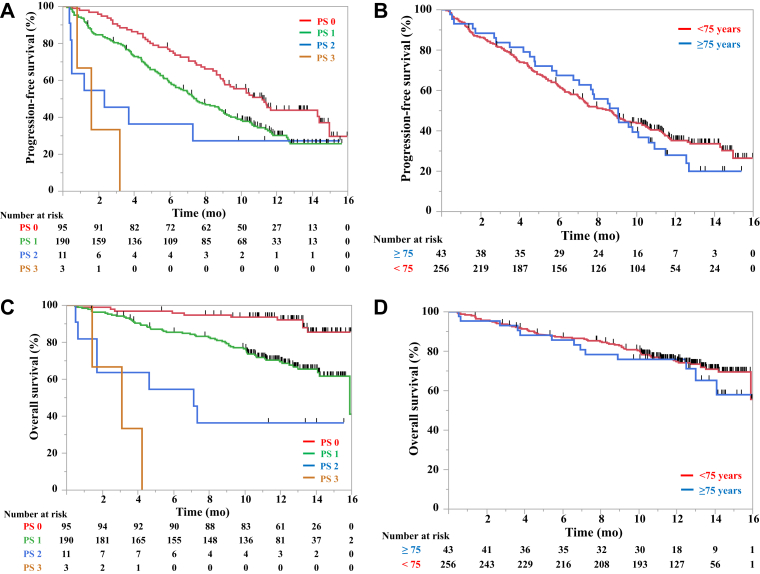
Overall, 299 patients were included. Multivariate analysis identified performance status (0-1) and programmed death-ligand 1 tumor proportion score (≥50%) as significant independent predictors of progression-free survival ( = 0.007, and = 0.003, respectively). The incidence of severe adverse events (AEs) was higher in the elderly and those with poor performance status than in their younger and good performance status counterparts. A total of 71 patients developed AEs that led to treatment discontinuation, and AE-related treatment discontinuation occurred at a significantly higher rate in older patients (median [range]) (70 [46-82] y) than in younger patients (68 [31-84] y) ( <0.001).
Combination treatment with pembrolizumab plus chemotherapy had low real-world effectiveness for poor performance status patients. Severe AEs occurred at a higher rate in the elderly and poor performance status patients, and the AE-related treatment discontinuation rate increased with age. Physicians should be cautious about using this regimen, especially in the elderly and poor performance status patients.
细胞毒性化疗与程序性细胞死亡蛋白1或程序性死亡配体1抑制剂联合治疗非小细胞肺癌(NSCLC),尤其是老年患者(年龄≥75岁)或体能状态较差(≥2)患者的真实世界有效性尚未完全阐明。我们调查了这种联合疗法在这些人群中的真实世界有效性和安全性。
这项多中心回顾性研究评估了2018年12月至2019年6月期间接受铂类、培美曲塞和帕博利珠单抗联合治疗的初治晚期NSCLC患者。这是一项预先指定的更新后二次分析,主要目的是调查该队列中的安全性和有效性。
总共纳入了299例患者。多变量分析确定体能状态(0-1)和程序性死亡配体1肿瘤比例评分(≥50%)分别为无进展生存期的显著独立预测因素(分别为P = 0.007和P = 0.003)。老年患者和体能状态较差患者的严重不良事件(AE)发生率高于年轻患者和体能状态较好的患者。共有71例患者发生导致治疗中断的AE,与AE相关的治疗中断在老年患者(中位年龄[范围])(70[46-82]岁)中的发生率显著高于年轻患者(68[31-84]岁)(P<0.001)。
帕博利珠单抗联合化疗对体能状态较差的患者真实世界有效性较低。老年患者和体能状态较差患者中严重AE的发生率较高,且与AE相关的治疗中断率随年龄增加而升高。医生在使用该方案时应谨慎,尤其是在老年患者和体能状态较差的患者中。