Section of Gastroenterology and HepatologyDipartimento Di Promozione Della SaluteUniversity of PalermoPalermoItaly.
Dipartimento di Scienze EconomicheAziendali e StatisticheUniversity of PalermoPalermoItaly.
Hepatol Commun. 2022 May;6(5):1032-1044. doi: 10.1002/hep4.1877. Epub 2022 Feb 11.
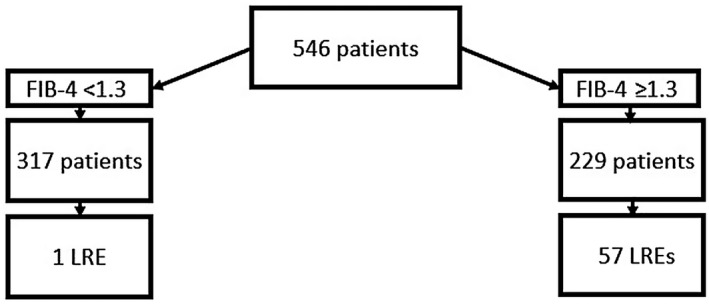
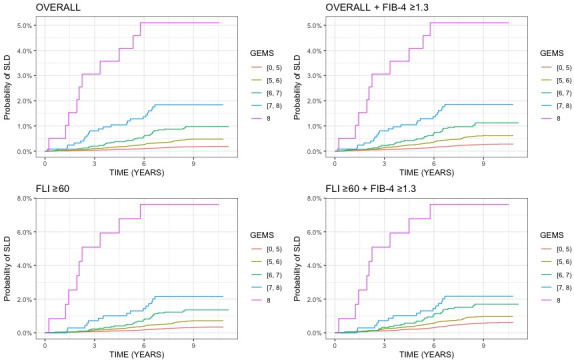
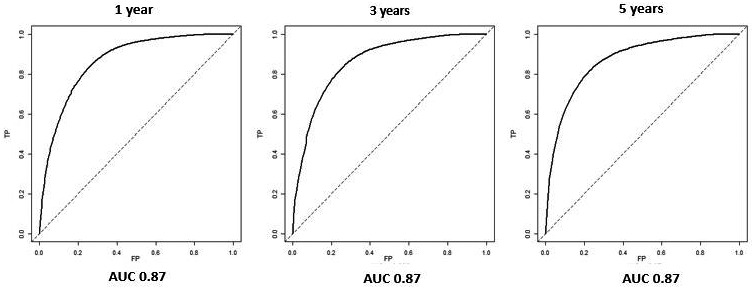
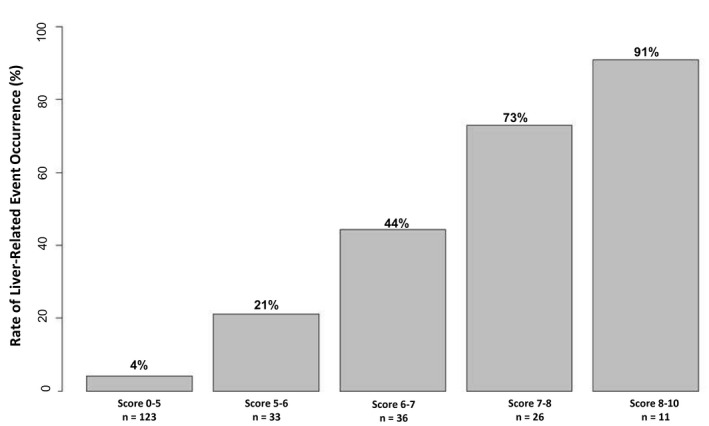
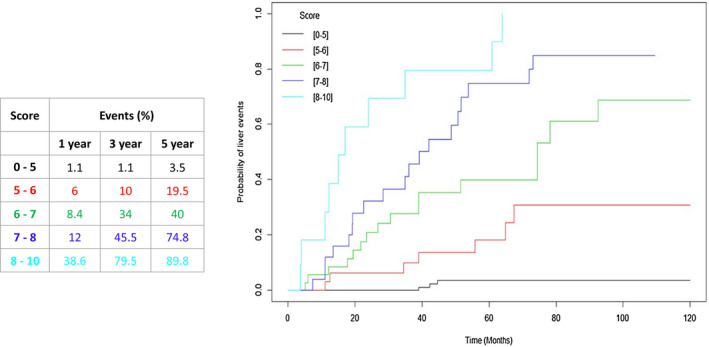
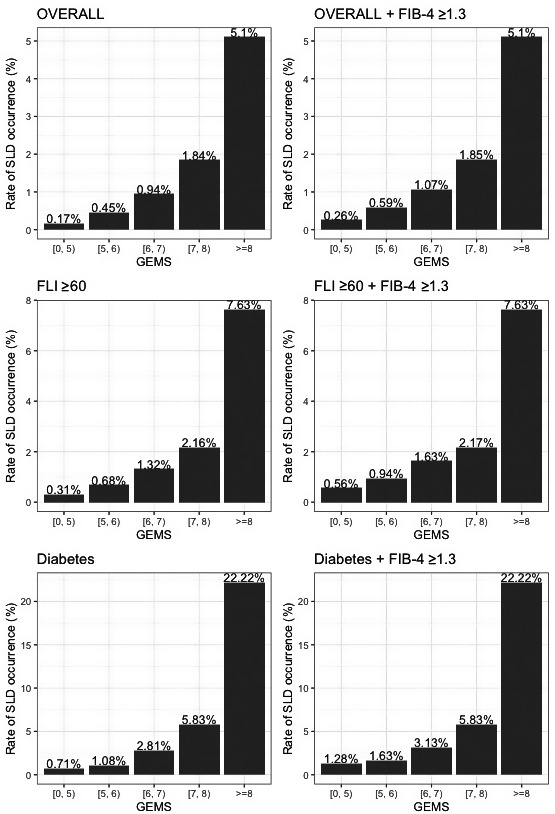
Nonalcoholic fatty liver disease (NAFLD) is an emerging cause of liver-related events (LREs). Here, we have assessed the ability of a composite score based on clinical features, metabolic comorbidities, and genetic variants to predict LREs. A total of 546 consecutive patients with NAFLD were recruited and stratified according to the fibrosis-4 (FIB-4) index. LREs were defined as occurrence of hepatocellular carcinoma or hepatic decompensation. Cox regression multivariate analysis was used to identify baseline variables associated with LREs. The UK Biobank was used as the validation cohort, and severe liver disease (incidence of cirrhosis, decompensated liver disease, hepatocellular carcinoma, and/or liver transplantation) was used as the outcome. LREs were experienced by 58 patients, only one of whom was in the cohort of patients with a FIB-4 score < 1.3. Multivariate Cox regression analysis of 229 patients with a FIB-4 score ≥ 1.3 highlighted clinical variables independently associated with the development of LREs, including older age, low platelet count, low albumin, low high-density lipoprotein cholesterol, certain genetic factors, and interactions between genetic factors and sex or diabetes. The area under the curve (AUC) for the model was 0.87 at 1, 3, and 5 years. Our novel Genetic and Metabolic Staging (GEMS) scoring system was derived from the Cox model linear predictor, ranked from 0 to 10, and categorized into five classes (0-5, 5-6, 6-7, 7-8, and 8-10). The risk of LREs increased from 4% in patients in the best class (GEMS score 0-5) to 91% in the worst (GEMS score 8-10). GEMS score was associated with incident severe liver disease in the study population (hazard ratio, 1.56; 95% confidence interval, 1.48-1.65; P < 0.001) as well as in the UK Biobank cohort where AUCs for prediction of severe liver disease at 1, 3, and 5 years were 0.70, 0.69, and 0.67, respectively. Conclusion: The novel GEMS scoring system has an adequate ability to predict the outcome of patients with NAFLD.
非酒精性脂肪性肝病 (NAFLD) 是肝脏相关事件 (LREs) 的一个新兴原因。在这里,我们评估了基于临床特征、代谢合并症和遗传变异的综合评分预测 LREs 的能力。共招募了 546 例连续的 NAFLD 患者,并根据纤维化 4 (FIB-4) 指数进行分层。LREs 定义为肝细胞癌或肝功能失代偿的发生。使用 Cox 回归多变量分析确定与 LREs 相关的基线变量。英国生物银行被用作验证队列,严重肝病(肝硬化、肝功能失代偿、肝细胞癌和/或肝移植的发生率)被用作结局。58 例患者经历了 LREs,其中只有 1 例患者的 FIB-4 评分<1.3。对 229 例 FIB-4 评分≥1.3 的患者进行多变量 Cox 回归分析,突出了与 LREs 发展相关的临床变量,包括年龄较大、血小板计数低、白蛋白低、高密度脂蛋白胆固醇低、某些遗传因素以及遗传因素与性别或糖尿病之间的相互作用。该模型的曲线下面积 (AUC) 在 1、3 和 5 年时分别为 0.87。我们的新型遗传和代谢分期 (GEMS) 评分系统源自 Cox 模型线性预测器,范围为 0 至 10,并分为五个等级 (0-5、5-6、6-7、7-8 和 8-10)。LREs 的风险从最佳等级 (GEMS 评分 0-5) 患者的 4%增加到最差等级 (GEMS 评分 8-10) 的 91%。GEMS 评分与研究人群中严重肝病的发生率相关(风险比,1.56;95%置信区间,1.48-1.65;P<0.001),以及在英国生物库队列中,预测严重肝病的 AUC 在 1、3 和 5 年时分别为 0.70、0.69 和 0.67。结论:新型 GEMS 评分系统具有足够的能力预测 NAFLD 患者的结局。