Chen Vincent L, Vespasiani-Gentilucci Umberto
Division of Gastroenterology and Hepatology, Department of Internal Medicine, University of Michigan Medical School, Ann Arbor, Michigan, USA.
Research Unit of Hepatology, Università Campus Bio-Medico di Rome, Rome, Italy.
Liver Int. 2025 Mar;45(3):e16103. doi: 10.1111/liv.16103. Epub 2024 Sep 16.
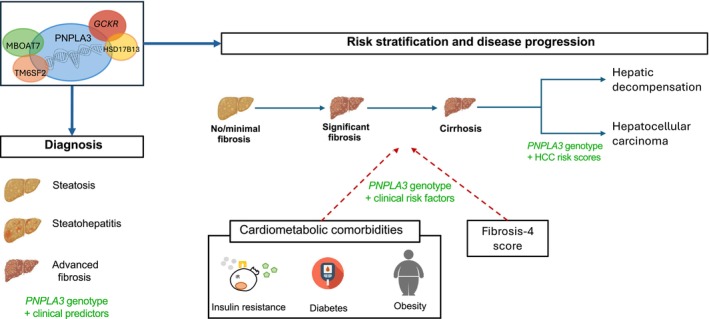
The PNPLA3-rs738409-G variant was the first common variant associated with hepatic fat accumulation and progression of metabolic dysfunction-associated steatotic liver disease (MASLD). Nevertheless, to date, the clinical translation of this discovery has been minimal because it has not yet been clearly demonstrated where the genetic information may play an independent and additional role in clinical risk prediction. In this mini-review, we will discuss the most relevant evidence regarding the potential integration of the PNPLA3 variant into scores and algorithms for liver disease diagnostics and risk stratification, specifically focusing on MASLD but also extending to liver diseases of other etiologies. The PNPLA3 variant adds little in diagnosing the current state of the disease, whether in terms of presence/absence of metabolic dysfunction-associated steatohepatitis or the stage of fibrosis. While it can play an important role in prediction, allowing for the early definition of risk profiles that enable tailored monitoring and interventions over time, this is most valuable when applied to populations with relatively high pre-test probability of having significant fibrosis based on either non-invasive tests (e.g. Fibrosis-4) or demographics (e.g. diabetes). Indeed, in this context, integrating FIB4 with the PNPLA3 genotype can refine risk stratification, though there is still no evidence that genetic information adds to liver stiffness determined by elastography. Similarly, in patients with known liver cirrhosis, knowing the PNPLA3 genotype can play a role in predicting the risk of hepatocellular carcinoma, while more doubts remain about the risk of decompensation.
PNPLA3基因rs738409位点的G变异是首个与肝脏脂肪蓄积及代谢功能障碍相关脂肪性肝病(MASLD)进展相关的常见变异。然而,迄今为止,这一发现的临床转化程度极低,因为尚未明确证明该基因信息在临床风险预测中可发挥独立且额外的作用。在本综述中,我们将讨论关于将PNPLA3变异纳入肝脏疾病诊断及风险分层的评分系统和算法的最相关证据,特别聚焦于MASLD,但也会扩展至其他病因的肝脏疾病。PNPLA3变异在诊断疾病当前状态方面作用不大,无论是代谢功能障碍相关脂肪性肝炎的有无还是纤维化阶段。虽然它在预测中可发挥重要作用,能够早期确定风险概况,以便随着时间推移进行针对性监测和干预,但当应用于基于非侵入性检测(如Fibrosis-4)或人口统计学特征(如糖尿病)具有较高显著纤维化预测试概率的人群时,这才最具价值。实际上,在这种情况下,将FIB4与PNPLA3基因型相结合可优化风险分层,不过仍无证据表明基因信息能增加由弹性成像测定的肝脏硬度。同样,在已知肝硬化的患者中,了解PNPLA3基因型可在预测肝细胞癌风险方面发挥作用,而对于失代偿风险则仍存在更多疑问。