Division of Radiation Oncology, National Cancer Centre, Singapore, Singapore.
Division of Physics and Applied Physics, Nanyang Technological University, Singapore, Singapore.
J Appl Clin Med Phys. 2022 May;23(5):e13560. doi: 10.1002/acm2.13560. Epub 2022 Feb 11.
Respiratory gating is one of the motion management techniques that is used to deliver radiation dose to a tumor at a specific position under free breathing. However, due to the dynamic feedback process of this approach, regular equipment quality assurance (QA) and patient-specific QA checks need to be performed. This work proposes a new QA methodology using electronic portal imaging detector (EPID) to determine the target localization accuracy of phase gating.
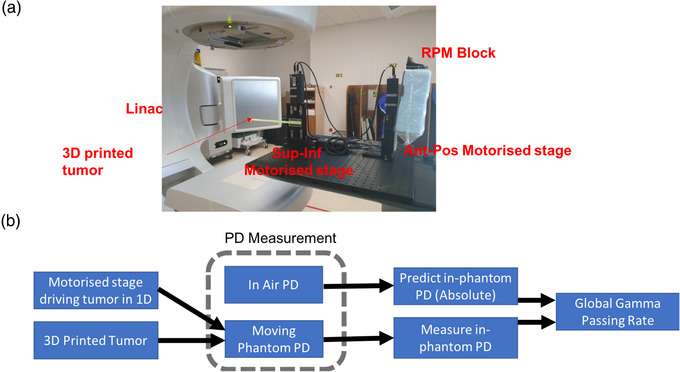
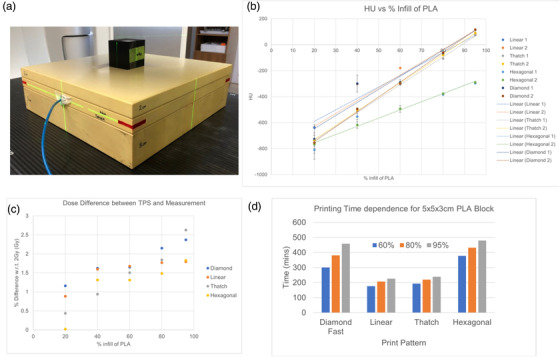
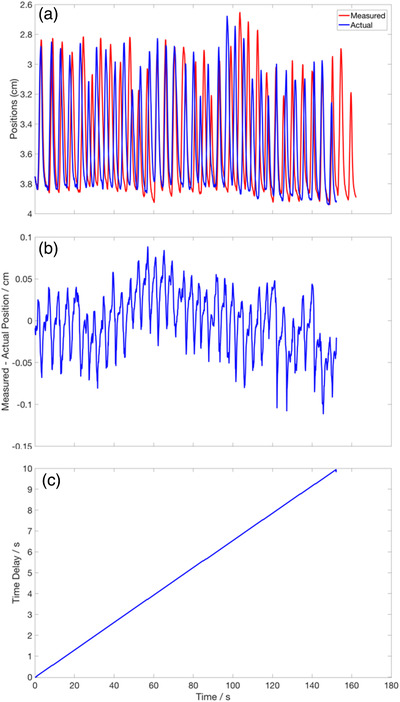
QA tools comprising 3D printed spherical tumor phantoms, programmable stages, and an EPID detector are characterized and assembled. Algorithms for predicting portal dose (PD) through moving phantoms are developed and verified using gamma analysis for two spherical tumor phantoms (2 cm and 4 cm), two different 6 MV volumetric modulated arc therapy plans, and two different gating windows (30%-70% and 40%-60%). Comparison between the two gating windows is then performed using the Wilcoxon signed-rank test. An optimizer routine, which is used to determine the optimal window, based on maximal gamma passing rate (GPR), was applied to an actual breathing curve and breathing plan. This was done to ascertain if our method yielded a similar result with the actual gating window.
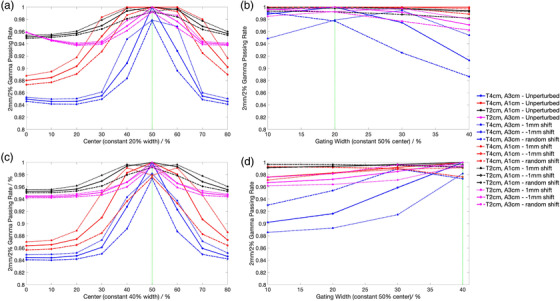
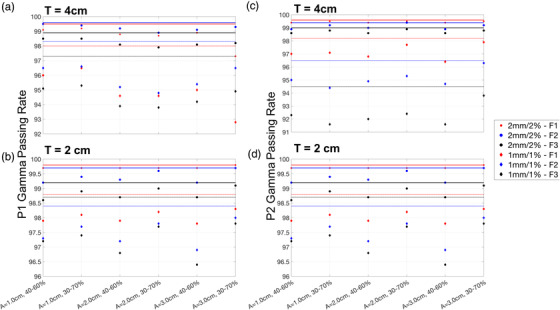
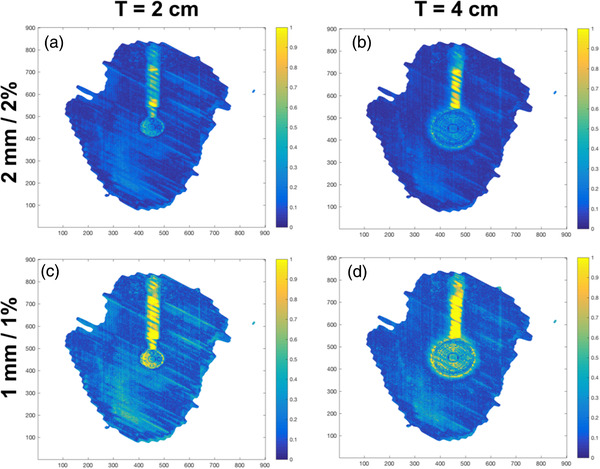
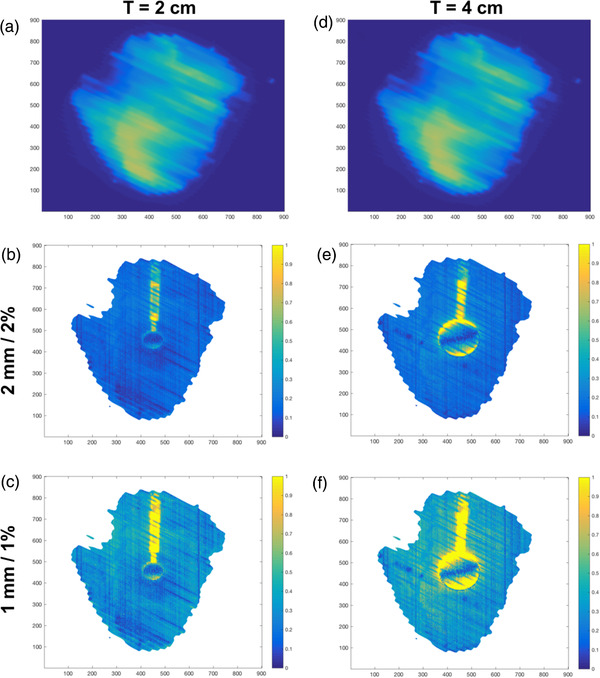
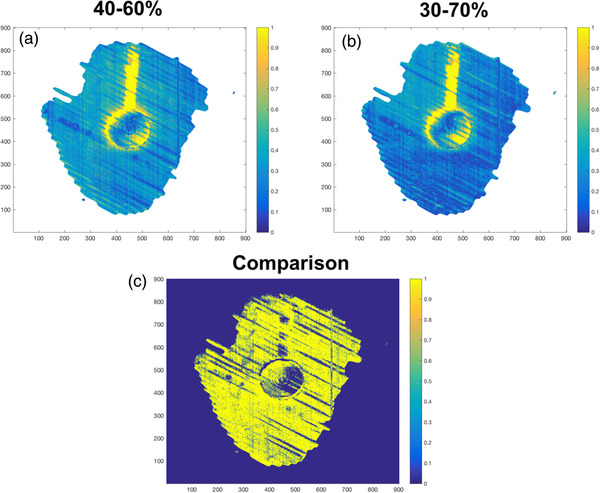
High GPRs of more than 97% and 91% were observed when comparing the predicted PD with the measured PD in moving phantom at 2 mm/2% and 1 mm/1% levels, respectively. Analysis of gamma heatmaps shows an excellent agreement with the tumor phantom. The GPR of 40%-60% PD was significantly lower than that of the 30%-70% PD at the 1 mm/1% level (p = 0.0064). At the 2 mm/2% level, no significant differences were observed. The optimizer routine could accurately predict the center of the gating window to within a 10% range.
We have successfully performed and verified a new method for QA with the use of a moving phantom with EPID for phase gating with real-time position management.
呼吸门控是一种运动管理技术,用于在自由呼吸下将辐射剂量递送至肿瘤的特定位置。然而,由于该方法的动态反馈过程,需要进行常规的设备质量保证(QA)和患者特异性 QA 检查。本工作提出了一种使用电子射野影像装置(EPID)来确定相位门控的靶定位精度的新 QA 方法。
使用 3D 打印的球形肿瘤体模、可编程台架和 EPID 探测器对 QA 工具进行了表征和组装。开发了通过移动体模预测电子射野剂量(PD)的算法,并通过伽马分析对两个球形肿瘤体模(2cm 和 4cm)、两个不同的 6MV 容积调强弧形治疗计划和两个不同的门控窗(30%-70%和 40%-60%)进行了验证。然后使用 Wilcoxon 符号秩检验对两个门控窗进行了比较。应用一种优化程序,根据最大伽马通过率(GPR)来确定最佳窗口,该程序应用于实际呼吸曲线和呼吸计划。这样做是为了确定我们的方法是否与实际门控窗产生相似的结果。
在 2mm/2%和 1mm/1%的水平下,比较移动体模中的预测 PD 与实测 PD 时,观察到 GPR 分别超过 97%和 91%。伽马热图分析显示与肿瘤体模具有极好的一致性。在 1mm/1%的水平下,40%-60%PD 的 GPR 显著低于 30%-70%PD(p=0.0064)。在 2mm/2%的水平下,没有观察到显著差异。优化程序可以准确地预测门控窗的中心在 10%的范围内。
我们已经成功地使用带 EPID 的移动体模进行了相位门控的实时位置管理的 QA 新方法的执行和验证。