Department of Radiation Oncology, The Netherlands Cancer Institute - Antoni van Leeuwenhoek, Amsterdam, The Netherlands.
J Appl Clin Med Phys. 2019 Jun;20(6):79-90. doi: 10.1002/acm2.12610. Epub 2019 May 13.
Despite their availability and simplicity of use, Electronic Portal Imaging Devices (EPIDs) have not yet replaced detector arrays for patient specific QA in 3D. The purpose of this study is to perform a large scale dosimetric evaluation of transit and non-transit EPID dosimetry against absolute dose measurements in 3D.
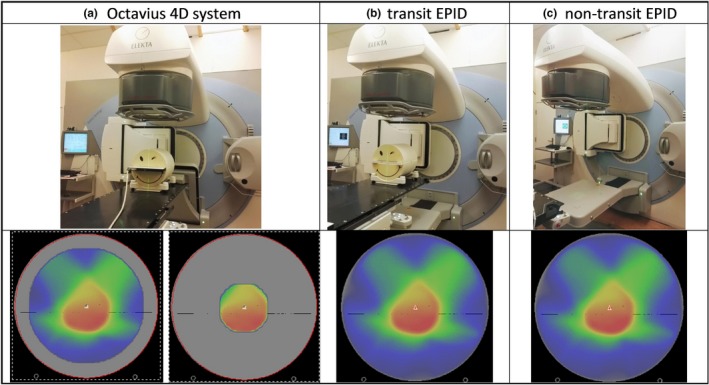
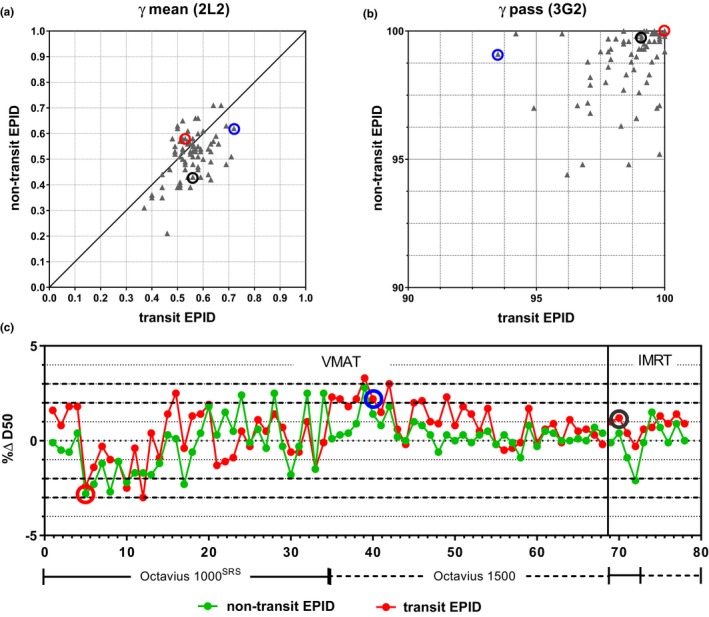
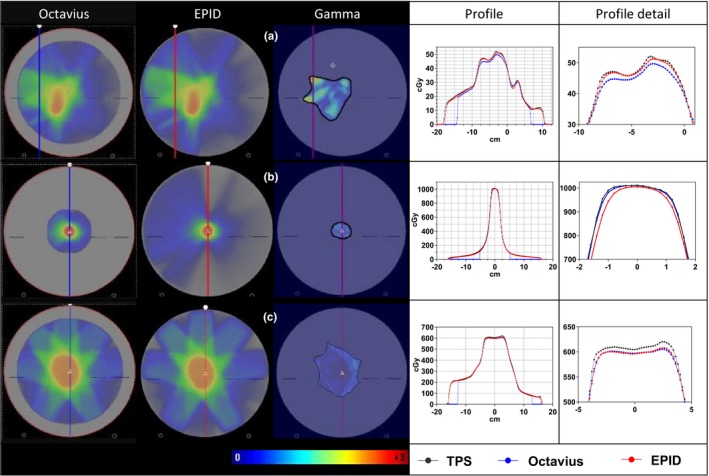
After evaluating basic dosimetric characteristics of the EPID and two detector arrays (Octavius 1500 and Octavius 1000 ), 3D dose distributions for 68 VMAT arcs, and 10 IMRT plans were reconstructed within the same phantom geometry using transit EPID dosimetry, non-transit EPID dosimetry, and the Octavius 4D system. The reconstructed 3D dose distributions were directly compared by γ-analysis (2L2 = 2% local/2 mm and 3G2 = 3% global/2 mm, 50% isodose) and by the percentage difference in median dose to the high dose volume (%∆HDV ).
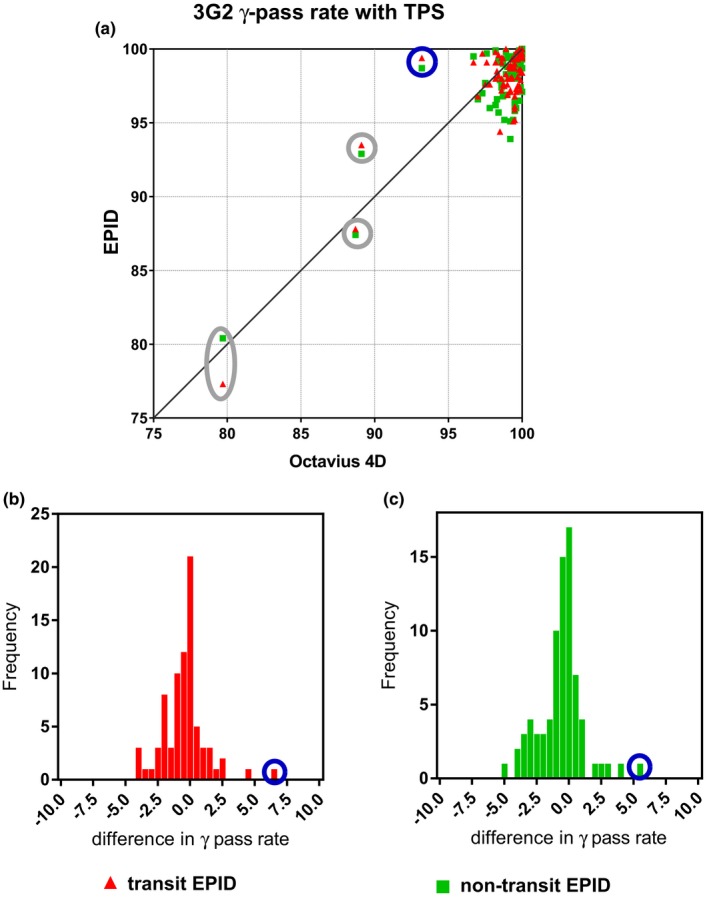
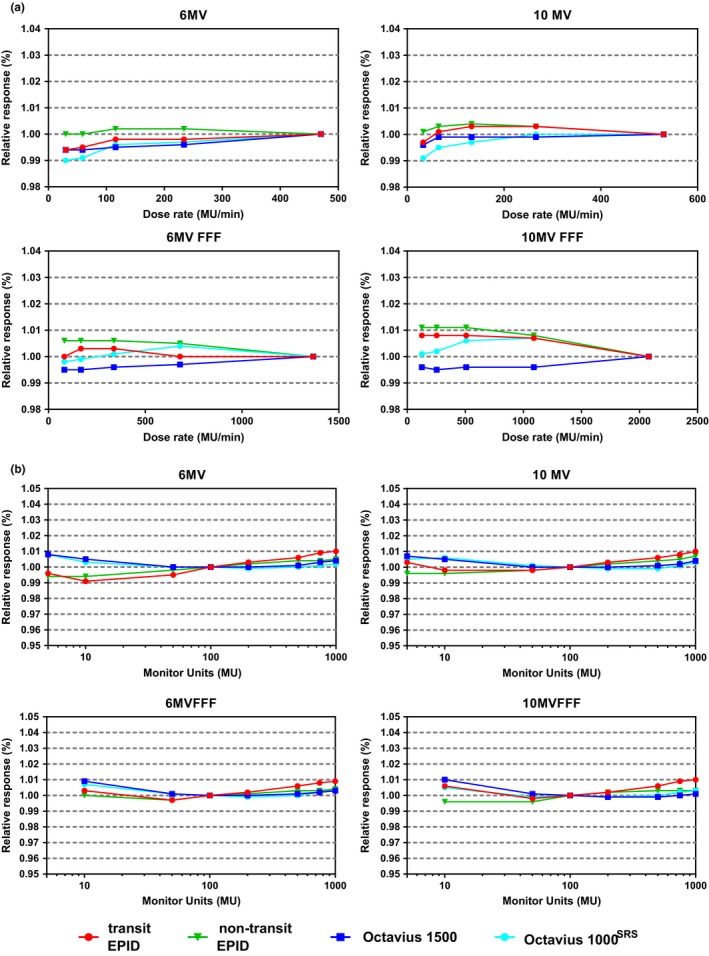
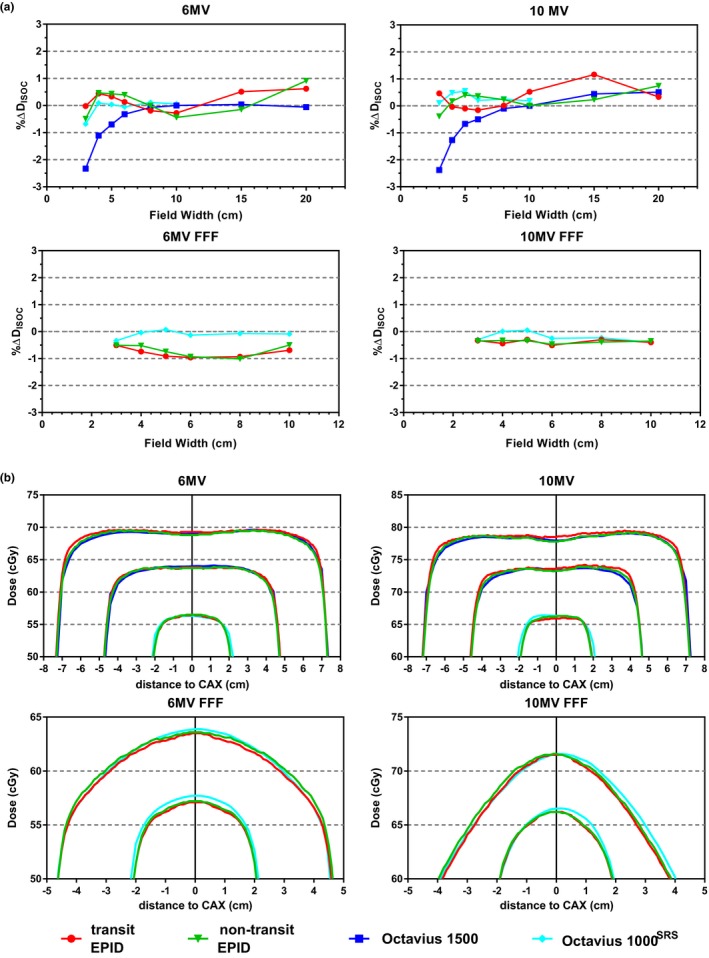
Regarding dose rate dependency, dose linearity, and field size dependence, the agreement between EPID dosimetry and the two detector arrays was found to be within 1.0%. In the 2L2 γ-comparison with Octavius 4D dose distributions, the average γ-pass rate value was 92.2 ± 5.2%(1SD) and 94.1 ± 4.3%(1SD) for transit and non-transit EPID dosimetry, respectively. 3G2 γ-pass rate values were higher than 95% in 150/156 cases. %∆HDV values were within 2% in 134/156 cases and within 3% in 155/156 cases. With regard to the clinical classification of alerts, 97.5% of the treatments were equally classified by EPID dosimetry and Octavius 4D.
Transit and non-transit EPID dosimetry are equivalent in dosimetric terms to conventional detector arrays for patient specific QA. Non-transit 3D EPID dosimetry can be readily used for pre-treatment patient specific QA of IMRT and VMAT, eliminating the need of phantom positioning.
尽管电子射野影像装置(EPID)易于使用且使用方便,但在 3D 中,它们尚未替代探测器阵列进行特定于患者的 QA。本研究的目的是对 3D 中的传输和非传输 EPID 剂量测定与绝对剂量测量进行大规模的剂量评估。
在评估 EPID 和两个探测器阵列(Octavius 1500 和 Octavius 1000)的基本剂量特性后,在相同的体模几何形状中使用传输 EPID 剂量测定、非传输 EPID 剂量测定和 Octavius 4D 系统重建了 68 个 VMAT 弧形和 10 个调强放疗计划的 3D 剂量分布。通过γ分析(2L2=2%局部/2mm 和 3G2=3%全局/2mm,50%等剂量线)和高剂量体积中位数剂量的百分比差异(%∆HDV)直接比较重建的 3D 剂量分布。
关于剂量率依赖性、剂量线性度和射野大小依赖性,发现 EPID 剂量测定与两个探测器阵列之间的一致性在 1.0%以内。在与 Octavius 4D 剂量分布的 2L2γ比较中,传输和非传输 EPID 剂量测定的平均γ通过率值分别为 92.2±5.2%(1SD)和 94.1±4.3%(1SD)。3G2γ通过率值在 150/156 例中高于 95%。在 134/156 例中,%∆HDV 值在 2%以内,在 155/156 例中在 3%以内。关于警报的临床分类,97.5%的治疗方案由 EPID 剂量测定和 Octavius 4D 同样分类。
在特定于患者的 QA 方面,传输和非传输 EPID 剂量测定在剂量学上与传统探测器阵列等效。非传输 3D EPID 剂量测定可用于治疗前的 IMRT 和 VMAT 特定于患者的 QA,无需进行体模定位。