Division of Physical Activity, Prevention and Cancer, National Center for Tumor Diseases (NCT) and German Cancer Research Center (DKFZ), 69120, Heidelberg, Germany.
Psycho-Oncology Service, National Center for Tumor Diseases (NCT) and Department of General Internal and Psychosomatic Medicine, University Hospital Heidelberg, Heidelberg, Germany.
Support Care Cancer. 2022 Jun;30(6):4813-4821. doi: 10.1007/s00520-022-06833-w. Epub 2022 Feb 11.
To investigate cancer patients' knowledge and attitudes regarding fatigue and the potential benefits and acceptability of a brief information booklet.
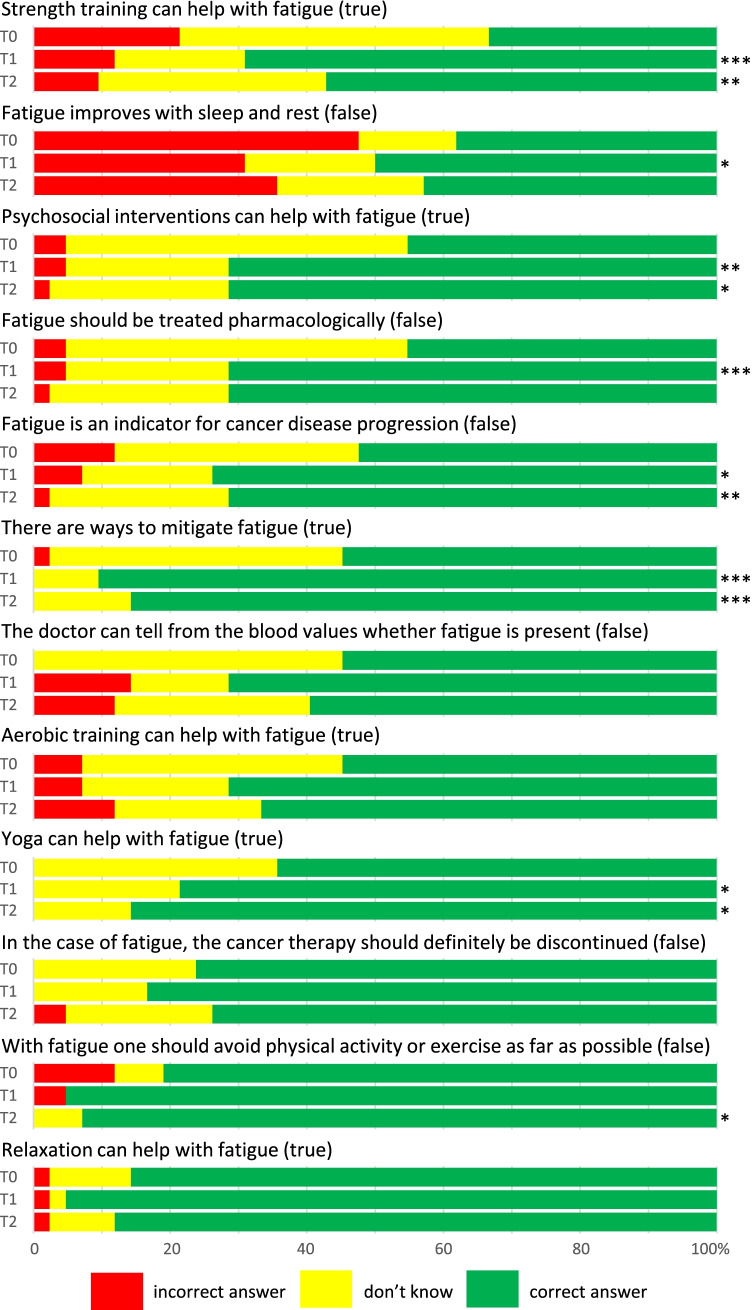
The CARPE DIEM study assessed knowledge and attitudes regarding fatigue in a diverse group of 50 cancer patients before (T0) and about one (T1) and four months (T2) after reading the booklet. At T1, participants additionally rated its usefulness.
At baseline, 37.5% of respondents did not know the term "fatigue" or what it meant. Those who already knew something about fatigue mainly had obtained their information from booklets, books, or articles (63.3%) and/or the internet (46.7%). Overall, knowledge gaps existed, particularly about potential fatigue treatment options and whether fatigue is an indicator of cancer progression. Furthermore, 56.4% felt poorly informed, and 46.1% reported feeling helpless in the face of fatigue. Lower knowledge at baseline was significantly associated with lower education and older age. At T1 and T2, there were significant improvements in several knowledge questions and attitudes. Patient-reported benefits included getting new information about fatigue (91.1%), awareness of not being alone with their problems (89.7%), taking appropriate actions (72.9%), and encouragement to talk about their fatigue with family/friends (55.3%) or with a health professional (52.7%).
Specific gaps were identified in the provision of information and education for cancer patients about fatigue. A low-cost intervention asking to read a brief information booklet was associated with improved knowledge. This could be considered as a first step offered as part of a bundle of further efforts to improve knowledge and care of fatigue.
调查癌症患者对疲劳的知识和态度,以及一本简短信息手册的潜在益处和可接受性。
CARPE DIEM 研究在阅读手册前后约一个月(T1)和四个月(T2),评估了 50 名癌症患者对疲劳的知识和态度。在 T1 时,参与者还对其有用性进行了评分。
在基线时,37.5%的受访者不知道“疲劳”这个术语或其含义。那些已经了解一些疲劳知识的人主要从手册、书籍或文章(63.3%)和/或互联网(46.7%)获得信息。总的来说,知识差距存在,特别是关于潜在的疲劳治疗选择以及疲劳是否是癌症进展的指标。此外,56.4%的人感到信息不足,46.1%的人面对疲劳感到无助。基线时的知识水平较低与教育程度较低和年龄较大显著相关。在 T1 和 T2 时,几个知识问题和态度都有显著改善。患者报告的益处包括获得有关疲劳的新信息(91.1%)、意识到自己并不孤单(89.7%)、采取适当的行动(72.9%)、鼓励与家人/朋友(55.3%)或与健康专业人员(52.7%)谈论疲劳。
在为癌症患者提供有关疲劳的信息和教育方面,存在特定的差距。要求阅读一本简短信息手册的低成本干预措施与知识的提高有关。这可以被视为提供的一系列进一步努力的第一步,以改善疲劳的知识和护理。