Department of Nephrology and Hypertension, Universitätsklinikum Erlangen und Friedrich-Alexander-Universität Erlangen-Nürnberg, Erlangen, Germany.
Institute of Pathology, Universitätsklinikum Erlangen und Friedrich-Alexander-Universität Erlangen-Nürnberg, Erlangen, Germany.
J Biol Chem. 2022 Mar;298(3):101699. doi: 10.1016/j.jbc.2022.101699. Epub 2022 Feb 8.
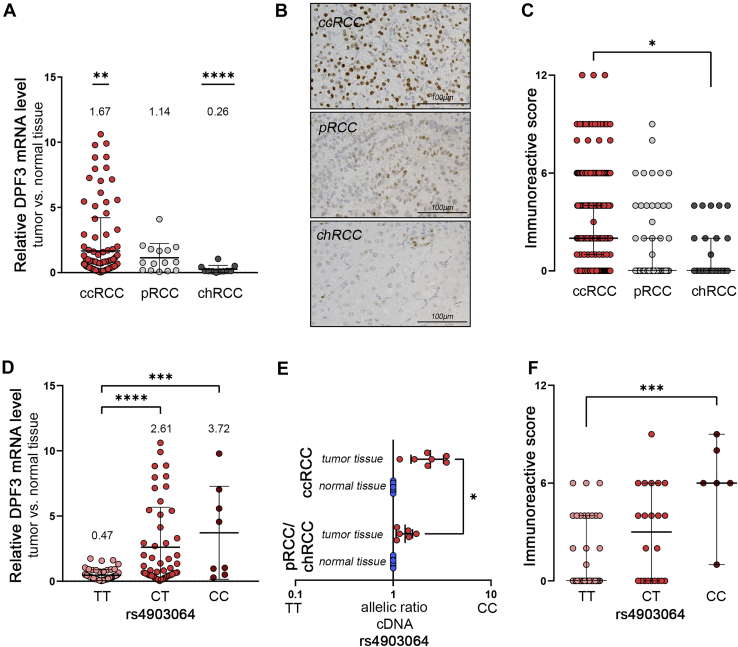
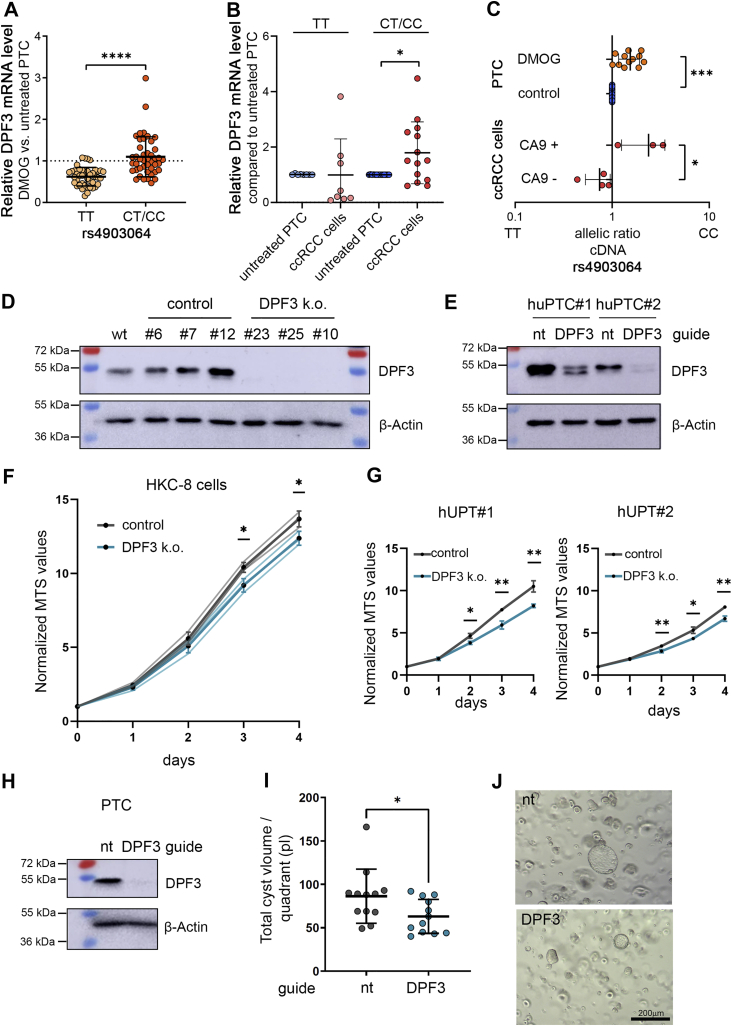
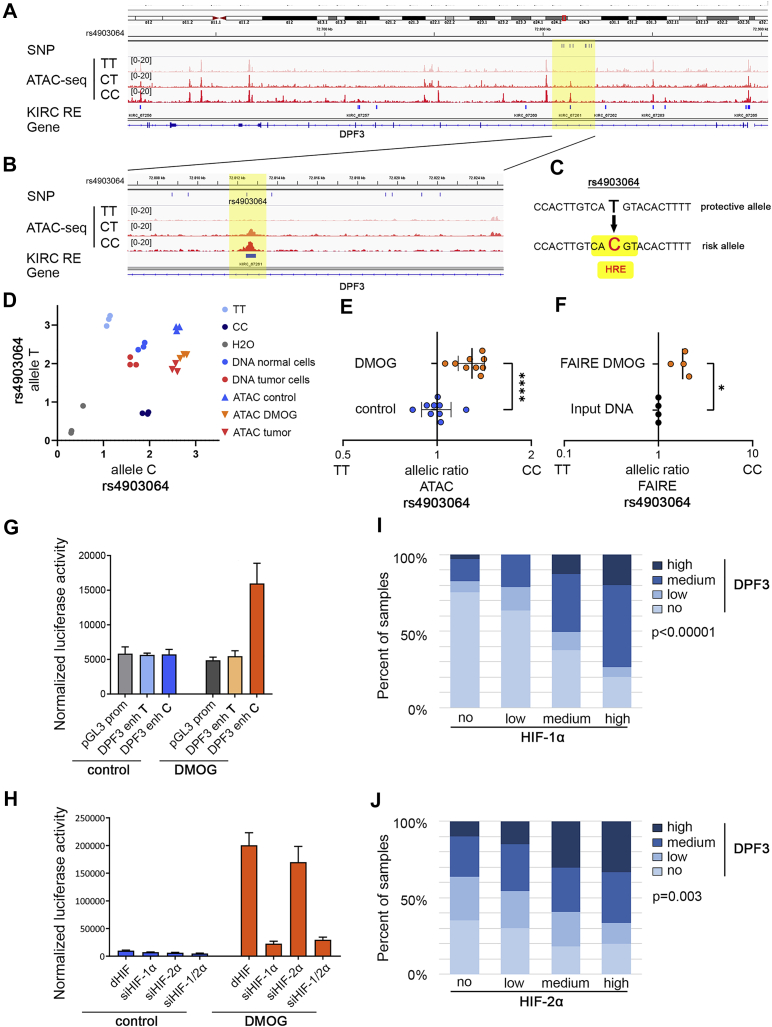
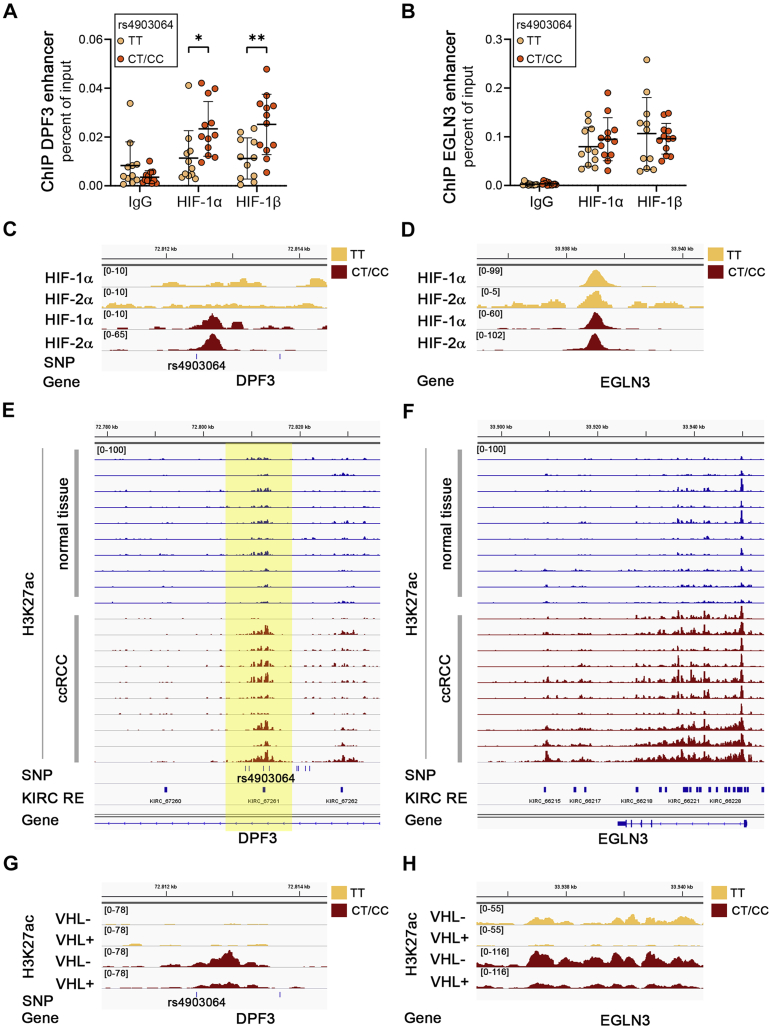
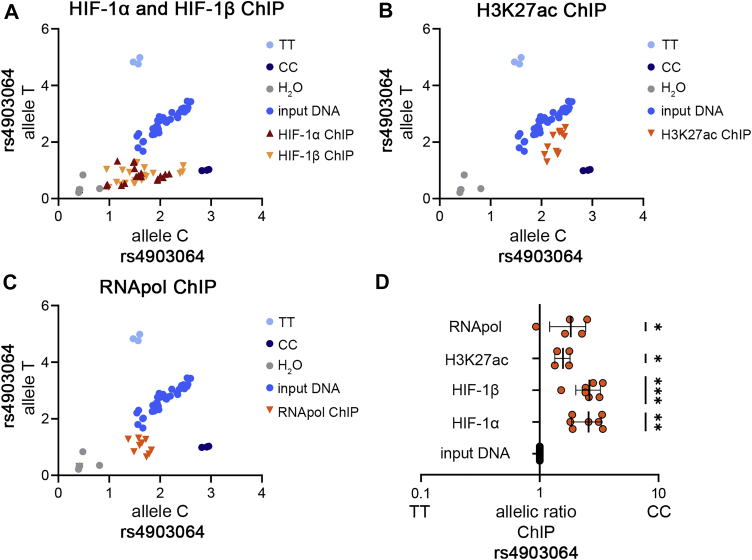
Evolution of clear cell renal cell carcinoma is guided by dysregulation of hypoxia-inducible transcription factor (HIF) pathways following loss of the von Hippel-Lindau tumor suppressor protein. Renal cell carcinoma (RCC)-associated polymorphisms influence HIF-DNA interactions at enhancers of important oncogenes thereby modulating the risk of developing renal cancer. A strong signal of genome-wide association with RCC was determined for the single nucleotide polymorphism (SNP) rs4903064, located on chr14q.24.2 within an intron of DPF3, encoding for Double PHD Fingers 3, a member of chromatin remodeling complexes; however, it is unclear how the risk allele operates in renal cells. In this study, we used tissue specimens and primary renal cells from a large cohort of RCC patients to examine the function of this polymorphism. In clear cell renal cell carcinoma tissue, isolated tumor cells as well as in primary renal tubular cells, in which HIF was stabilized, we determined genotype-specific increases of DPF3 mRNA levels and identified that the risk SNP resides in an active enhancer region, creating a novel HIF-binding motif. We then confirmed allele-specific HIF binding to this locus using chromatin immunoprecipitation of HIF subunits. Consequentially, HIF-mediated DPF3 regulation was dependent on the presence of the risk allele. Finally, we show that DPF3 deletion in proximal tubular cells retarded cell growth, indicating potential roles for DPF3 in cell proliferation. Our analyses suggest that the HIF pathway differentially operates on a SNP-induced hypoxia-response element at 14q24.2, thereby affecting DPF3 expression, which increases the risk of developing renal cancer.
透明细胞肾细胞癌的发生是由于希佩尔-林道肿瘤抑制蛋白失活后,缺氧诱导转录因子(HIF)通路失调所致。肾细胞癌(RCC)相关的多态性影响重要癌基因增强子处的 HIF-DNA 相互作用,从而调节发生肾癌的风险。位于 14q24.2 染色体上的 DPF3 基因内含子中的单核苷酸多态性(SNP)rs4903064 与 RCC 具有很强的全基因组关联信号,该 SNP 编码双 PH 结构域蛋白 3(Double PHD Fingers 3),是染色质重塑复合物的成员;然而,该风险等位基因在肾细胞中的作用尚不清楚。在这项研究中,我们使用来自大量 RCC 患者的组织标本和原代肾细胞来研究该多态性的功能。在透明细胞肾细胞癌组织中,分离的肿瘤细胞以及在 HIF 稳定的原代肾小管细胞中,我们确定了 DP3F mRNA 水平的基因型特异性增加,并确定风险 SNP 位于一个活跃的增强子区域,创建了一个新的 HIF 结合基序。然后,我们使用 HIF 亚基的染色质免疫沉淀来证实该基因座的等位基因特异性 HIF 结合。因此,HIF 介导的 DP3F 调节依赖于风险等位基因的存在。最后,我们表明近端肾小管细胞中 DP3F 的缺失会减缓细胞生长,表明 DP3F 在细胞增殖中可能发挥作用。我们的分析表明,HIF 通路在 14q24.2 上的 SNP 诱导的低氧反应元件上以不同的方式起作用,从而影响 DP3F 的表达,增加发生肾癌的风险。