Cancer Vaccine Development Division, Research Center for Innovative Cancer Therapy, Kurume University, Kurume, Fukuoka, 830-0011, Japan.
Department of Pathology, Kurume University School of Medicine, Kurume, Fukuoka, 830-0011, Japan.
Med Oncol. 2022 Feb 12;39(5):58. doi: 10.1007/s12032-022-01659-2.
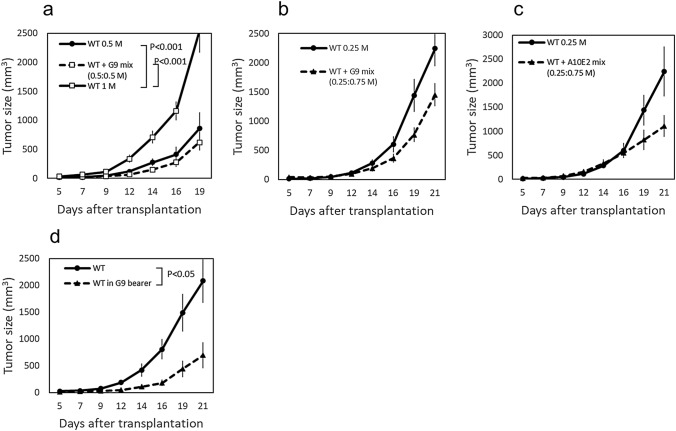
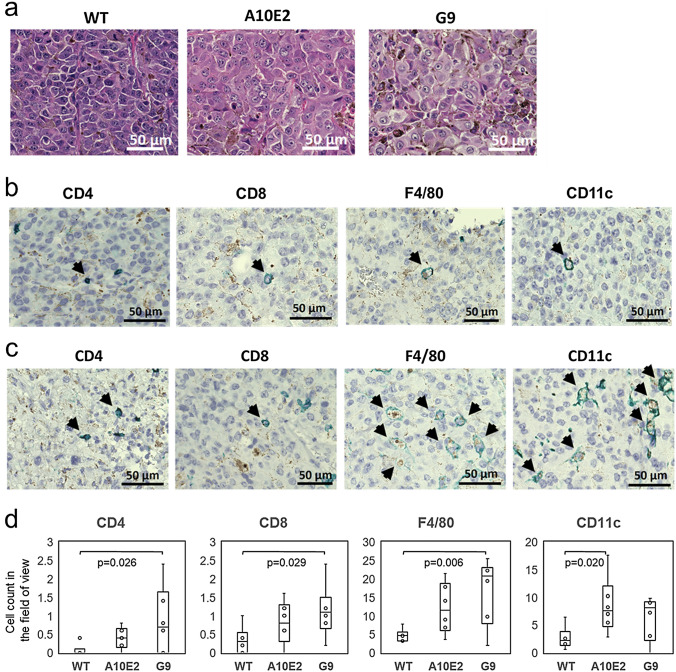
High-mobility group box 1 (HMGB1) has been reported as a damage-associated molecular pattern (DAMP) molecule that is released from damaged or dead cells and induces inflammation and subsequent innate immunity. However, the role of HMGB1 in the anti-tumor immunity is unclear since inflammation in the tumor microenvironment also contributes to tumor promotion and progression. In the present study, we established HMGB1-knockout clones from B16F10 and CT26 murine tumors by genome editing using the CRISPR/Cas9 system and investigated the role of HMGB1 in anti-tumor immunity. We found that (1) knockout of HMGB1 in the tumor cells suppressed in vivo, but not in vitro, tumor growth, (2) the suppression of the in vivo tumor growth was mediated by CD8 T cells, and (3) infiltration of CD8 T cells, macrophages and dendritic cells into the tumor tissues was accelerated in HMGB1-knockout tumors. These results demonstrated that knockout of HMGB1 in tumor cells converted tumors from poor infiltration of immune cells called "cold" to "immune-inflamed" or "hot" and inhibited in vivo tumor growth mediated by cytotoxic T lymphocytes. Infiltration of immune cells to the tumor microenvironment is an important step in the series known as the cancer immunity cycle. Thus, manipulation of tumor-derived HMGB1 might be applicable to improve the clinical outcomes of cancer immunotherapies, including immune checkpoint blockades and cancer vaccine therapies.
高迁移率族蛋白 B1(HMGB1)已被报道为一种损伤相关分子模式(DAMP)分子,它从受损或死亡的细胞中释放出来,诱导炎症和随后的固有免疫。然而,HMGB1 在抗肿瘤免疫中的作用尚不清楚,因为肿瘤微环境中的炎症也有助于肿瘤的促进和进展。在本研究中,我们使用 CRISPR/Cas9 系统对 B16F10 和 CT26 两种鼠肿瘤进行基因组编辑,建立了 HMGB1 敲除克隆,并研究了 HMGB1 在抗肿瘤免疫中的作用。我们发现:(1)肿瘤细胞中 HMGB1 的敲除抑制了体内肿瘤的生长,但不影响体外肿瘤的生长;(2)体内肿瘤生长的抑制是由 CD8 T 细胞介导的;(3)HMGB1 敲除肿瘤组织中 CD8 T 细胞、巨噬细胞和树突状细胞的浸润加速。这些结果表明,肿瘤细胞中 HMGB1 的敲除将肿瘤从免疫细胞浸润不良的“冷肿瘤”转化为“免疫炎症”或“热肿瘤”,并抑制了由细胞毒性 T 淋巴细胞介导的体内肿瘤生长。免疫细胞浸润肿瘤微环境是癌症免疫循环这一系列过程中的重要步骤。因此,对肿瘤源性 HMGB1 的操纵可能适用于改善癌症免疫疗法的临床疗效,包括免疫检查点阻断和癌症疫苗治疗。