Department of Urology, Selcuk University School of Medicine, Konya, Turkey.
Center for Psychology, Faculty of Psychology and Educational Sciences, University of Porto, Porto, Portugal.
Int J Impot Res. 2022 Mar;34(2):152-157. doi: 10.1038/s41443-022-00540-0. Epub 2022 Feb 12.
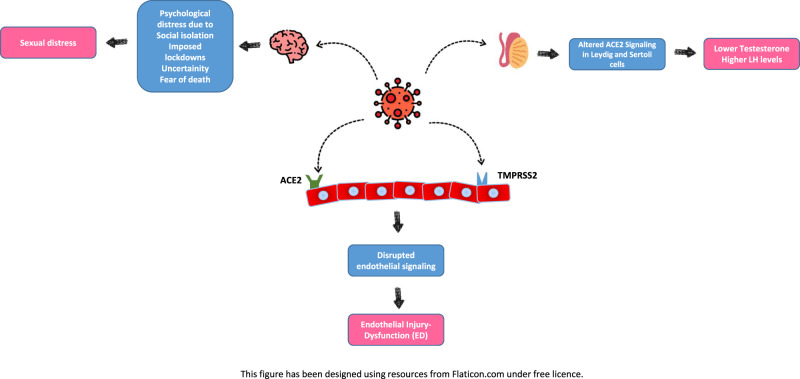
The novel severe acute respiratory syndrome coronavirus 2 caused the coronavirus 2019 (COVID-19) pandemic that resulted in more than 150 million infections and 3.5 million deaths globally. COVID-19 affected men more than women, emerging with more severe disease and higher mortality rates. Androgens may be responsible for the underlying reason of more severe disease, as androgen receptors have been implicated to mediate viral cell entry and infection. Besides, male reproductive organs have been reported to be affected by the especially severe disease, resulting in erectile dysfunction (ED). In this narrative review, we aimed to gather possible mechanisms of the development of ED led by COVID-19. Current evidence illuminates endothelial dysfunction, direct testicular damage, and the psychological burden of COVID-19 that are of the pathways of ED. Although the proposed underlying mechanisms partly fail to answer the questions by which COVID-19 leads to ED, it is important to monitor men who recovered from COVID-19 regarding the sexual dysfunction sequelae of infection and address the long-term consequences.
新型严重急性呼吸综合征冠状病毒 2 引起了 2019 年冠状病毒病(COVID-19)大流行,导致全球超过 1.5 亿人感染和 350 万人死亡。COVID-19 对男性的影响大于女性,出现更严重的疾病和更高的死亡率。雄激素可能是导致疾病更严重的根本原因,因为雄激素受体被认为介导病毒细胞进入和感染。此外,据报道男性生殖器官也受到这种特别严重疾病的影响,导致勃起功能障碍(ED)。在这篇叙述性综述中,我们旨在收集 COVID-19 导致 ED 发展的可能机制。现有证据表明,内皮功能障碍、直接睾丸损伤和 COVID-19 的心理负担是 ED 的途径。虽然提出的潜在机制部分未能回答 COVID-19 导致 ED 的问题,但重要的是要监测从 COVID-19 中康复的男性,了解感染引起的性功能障碍后遗症,并解决长期后果。