Liu Xinyi, Li Yanhua, Wang Xin, Song Yifan, Wu Lina, Yu Benyuan, Ma Xiaodong, Ma Peixiang, Liu Ming, Huang Xingxu, Wang Xinjie
Shenzhen Branch, Guangdong Laboratory of Lingnan Modern Agriculture, Genome Analysis Laboratory of the Ministry of Agriculture and Rural Affairs, Agricultural Genomics Institute at Shenzhen, Chinese Academy of Agricultural Sciences, Shenzhen, China.
Guangzhou Laboratory, Bio-Island, Guangzhou, China.
Front Microbiol. 2022 Jan 28;12:820698. doi: 10.3389/fmicb.2021.820698. eCollection 2021.
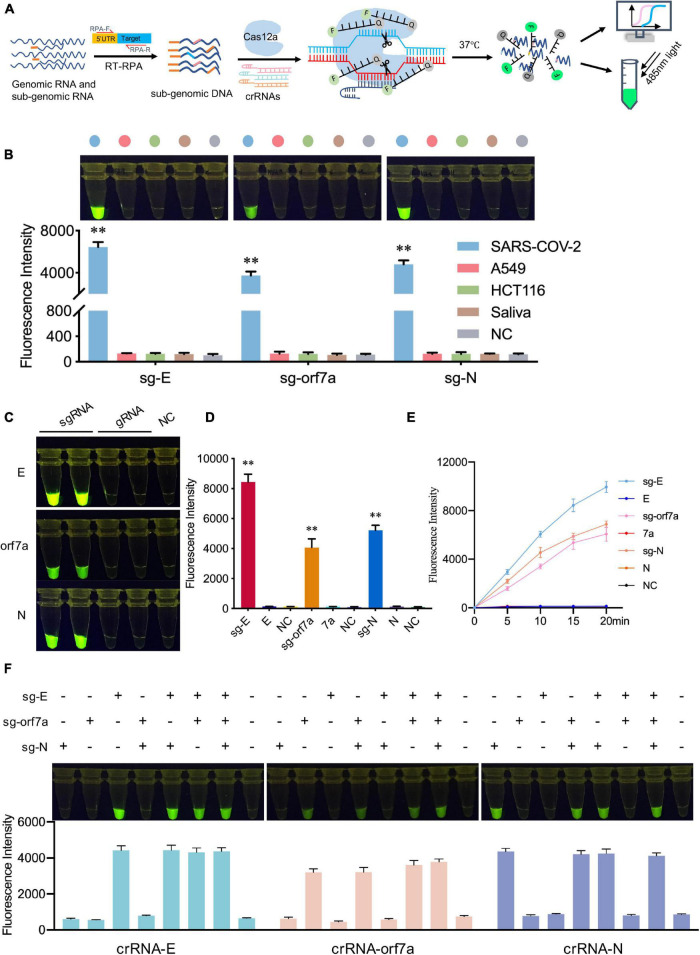
Rapid and sensitive nucleic acid detection of SARS-CoV-2 has contributed to the clinical diagnosis and control of COVID-19. Although detection of virus genomic RNA (gRNA) has been commonly used in clinical diagnosis, SARS-CoV-2 gRNA detection could not discriminate between active infectious virus with remnant viral RNA. In contrast to genomic RNA, subgenomic RNAs (sgRNAs) are only produced when the virus is actively replicating and transcription, detection of sgRNA could be an indication to evaluate infectivity. CRISPR/Cas-based nucleic acid detection methods have been considered potential diagnostic tools due to their intrinsic sensitivity, specificity and simplicity. In this study, to specifically detect active virus replication, we developed a CRISPR-based active SARS-CoV-2 (CRISPR-actCoV) detection strategy by detecting sgRNAs of SARS-CoV-2. CRISPR-actCoV with CRISPR Cas12a-assisted fluorescence reporter system enables detection of sgRNAs at 10 copies in 35 min with high specificity and can be read out with naked eyes. Further, we performed CRISPR-actCoV mediated sgRNA detection in 30 SARS-CoV-2 potentially infected clinical samples, and 21 samples were SARS-CoV-2 sgRNA positive. A quantitative RT-PCR assay was also performed to detect gRNA of SARS-CoV-2 in parallel. Among the 30 clinical samples, 27 samples were gRNA positive. Taken together, CRISPR-actCoV provides an alternative for rapid and accurate detection of active SARS-CoV-2 and has great significance in better response of coronavirus causing epidemic disease.
严重急性呼吸综合征冠状病毒2(SARS-CoV-2)的快速灵敏核酸检测有助于2019冠状病毒病(COVID-19)的临床诊断和防控。虽然病毒基因组RNA(gRNA)检测已普遍应用于临床诊断,但SARS-CoV-2 gRNA检测无法区分携带残留病毒RNA的活性感染性病毒。与基因组RNA不同,亚基因组RNA(sgRNA)仅在病毒活跃复制和转录时产生,检测sgRNA可能是评估传染性的一个指标。基于CRISPR/Cas的核酸检测方法因其固有的灵敏度、特异性和简便性而被视为潜在的诊断工具。在本研究中,为了特异性检测活性病毒复制,我们通过检测SARS-CoV-2的sgRNA开发了一种基于CRISPR的活性SARS-CoV-2(CRISPR-actCoV)检测策略。具有CRISPR Cas12a辅助荧光报告系统的CRISPR-actCoV能够在35分钟内检测到10个拷贝的sgRNA,具有高特异性,且可肉眼读取结果。此外,我们在30份SARS-CoV-2潜在感染临床样本中进行了CRISPR-actCoV介导的sgRNA检测,其中21份样本SARS-CoV-2 sgRNA呈阳性。同时还进行了定量逆转录聚合酶链反应(RT-PCR)检测以并行检测SARS-CoV-2的gRNA。在这30份临床样本中,27份样本gRNA呈阳性。综上所述,CRISPR-actCoV为快速准确检测活性SARS-CoV-2提供了一种替代方法,对更好应对引起流行病的冠状病毒具有重要意义。