Schultz Bárbara M, Acevedo Orlando A, Kalergis Alexis M, Bueno Susan M
Millennium Institute on Immunology and Immunotherapy, Facultad de Ciencias Biológicas, Pontificia Universidad Católica de Chile, Santiago, Chile.
Departamento de Endocrinología, Facultad de Medicina, Pontificia Universidad Católica de Chile, Santiago, Chile.
Front Microbiol. 2022 Jan 26;13:798853. doi: 10.3389/fmicb.2022.798853. eCollection 2022.
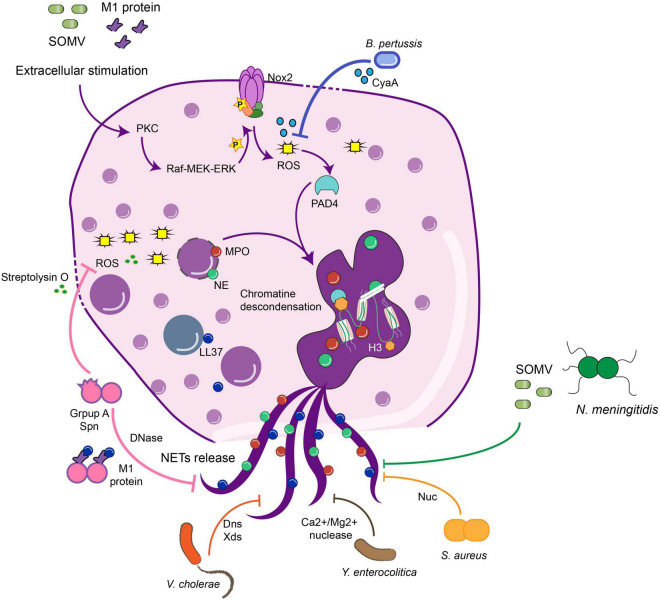
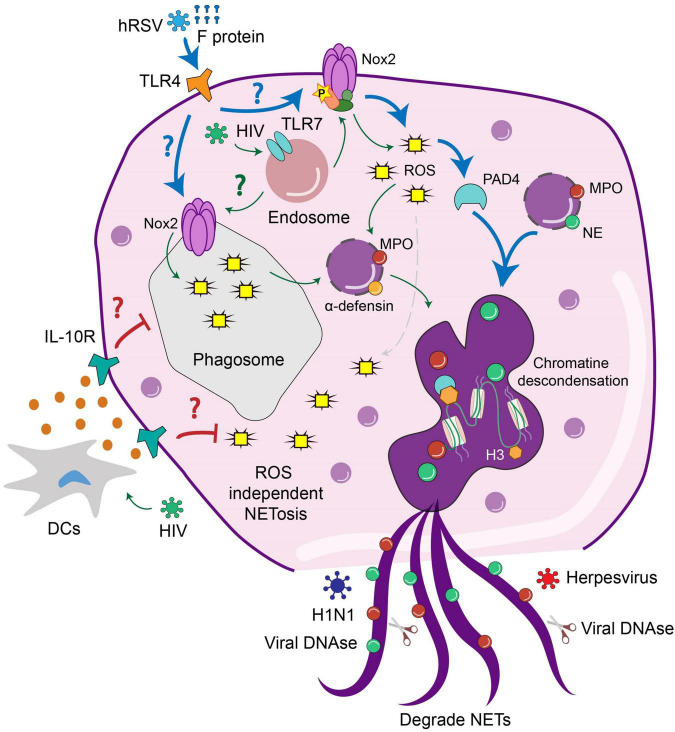
Neutrophils are innate immune cells that play an essential role during the clearance of pathogens that can release chromatin structures coated by several cytoplasmatic and granular antibacterial proteins, called neutrophil extracellular traps (NETs). These supra-molecular structures are produced to kill or immobilize several types of microorganisms, including bacteria and viruses. The contribution of the NET release process (or NETosis) to acute inflammation or the prevention of pathogen spreading depends on the specific microorganism involved in triggering this response. Furthermore, studies highlight the role of innate cells different from neutrophils in triggering the release of extracellular traps during bacterial infection. This review summarizes the contribution of NETs during bacterial and viral infections, explaining the molecular mechanisms involved in their formation and the relationship with different components of such pathogens.
中性粒细胞是先天性免疫细胞,在清除病原体过程中发挥重要作用,这些病原体可释放被多种细胞质和颗粒性抗菌蛋白包裹的染色质结构,即中性粒细胞胞外诱捕网(NETs)。这些超分子结构的产生是为了杀死或固定多种类型的微生物,包括细菌和病毒。NET释放过程(或NETosis)对急性炎症或防止病原体传播的作用取决于引发这种反应的特定微生物。此外,研究强调了不同于中性粒细胞的先天性细胞在细菌感染期间触发细胞外诱捕网释放中的作用。本综述总结了NETs在细菌和病毒感染中的作用,解释了其形成所涉及的分子机制以及与这些病原体不同成分的关系。