Lin Shoukai, Lin Dahe, Wu Bisha, Ma Shiwei, Sun Shengfeng, Zhang Ting, Zhang Wenting, Bai Yunlu, Wang Qiong, Wu Jincheng
College of Environmental and Biological Engineering, Putian University, Putian, China.
Fujian Provincial Key Laboratory of Ecology-Toxicological Effects & Control for Emerging Contaminants, Putian University, Putian, China.
Front Plant Sci. 2022 Jan 27;13:823993. doi: 10.3389/fpls.2022.823993. eCollection 2022.
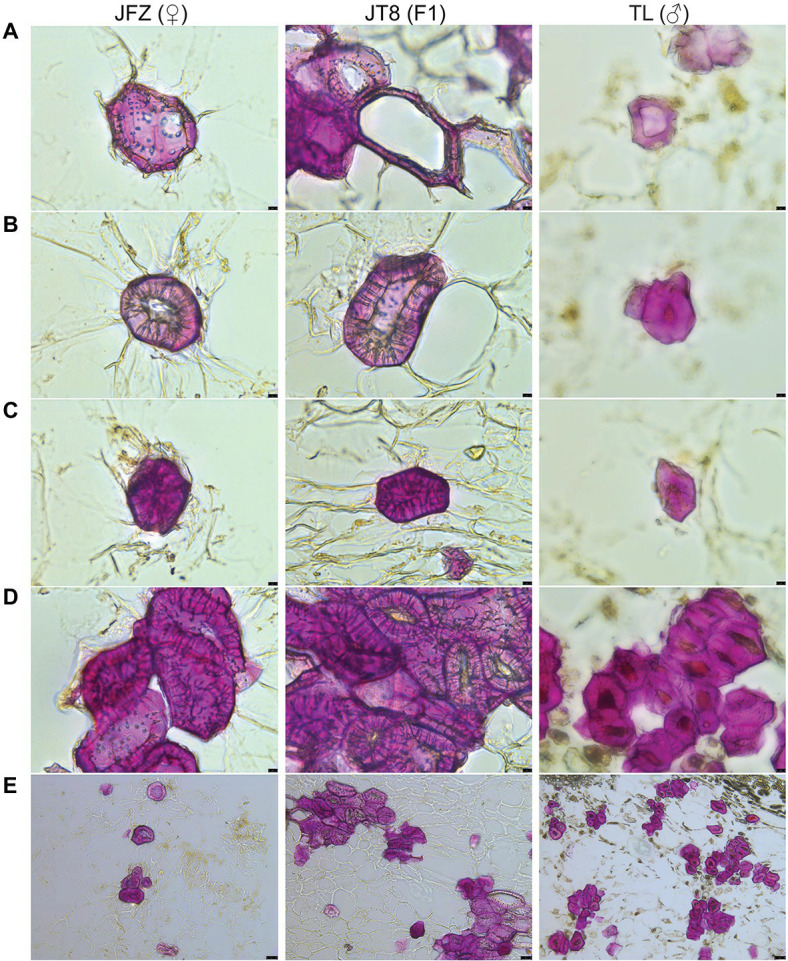
Some members of the family, particularly pear, contain stone cells in their fruits. Although stone cells in pear fruits are well studied, relatively little attention has been given to loquat stone cells. Only a few reports have suggested a relationship between stone cell traits and storage and transport tolerance of loquat fruits. Previously, we generated the variety JT8 from the interspecific hybrid of the loquat cultivar Jiefangzhong (JFZ; Lindl. cv. Jiefangzhong, female parent) and wild Taiwanese loquat (TL; Nakai, male parent). The JT8 fruits had a granular feel, similar to that of pear fruits, due to the presence of stone cells. In this study, the shape, size, development, and distribution dynamics of stone cells of plants were thoroughly investigated. The results showed that loquat stone cells are brachysclereids and often contain typical branching pits. Loquat stone cells were distributed as both single stone cells and in stone cell clusters (SCCs), and the density of the stone cells near the core was higher than that near the peel. Stone cell density first increased and then decreased during fruit development. These traits noted in were very similar to those observed in pear, indicating a close relationship between loquat and pear. Moreover, the contents, density dynamics, and aggregation traits of stone cells of the interspecific hybrid JT8 were derived from the male parent (TL). Transgressive segregation was likely exhibited in the content of stone cells and the size of the SCCs. More specifically, the content of stone cells reached 1.61% (w/w). In extreme cases, SCCs of JT8 exceeded 1,000 μm in length and 500 μm in width. This demonstrated that stone cell traits could be transmitted from parent to progeny through interspecific hybridization. The density dynamics of stone cells in two loquat cultivars with different storage and transport tolerances were also investigated, which indicated that the cultivar with more stone cells was more tolerant to storage and transport. We suggest that wild loquat genetic resources containing stone cells in plants can be used to gradually improve the storage and transport tolerance of loquat fruits.
蔷薇科的一些成员,特别是梨,其果实中含有石细胞。尽管对梨果实中的石细胞已有深入研究,但对枇杷石细胞的关注相对较少。仅有少数报道指出石细胞性状与枇杷果实贮藏和运输耐受性之间的关系。此前,我们通过枇杷品种解放钟(JFZ;Lindl. cv. Jiefangzhong,母本)与野生台湾枇杷(TL;Nakai,父本)的种间杂交培育出了品种JT8。由于存在石细胞,JT8果实有颗粒感,类似于梨果实。在本研究中,对该品种植物石细胞的形状、大小、发育及分布动态进行了全面研究。结果表明,枇杷石细胞为短石细胞,常含有典型的分枝纹孔。枇杷石细胞以单个石细胞和石细胞团(SCCs)的形式分布,果核附近的石细胞密度高于果皮附近。果实发育过程中,石细胞密度先增加后降低。这些在JT8中观察到的性状与梨中观察到的非常相似,表明枇杷与梨关系密切。此外,种间杂种JT8石细胞的含量、密度动态及聚集性状均来源于父本(TL)。石细胞含量和SCCs大小可能表现出超亲分离。具体而言,石细胞含量达到1.61%(w/w)。在极端情况下,JT8的SCCs长度超过1000μm,宽度超过500μm。这表明石细胞性状可通过种间杂交从亲本传递给后代。还研究了两个贮藏和运输耐受性不同的枇杷品种石细胞的密度动态,结果表明石细胞较多的品种更耐贮藏和运输。我们建议,含有石细胞的野生枇杷遗传资源可用于逐步提高枇杷果实的贮藏和运输耐受性。