Aliberti Gianna M, Bhatia Roma, Desrochers Laura B, Gilliam Elizabeth A, Schonberg Mara A
Beth Israel Deaconess Medical Center, Harvard Medical School, Boston, MA, USA.
Prev Med Rep. 2022 Apr;26:101729. doi: 10.1016/j.pmedr.2022.101729. Epub 2022 Feb 8.
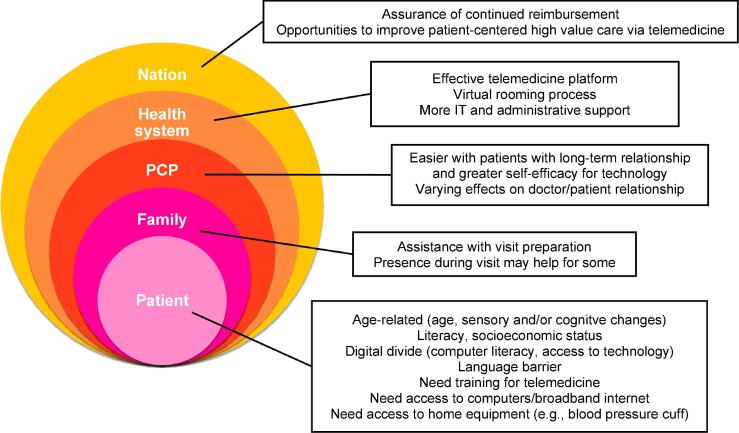
To learn how to improve telemedicine for adults >65, we asked primary care clinicians ("PCPs") affiliated with one large Boston-area health system their views on using telemedicine (which included phone-only or video visits) with adults >65 during the COVID-19 pandemic. In open-ended questions, we asked PCPs to describe any challenges or useful experiences with telemedicine and suggestions for improving telemedicine as part of a larger web-based survey conducted between September 2020 and February 2021. Overall, 163/383 (42%) PCPs responded to the survey. Of these, 114 (70%) completed at least one open-ended question, 85% were non-Hispanic white, 59% were female, 75% were community-based, and 75% were in practice >20 years. We identified three major themes in participants' comments including the need to optimize telemedicine; integrate telemedicine within primary care; and that PCPs had disparate attitudes towards telemedicine for older adults. To optimize telemedicine, PCPs recommended more effective digital platforms, increased utilization of home medical equipment (e.g., blood pressure cuffs), and better coordination with caregivers. For integration, PCPs recommended targeting telemedicine for certain types of visits (e.g., chronic disease management), enabling video access, and reducing administrative burdens on PCPs. As for PCP attitudes, some felt telemedicine enhanced the doctor-patient relationship, improved the patient experience, and improved show rates. Others felt that telemedicine visits were incomplete without a physical exam, were less rewarding, and could be frustrating. Overall, PCPs saw a role for telemedicine in older adults' care but felt that more support is needed for these visits than currently offered.
为了了解如何改善针对65岁以上成年人的远程医疗服务,我们询问了隶属于波士顿地区一个大型医疗系统的基层医疗临床医生(“PCP”),他们对于在新冠疫情期间对65岁以上成年人使用远程医疗(包括仅通过电话或视频问诊)的看法。在开放式问题中,我们要求基层医疗临床医生描述他们在远程医疗方面遇到的任何挑战或有用经验,以及作为2020年9月至2021年2月期间开展的一项更大规模网络调查的一部分,对改善远程医疗的建议。总体而言,163/383(42%)的基层医疗临床医生回复了该调查。其中,114名(70%)至少完成了一个开放式问题,85%为非西班牙裔白人,59%为女性,75%为社区医疗从业者,75%有超过20年的从业经验。我们在参与者的评论中确定了三个主要主题,包括优化远程医疗的必要性;将远程医疗整合到基层医疗中;以及基层医疗临床医生对老年人远程医疗的态度不一。为了优化远程医疗,基层医疗临床医生建议采用更有效的数字平台,增加家用医疗设备(如血压计)的使用,并更好地与护理人员协调。对于整合方面,基层医疗临床医生建议针对特定类型的问诊(如慢性病管理)开展远程医疗,实现视频问诊,并减轻基层医疗临床医生的行政负担。至于基层医疗临床医生的态度,一些人认为远程医疗加强了医患关系,改善了患者体验,并提高了就诊率。另一些人则认为,没有体格检查的远程医疗问诊是不完整的,回报较低,而且可能令人沮丧。总体而言,基层医疗临床医生认为远程医疗在老年人护理中可以发挥作用,但觉得这些问诊目前所需的支持比现有的更多。