Center for Drug Safety and Effectiveness, Johns Hopkins Bloomberg School of Public Health, Baltimore, Maryland.
Department of Epidemiology, Johns Hopkins Bloomberg School of Public Health, Baltimore, Maryland.
JAMA Netw Open. 2020 Oct 1;3(10):e2021476. doi: 10.1001/jamanetworkopen.2020.21476.
Little is known about the association between the coronavirus disease 2019 (COVID-19) pandemic and the level and content of primary care delivery in the US.
To quantify national changes in the volume, type, and content of primary care delivered during the COVID-19 pandemic, especially with regard to office-based vs telemedicine encounters.
DESIGN, SETTING, AND PARTICIPANTS: Analysis of serial cross-sectional data from the IQVIA National Disease and Therapeutic Index, a 2-stage, stratified nationally representative audit of outpatient care in the US from the first calendar quarter (Q1) of 2018 to the second calendar quarter (Q2) of 2020.
Visit type (office-based or telemedicine), overall and stratified by patient population and geographic region; assessment of blood pressure or cholesterol measurement; and initiation or continuation of prescription medications.
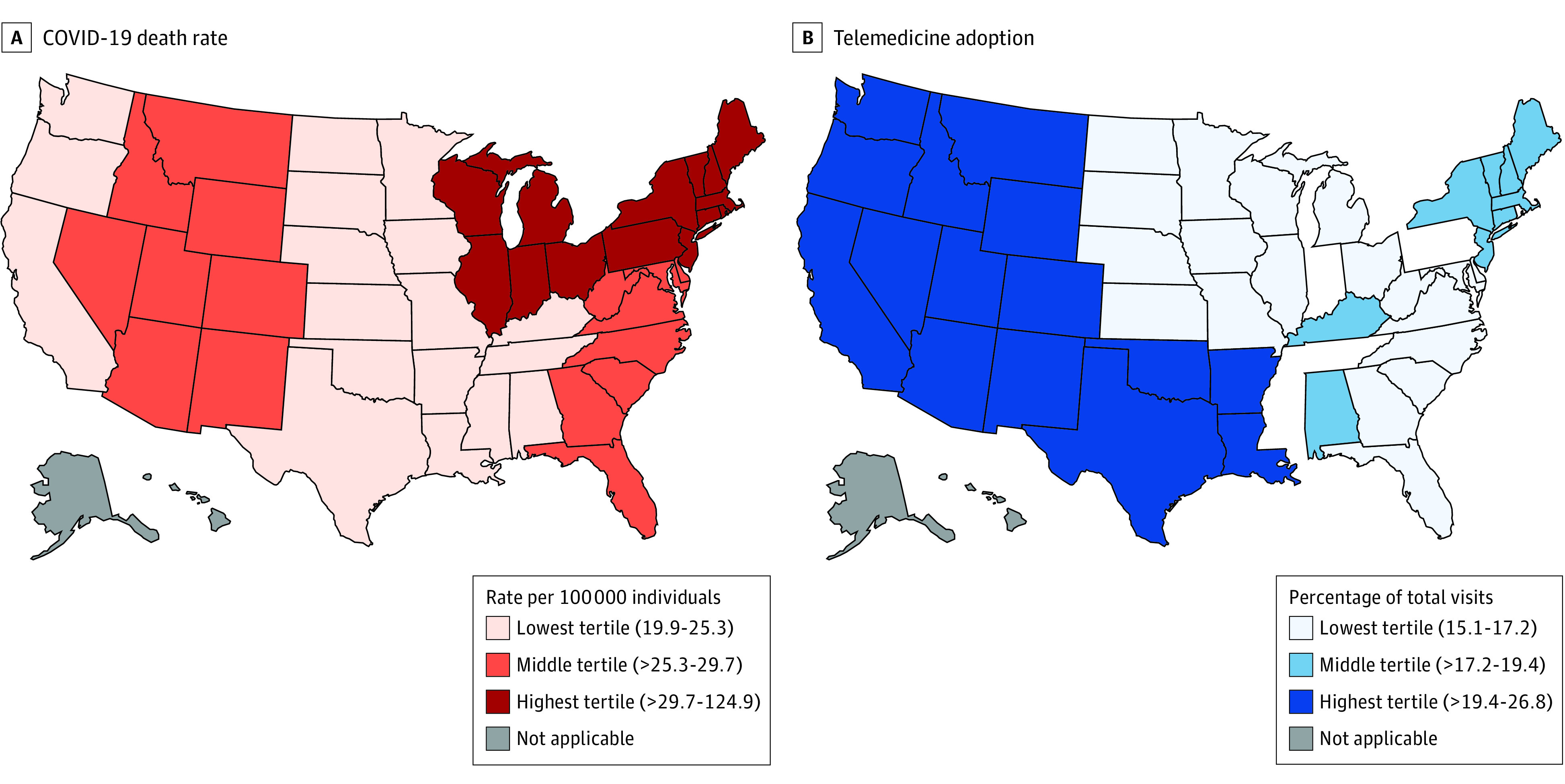
In the 8 calendar quarters between January 1, 2018, and December 31, 2019, between 122.4 million (95% CI, 117.3-127.5 million) and 130.3 million (95% CI, 124.7-135.9 million) quarterly primary care visits occurred in the US (mean, 125.8 million; 95% CI, 121.7-129.9 million), most of which were office-based (92.9%). In 2020, the total number of encounters decreased to 117.9 million (95% CI, 112.6-123.2 million) in Q1 and 99.3 million (95% CI, 94.9-103.8 million) in Q2, a decrease of 21.4% (27.0 million visits) from the average of Q2 levels during 2018 and 2019. Office-based visits decreased 50.2% (59.1 million visits) in Q2 of 2020 compared with Q2 2018-2019, while telemedicine visits increased from 1.1% of total Q2 2018-2019 visits (1.4 million quarterly visits) to 4.1% in Q1 of 2020 (4.8 million visits) and 35.3% in Q2 of 2020 (35.0 million visits). Decreases occurred in blood pressure level assessment (50.1% decrease, 44.4 million visits) and cholesterol level assessment (36.9% decrease, 10.2 million visits) in Q2 of 2020 compared with Q2 2018-2019 levels, and assessment was less common during telemedicine than during office-based visits (9.6% vs 69.7% for blood pressure; P < .001; 13.5% vs 21.6% for cholesterol; P < .001). New medication visits in Q2 of 2020 decreased by 26.0% (14.1 million visits) from Q2 2018-2019 levels. Telemedicine adoption occurred at similar rates among White individuals and Black individuals (19.3% vs 20.5% of patient visits, respectively, in Q1/Q2 of 2020), varied by region (low of 15.1% of visits [East North Central region], high of 26.8% of visits [Pacific region]), and was not correlated with regional COVID-19 burden.
The COVID-19 pandemic has been associated with changes in the structure of primary care delivery, with the content of telemedicine visits differing from that of office-based encounters.
对于 2019 年冠状病毒病(COVID-19)大流行与美国初级保健服务水平和内容之间的关联,人们知之甚少。
量化 COVID-19 大流行期间初级保健服务量、类型和内容的国家变化,特别是关注门诊与远程医疗就诊。
设计、地点和参与者:对来自 IQVIA 国家疾病和治疗索引的连续横断面数据进行分析,该索引是美国门诊护理的 2 阶段、分层全国代表性审计,从 2018 年第 1 个日历季度(Q1)到 2020 年第 2 个日历季度(Q2)。
就诊类型(门诊或远程医疗)、按患者人群和地理位置分层的总体情况;评估血压或胆固醇测量;以及开始或继续开处方药。
在 2018 年 1 月 1 日至 2019 年 12 月 31 日的 8 个日历季度中,美国的初级保健就诊量为 12240 万至 13030 万次(平均为 12580 万次;95%CI,12170 万至 12990 万次),其中大部分为门诊(92.9%)。2020 年,Q1 的总就诊次数降至 11790 万次(95%CI,11260 万至 12320 万次),Q2 降至 9930 万次(95%CI,9490 万至 10380 万次),与 2018-2019 年 Q2 水平相比下降了 21.4%(2700 万次就诊)。与 2018-2019 年相比,2020 年 Q2 的门诊就诊次数下降了 50.2%(5910 万次就诊),而远程医疗就诊次数从 2018-2019 年 Q2 总就诊次数的 1.1%(140 万次季度就诊)增加到 Q1 的 4.1%(480 万次就诊)和 Q2 的 35.3%(3500 万次就诊)。与 2018-2019 年 Q2 相比,2020 年 Q2 的血压水平评估(下降 50.1%,4440 万次就诊)和胆固醇水平评估(下降 36.9%,1020 万次就诊)减少,并且在远程医疗就诊中评估不太常见(血压:9.6%对 69.7%;P < .001;胆固醇:13.5%对 21.6%;P < .001)。2020 年 Q2 的新药物就诊量比 2018-2019 年 Q2 减少了 26.0%(1410 万次就诊)。远程医疗的采用率在白人和黑人患者中相似(2020 年 Q1/Q2 分别为 19.3%和 20.5%的患者就诊),因地区而异(东部中北部地区最低,为 15.1%的就诊;太平洋地区最高,为 26.8%的就诊),与区域 COVID-19 负担无关。
COVID-19 大流行与初级保健服务提供结构的变化有关,远程医疗就诊的内容与门诊就诊不同。