Karlsdottir Kristin, Gunnarsdottir Anna I, Grondal Gerdur, Love Thorvardur J, Stefansdottir Elinborg, Davidsdottir Loa G, Thorleifsdottir Ragna H, Gudbjornsson Bjorn
Hospital Pharmacy, Landspitali University Hospital, Reykjavik, Iceland.
School of Health Sciences, University of Iceland, Reykjavik, Iceland.
Front Med (Lausanne). 2022 Jan 27;9:799494. doi: 10.3389/fmed.2022.799494. eCollection 2022.
Due to a tender process in Iceland, all patients on Humira® were switched nationwide to its biosimilar Imraldi® in March 2019. The study aimed to explore the patient's perspective of the Humira® and Imraldi® injection devices.
A standard telephone interview was carried out among patients with inflammatory arthritis, inflammatory bowel disease and psoriasis, who underwent this nationwide switching program a few months earlier.
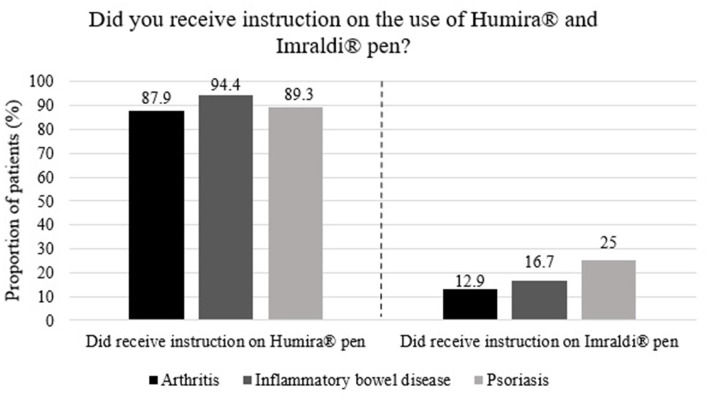
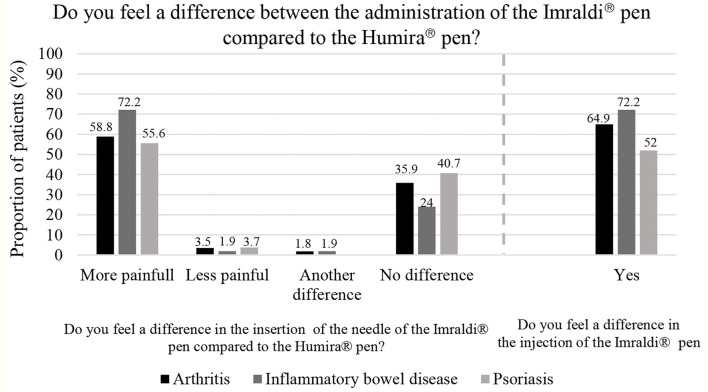
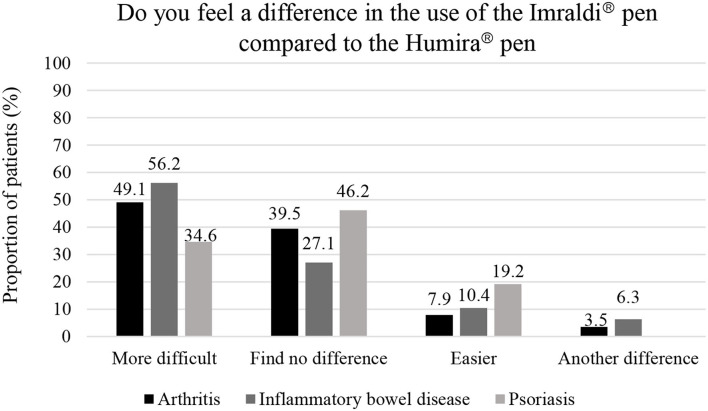
The response rate was 84.5% ( = 198). The average age was 50.8 years, and 53.5% were female. The patients self-administered the drugs in 96% of the cases. The majority (90.5%) stated that they received individualized instruction on using the Humira® pen, compared to 18.2% who accepted instruction in the case of the Imraldi® pen. Almost half (46.6%) of the patients found it more difficult to use the Imraldi® pen than the Humira® pen, while only 12.5% found the Imraldi® pen easier to use. Firstly, these differences were due to more painful insertion of the needle (62.2%) and secondly, due to the experience, the injection process was different (63.0%).
Patients with inflammatory disorders who have been treated regularly with adalimumab preferred the Humira® injection device over the Imraldi® device, according to our results. After all, these injection devices' structure and content are not the same, although both contain the same active ingredient, i.e. adalimumab. Our results highlight the importance of thorough information, not only with an information letter but also with the possibilities for individualized introduction in planning switching to biosimilars.
由于冰岛的招标程序,2019年3月全国所有使用修美乐(Humira®)的患者都改用其生物类似药依那西普(Imraldi®)。该研究旨在探讨患者对修美乐(Humira®)和依那西普(Imraldi®)注射装置的看法。
对几个月前参加全国换药计划的炎性关节炎、炎性肠病和银屑病患者进行了标准电话访谈。
回复率为84.5%(n = 198)。平均年龄为50.8岁,53.5%为女性。96%的患者自行给药。大多数(90.5%)表示他们接受了关于使用修美乐(Humira®)笔的个性化指导,而接受依那西普(Imraldi®)笔指导的患者为18.2%。近一半(46.6%)的患者发现使用依那西普(Imraldi®)笔比使用修美乐(Humira®)笔更困难,而只有12.5%的患者认为依那西普(Imraldi®)笔更容易使用。首先,这些差异是由于针头插入更疼(62.2%),其次,由于经验,注射过程不同(63.0%)。
根据我们的结果,长期接受阿达木单抗治疗的炎性疾病患者更喜欢修美乐(Humira®)注射装置而非依那西普(Imraldi®)装置。毕竟,尽管这两种注射装置的活性成分相同,即阿达木单抗,但其结构和内容物并不相同。我们的结果强调了全面信息的重要性,不仅要有信息函,还要有在计划改用生物类似药时进行个性化介绍的可能性。