Raimann Adalbert, Farr Alex, Huscsava Mercedes, Krois Wilfried, Strassl Robert, Schellnegger Julia, Eibensteiner Fabian, Göschl Bernadette, Schned Hannah, Steinbauer Philipp, Hetzmannseder Mathias, Stiegner Fabian, Greber-Platzer Susanne, Kiss Herbert, Plener Paul L, Aufricht Christoph, Berger Angelika, Wagner Michael
Division of Pediatric Pulmonology, Allergology and Endocrinology, Department of Pediatrics and Adolescent Medicine, Comprehensive Center for Pediatrics, Medical University of Vienna, Vienna, Austria.
Division of Obstetrics and Feto-Maternal Medicine, Department of Obstetrics and Gynecology, Comprehensive Center for Pediatrics, Medical University of Vienna, Vienna, Austria.
Front Med (Lausanne). 2022 Jan 26;9:823577. doi: 10.3389/fmed.2022.823577. eCollection 2022.
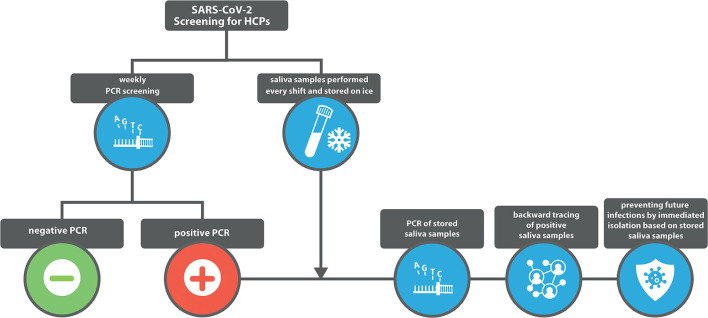
The objective of this study was to analyze the feasibility and acceptance of a non-invasive, daily and proactive screening program for SARS-CoV-2 infection employing serial saliva testing, in combination with a digital questionnaire among healthcare providers (HCPs) in a multi-professional setting.
This was a prospective cohort study involving HCPs from different units at a single tertiary care center, over a pilot phase of 4 weeks during the first wave of the COVID-19 pandemic from April 18th to June 6th, 2020.
Pediatric tertiary patient care units, Comprehensive Center for Pediatrics, Medical University of Vienna.
HCPs from different units, including physicians, nurses, midwives, and administrative staff (with patient contact) were considered eligible for the study. Study participants were working in different settings in our center at varying levels of risk exposure.
Saliva collection from mouth gargle and electronic symptom and exposure monitoring (eSEM) was performed by participants at the onset of each regular clinical shift (day or night shift), using an anonymous ID for matching the results.
RT-PCR of all saliva samples, eSEM, as well as feasibility and acceptance thereof.
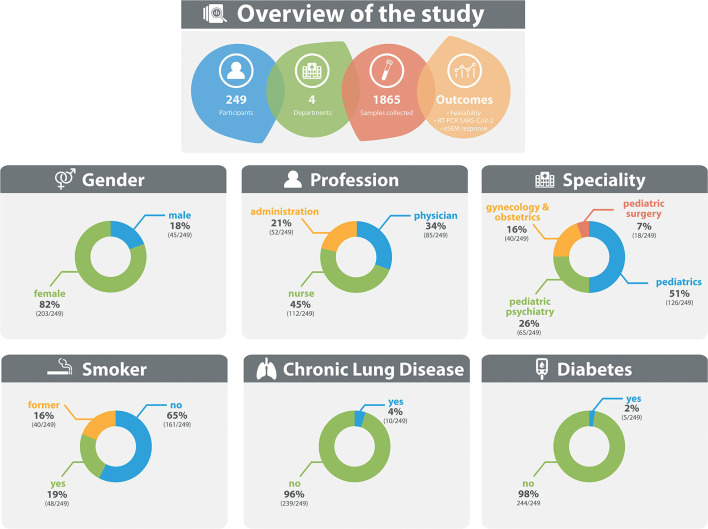
Two hundred and seventy-five volunteers collected 1,865 saliva samples and responded 1,378 times in the eSEM during a 4-week period. 1,331 (96.7%) responses were that the testing was feasible and acceptable. The most common severe symptom during the 4-week period mentioned by HCPs was headache, reported 54 times (3.9%). Two SARS-CoV-2 positive samples-one of them being associated with symptoms-were identified. The acceptance rate among HCPs was 96.6%.
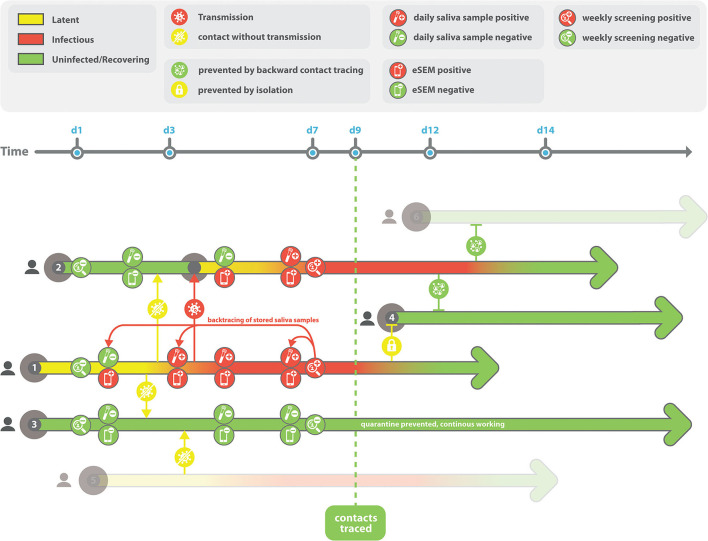
Serial saliva screening was a well-accepted and feasible method for monitoring SARS-CoV-2 infectious state in health care professionals. Combination of regular SARS-CoV-2 tests with sequential saliva collection and storage could potentially represent a highly efficient strategy to identify and trace virus positive staff for employee and patient safety.
本研究的目的是分析一项针对严重急性呼吸综合征冠状病毒2(SARS-CoV-2)感染的非侵入性、每日主动筛查计划的可行性和可接受性,该计划采用系列唾液检测,并结合多专业环境下医疗保健人员(HCPs)的数字问卷。
这是一项前瞻性队列研究,在2020年4月18日至6月6日新冠疫情第一波期间的4周试点阶段,纳入了单一三级护理中心不同科室的HCPs。
维也纳医科大学儿科综合中心的儿科三级患者护理单元。
来自不同科室的HCPs,包括医生、护士、助产士和行政人员(有患者接触)被认为符合研究条件。研究参与者在我们中心不同风险暴露水平的不同环境中工作。
参与者在每次常规临床班次(日班或夜班)开始时,通过漱口收集唾液,并进行电子症状和暴露监测(eSEM),使用匿名ID匹配结果。
所有唾液样本的逆转录聚合酶链反应(RT-PCR)、eSEM,以及其可行性和可接受性。
275名志愿者在4周内收集了1865份唾液样本,并在eSEM中回复了1378次。1331次(96.7%)回复表示检测是可行且可接受的。HCPs在4周期间提到的最常见严重症状是头痛,报告了54次(3.9%)。鉴定出两份SARS-CoV-2阳性样本,其中一份与症状相关。HCPs的接受率为96.6%。
系列唾液筛查是监测医护人员SARS-CoV-2感染状态的一种广泛接受且可行的方法。将常规的SARS-CoV-2检测与连续唾液采集和储存相结合,可能是一种高效策略,可识别和追踪病毒阳性工作人员,以保障员工和患者安全。