
抑制脊髓背角磷酸二酯酶-4通过cAMP-细胞因子-Cx43信号通路改善小鼠神经性疼痛。
Inhibition of phosphodiesterase-4 in the spinal dorsal horn ameliorates neuropathic pain via cAMP-cytokine-Cx43 signaling in mice.
作者信息
Zhang Fang-Fang, Wang Hao, Zhou Yan-Meng, Yu Hai-Yang, Zhang Melanie, Du Xian, Wang Dong, Zhang Feng, Xu Ying, Zhang Ji-Guo, Zhang Han-Ting
机构信息
Institute of Pharmacology, Shandong First Medical University & Shandong Academy of Medical Sciences, Tai'an, China.
Department of Neurobiology, Northwestern University Feinberg School of Medicine, Evanston, Illinois, USA.
出版信息
CNS Neurosci Ther. 2022 May;28(5):749-760. doi: 10.1111/cns.13807. Epub 2022 Feb 14.
BACKGROUND
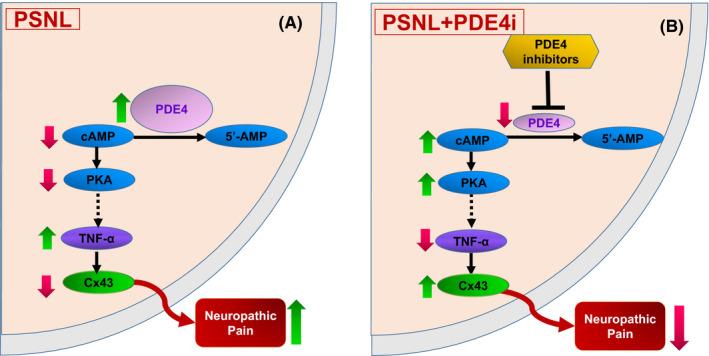
The spinal phosphodiesterase-4 (PDE4) plays an important role in chronic pain. Inhibition of PDE4, an enzyme catalyzing the hydrolysis of cyclic adenosine monophosphate AMP (cAMP), produces potent antinociceptive activity. However, the antinociceptive mechanism remains largely unknown. Connexin43 (Cx43), a gap junction protein, has been shown to be involved in controlling pain transduction at the spinal level; restoration of Cx43 expression in spinal astrocytes to the normal levels reduces nerve injury-induced pain. Here, we evaluate the novel mechanisms involving spinal cAMP-Cx43 signaling by which PDE4 inhibitors produce antinociceptive activity.
METHODS
First, we determined the effect of PDE4 inhibitors rolipram and roflumilast on partial sciatic nerve ligation (PSNL)-induced mechanical hypersensitivity. Next, we observed the role of cAMP-Cx43 signaling in the effect of PDE4 inhibitors on PSNL-induced mechanical hypersensitivity.
RESULTS
Single or repeated, intraperitoneal or intrathecal administration of rolipram or roflumilast significantly reduced mechanical hypersensitivity in mice following PSNL. In addition, repeated intrathecal treatment with either of PDE4 inhibitors reduced PSNL-induced downregulation of cAMP and Cx43, and upregulation of proinflammatory cytokines tumor necrosis factor-α (TNF-α) and interleukin-1β. Furthermore, the antinociceptive effects of PDE4 inhibitors were attenuated by the protein kinase A (PKA) inhibitor H89, TNF-α, or Cx43 antagonist carbenoxolone. Finally, PSNL-induced upregulation of PDE4B and PDE4D, especially the PDE4B subtype, was reduced by treatment with either of the PDE4 inhibitors.
CONCLUSIONS
The results suggest that the antinociceptive effect of PDE4 inhibitors is contributed by increasing Cx43 expression via cAMP-PKA-cytokine signaling in the spinal dorsal horn.
背景
脊髓磷酸二酯酶-4(PDE4)在慢性疼痛中起重要作用。抑制PDE4(一种催化环磷酸腺苷(cAMP)水解的酶)可产生强大的抗伤害感受活性。然而,其抗伤害感受机制仍 largely未知。连接蛋白43(Cx43)是一种缝隙连接蛋白,已被证明参与脊髓水平的疼痛传导控制;将脊髓星形胶质细胞中Cx43的表达恢复到正常水平可减轻神经损伤诱导的疼痛。在此,我们评估PDE4抑制剂产生抗伤害感受活性所涉及的脊髓cAMP - Cx43信号传导新机制。
方法
首先,我们确定PDE4抑制剂咯利普兰和罗氟司特对部分坐骨神经结扎(PSNL)诱导的机械性超敏反应的影响。接下来,我们观察cAMP - Cx43信号传导在PDE4抑制剂对PSNL诱导的机械性超敏反应作用中的作用。
结果
腹腔内或鞘内单次或重复给予咯利普兰或罗氟司特可显著降低PSNL后小鼠的机械性超敏反应。此外,用任何一种PDE4抑制剂进行重复鞘内治疗可减少PSNL诱导的cAMP和Cx43下调,以及促炎细胞因子肿瘤坏死因子-α(TNF-α)和白细胞介素-1β的上调。此外,PDE4抑制剂的抗伤害感受作用被蛋白激酶A(PKA)抑制剂H89、TNF-α或Cx43拮抗剂羧苄青霉素减弱。最后,用任何一种PDE4抑制剂治疗可减少PSNL诱导的PDE4B和PDE4D上调,尤其是PDE4B亚型。
结论
结果表明,PDE4抑制剂的抗伤害感受作用是通过脊髓背角中cAMP - PKA - 细胞因子信号传导增加Cx43表达来实现的。


 Zotero 插件