Department of Psychiatry and Neurochemistry, Institute of Neuroscience and Physiology, the Sahlgrenska Academy at the University of Gothenburg, Mölndal, Sweden; Wallenberg Centre for Molecular and Translational Medicine, University of Gothenburg, Gothenburg, Sweden; King's College London, Institute of Psychiatry, Psychology and Neuroscience, Maurice Wohl Institute Clinical Neuroscience Institute, London, UK; NIHR Biomedical Research Centre for Mental Health and Biomedical Research Unit for Dementia at South London and Maudsley NHS Foundation, London, UK.
Department of Psychiatry and Neurochemistry, Institute of Neuroscience and Physiology, the Sahlgrenska Academy at the University of Gothenburg, Mölndal, Sweden; Translational Neuroimaging Laboratory, McGill Centre for Studies in Aging, McGill University, Montreal, QC, Canada.
EBioMedicine. 2022 Feb;76:103836. doi: 10.1016/j.ebiom.2022.103836. Epub 2022 Feb 12.
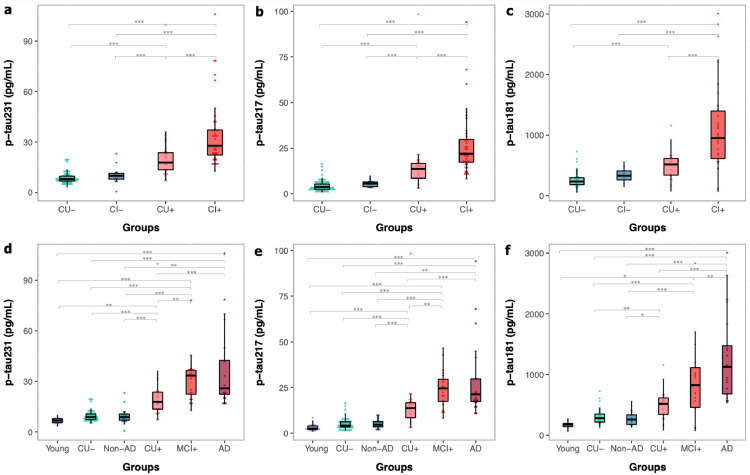
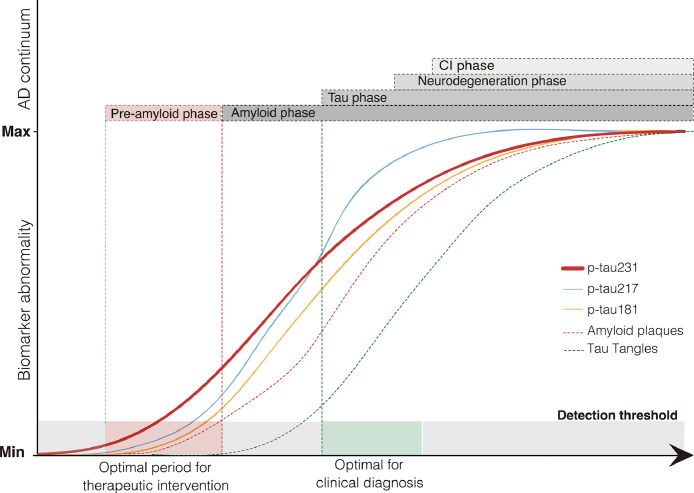
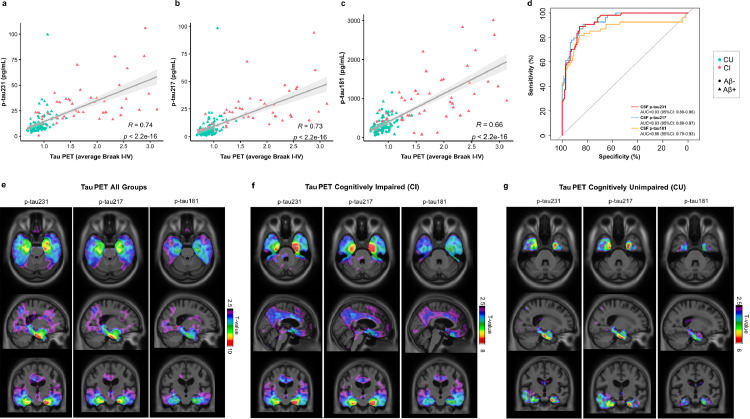
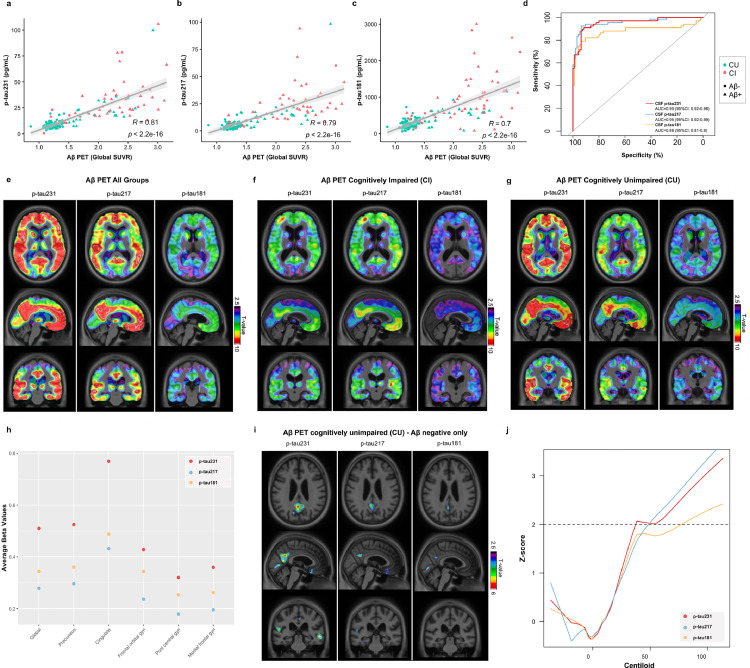
Phosphorylated tau (p-tau) epitopes in cerebrospinal fluid (CSF) are accurate biomarkers for a pathological and clinical diagnosis of Alzheimer's disease (AD) and are seen to be increased in preclinical stage of the disease. However, it is unknown if these increases transpire earlier, prior to amyloid-beta (Aβ) positivity as determined by position emission tomography (PET), and if an ordinal sequence of p-tau epitopes occurs at this incipient phase METHODS: We measured CSF concentrations of p-tau181, p-tau217 and p-tau231 in 171 participants across the AD continuum who had undergone Aβ ([F]AZD4694) and tau ([F]MK6240) position emission tomography (PET) and clinical assessment FINDINGS: All CSF p-tau biomarkers were accurate predictors of cognitive impairment but CSF p-tau217 demonstrated the largest fold-changes in AD patients in comparison to non-AD dementias and cognitively unimpaired individuals. CSF p-tau231 and p-tau217 predicted Aβ and tau to a similar degree but p-tau231 attained abnormal levels first. P-tau231 was sensitive to the earliest changes of Aβ in the medial orbitofrontal, precuneus and posterior cingulate before global Aβ PET positivity was reached INTERPRETATION: We demonstrate that CSF p-tau231 increases early in development of AD pathology and is a principal candidate for detecting incipient Aβ pathology for therapeutic trial application FUNDING: Canadian Institutes of Health Research (CIHR), Canadian Consortium of Neurodegeneration and Aging, Weston Brain Institute, Brain Canada Foundation, the Fonds de Recherche du Québec.
脑脊液(CSF)中磷酸化tau(p-tau)表位是阿尔茨海默病(AD)病理和临床诊断的准确生物标志物,并且在疾病的临床前阶段可见其增加。然而,尚不清楚这些增加是否发生在淀粉样蛋白-β(Aβ)阳性之前,即通过正电子发射断层扫描(PET)确定,并且在这个初始阶段是否会发生 p-tau 表位的有序序列。方法:我们在跨越 AD 连续体的 171 名参与者中测量了 CSF 中 p-tau181、p-tau217 和 p-tau231 的浓度,这些参与者都进行了 Aβ[F]AZD4694 和 tau[F]MK6240 正电子发射断层扫描(PET)和临床评估。结果:所有 CSF p-tau 生物标志物都是认知障碍的准确预测指标,但与非 AD 痴呆和认知正常个体相比,CSF p-tau217 在 AD 患者中表现出最大的折叠变化。CSF p-tau231 和 p-tau217 对 Aβ 和 tau 的预测程度相似,但 p-tau231 首先达到异常水平。p-tau231 对内侧眶额、后扣带回和楔前叶的 Aβ 最早变化敏感,然后达到全局 Aβ PET 阳性。解释:我们证明 CSF p-tau231 在 AD 病理学的早期发展中增加,并且是用于检测起始 Aβ 病理学的主要候选者,可用于治疗试验应用。资金来源:加拿大卫生研究院(CIHR),加拿大神经退行性疾病和衰老联合会,韦斯顿脑研究所,加拿大脑基金会,魁北克研究基金会。