Lantero-Rodriguez Juan, Montoliu-Gaya Laia, Ashton Nicholas J, Pola Ilaria, Therriault Joseph, Rahmouni Nesrine, Brum Wagner S, Servaes Stijn, Stevenson Jenna, Di Molfetta Guglielmo, Arslan Burak, Klostranec Jesse, Vitali Paolo, Montembeault Maxime, Gauthier Serge, Tissot Cecile, Macedo Arthur C, Pascoal Tharick A, Jeromin Andreas, Gobom Johan, Blennow Kaj, Zetterberg Henrik, Rosa-Neto Pedro, Benedet Andrea L
Department of Psychiatry and Neurochemistry, Institute of Neuroscience & Physiology, The Sahlgrenska Academy at the University of Gothenburg, Mölndal, Sweden.
Wallenberg Centre for Molecular and Translational Medicine, University of Gothenburg, Gothenburg, Sweden.
Acta Neuropathol. 2025 Mar 17;149(1):27. doi: 10.1007/s00401-025-02863-w.
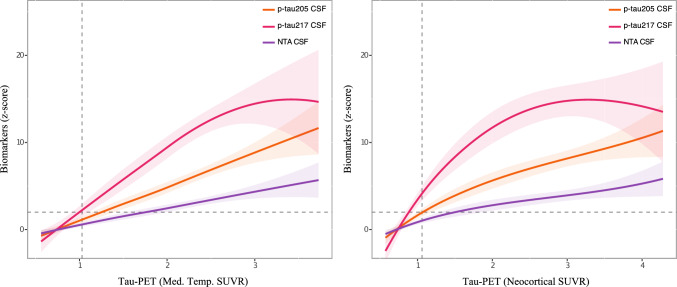
Recently, conceptual systems for the in vivo staging of Alzheimer's disease (AD) using fluid biomarkers have been suggested. Thus, it is important to assess whether available fluid biomarkers can successfully stage AD into clinically and biologically relevant categories. In the TRIAD cohort, we explored whether p-tau217, p-tau205 and NTA-tau (biomarkers of early, intermediate and late AD pathology, respectively) have potential for biofluid-based staging in cerebrospinal fluid (CSF; n = 219) and plasma (n = 150), and compared them in a paired CSF and plasma subset (n = 76). Our findings suggest a good concordance between biofluid staging and underlying pathology when classifying amyloid-positivity into three categories based on neurofibrillary pathology: minimal/non-existent (p-tau217 positive), early-to-intermediate (p-tau217 and p-tau205 positivity), and advanced tau tangle deposition (p-tau217, p-tau205 and NTA-tau positive), as indexed by tau-PET. Discordant cases accounted for 4.6% and 13.3% of all CSF and plasma measurements respectively (9.2% and 11.8% in paired samples). Notably, CSF- and plasma-based staging matched one another in 61.7% of the cases, while approximately 32% of the remaining participants were one to three biofluid stages higher in CSF as compared to plasma. Overall, these exploratory results suggest that biofluid staging of AD holds potential for offering valuable insights into underlying AD hallmarks and disease severity. However, its applicability beyond molecular characterization at research settings has yet to be demonstrated.
最近,有人提出了使用体液生物标志物对阿尔茨海默病(AD)进行体内分期的概念系统。因此,评估现有的体液生物标志物能否成功地将AD分为临床和生物学上相关的类别很重要。在TRIAD队列中,我们探讨了p-tau217、p-tau205和NTA-tau(分别为AD早期、中期和晚期病理的生物标志物)在脑脊液(CSF;n = 219)和血浆(n = 150)中基于生物流体进行分期的潜力,并在配对的脑脊液和血浆亚组(n = 76)中对它们进行了比较。我们的研究结果表明,当根据神经原纤维病理将淀粉样蛋白阳性分为三类时:最小/不存在(p-tau217阳性)、早期至中期(p-tau217和p-tau205阳性)和晚期tau缠结沉积(p-tau217、p-tau205和NTA-tau阳性),生物流体分期与潜在病理之间具有良好的一致性,以tau-PET为指标。不一致的病例分别占所有脑脊液和血浆测量值的4.6%和13.3%(配对样本中为9.2%和11.8%)。值得注意的是,在61.7%的病例中,基于脑脊液和血浆的分期相互匹配,而其余参与者中约32%的脑脊液生物流体分期比血浆高1至3期。总体而言,这些探索性结果表明,AD的生物流体分期有可能为潜在的AD特征和疾病严重程度提供有价值的见解。然而,其在研究环境之外的分子特征之外的适用性尚未得到证实。