Department of Biotechnology, The College of Basic Medical Science, Dalian Medical University, Dalian 116044, China.
Key Laboratory of Science and Technology on Microsystem, Shanghai Institute of Microsystem and Information Technology, Chinese Academy of Sciences, Shanghai 200050, China.
Cells. 2022 Jan 21;11(3):361. doi: 10.3390/cells11030361.
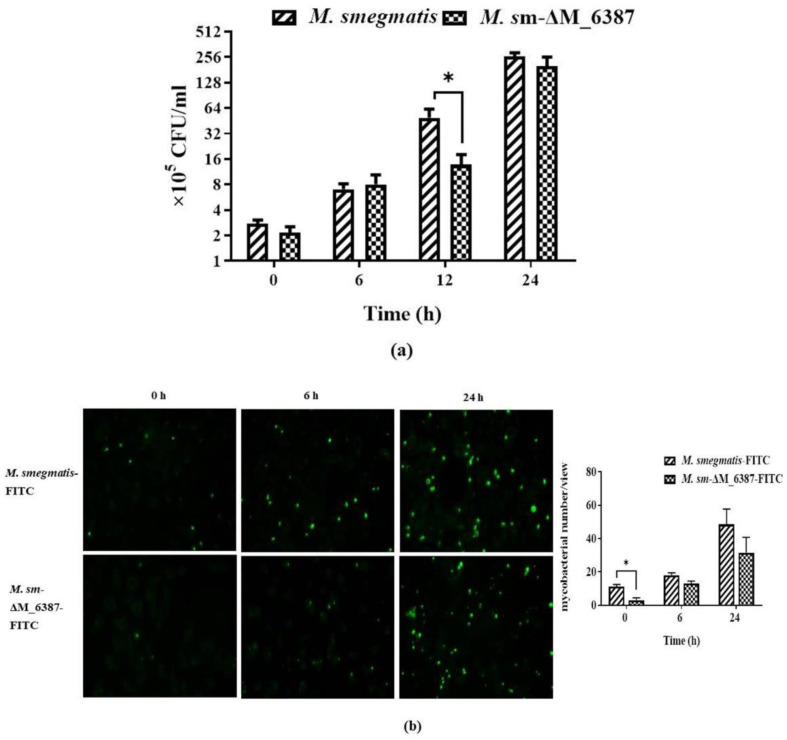
() is an intracellular pathogen persisting in phagosomes that has the ability to escape host immune surveillance causing tuberculosis (TB). Lipoarabinomannan (LAM), as a glycolipid, is one of the complex outermost components of the mycobacterial cell envelope and plays a critical role in modulating host responses during infection. Different species within the genus exhibit distinct LAM structures and elicit diverse innate immune responses. However, little is known about the mechanisms. In this study, we first constructed a LAM-truncated mutant with fewer arabinofuranose (Ara) residues named -ΔM_6387 ( arabinosyltransferase EmbC gene knockout strain). It exhibited some prominent cell wall defects, including tardiness of mycobacterial migration, loss of acid-fast staining, and increased cell wall permeability. Within alveolar epithelial cells (A549) infected by -ΔM_6387, the uptake rate was lower, phagosomes with bacterial degradation appeared, and microtubule-associated protein light chain 3 (LC3) recruitment was enhanced compared to wild type (). We further confirmed that the variability in the removal capability of -ΔM_6387 resulted from host cell responses rather than the changes in the mycobacterial cell envelope. Moreover, we found that -ΔM_6387 or its glycolipid extracts significantly induced expression changes in some genes related to innate immune responses, including Toll-like receptor 2 (TLR2), class A scavenger receptor (SR-A), Rubicon, LC3, tumor necrosis factor alpha (TNF-α), Bcl-2, and Bax. Therefore, our studies suggest that nonpathogenic can deposit LC3 on phagosomal membranes, and the decrease in the quantity of residues for LAM molecules not only impacts mycobacterial cell wall integrity but also enhances host defense responses against the intracellular pathogens and decreases phagocytosis of host cells.
()是一种存在于吞噬体中的细胞内病原体,能够逃避宿主免疫监视,导致结核病(TB)。脂阿拉伯甘露聚糖(LAM)作为一种糖脂,是分枝杆菌细胞外膜的复杂最外层成分之一,在感染过程中对调节宿主反应起着关键作用。属内的不同种属表现出不同的 LAM 结构,并引起不同的先天免疫反应。然而,对于其机制知之甚少。在本研究中,我们首先构建了一个 LAM 截短突变体,其阿拉伯呋喃糖(Ara)残基较少,命名为-ΔM_6387(阿拉伯糖基转移酶 EmbC 基因敲除株)。它表现出一些明显的细胞壁缺陷,包括分枝杆菌迁移迟缓、抗酸染色丢失和细胞壁通透性增加。在感染-ΔM_6387 的肺泡上皮细胞(A549)中,与野生型()相比,摄取率较低,出现细菌降解的吞噬体,微管相关蛋白轻链 3(LC3)募集增强。我们进一步证实,-ΔM_6387 的去除能力的变化是由于宿主细胞反应而不是分枝杆菌细胞外膜的变化。此外,我们发现-ΔM_6387 或其糖脂提取物显著诱导了一些与先天免疫反应相关的基因表达变化,包括 Toll 样受体 2(TLR2)、A 类清道夫受体(SR-A)、Rubicon、LC3、肿瘤坏死因子-α(TNF-α)、Bcl-2 和 Bax。因此,我们的研究表明,非致病性分枝杆菌可以在吞噬体膜上沉积 LC3,并且 LAM 分子的残基数量减少不仅会影响分枝杆菌细胞壁的完整性,还会增强宿主对细胞内病原体的防御反应,减少宿主细胞的吞噬作用。