Department of Cell Biology and Molecular Genetics, University of Maryland, College Park, MD, United States.
Front Cell Infect Microbiol. 2020 Oct 23;10:595029. doi: 10.3389/fcimb.2020.595029. eCollection 2020.
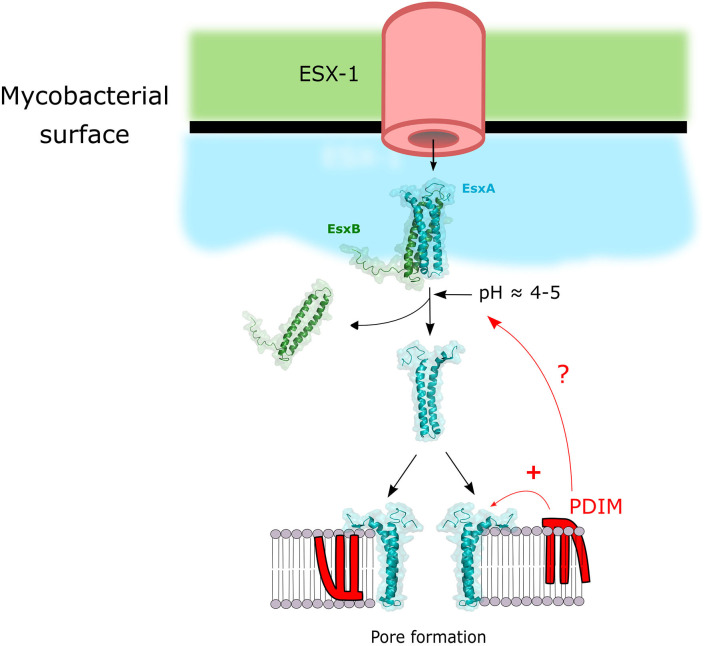
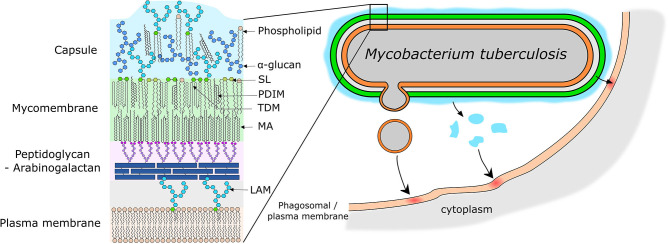
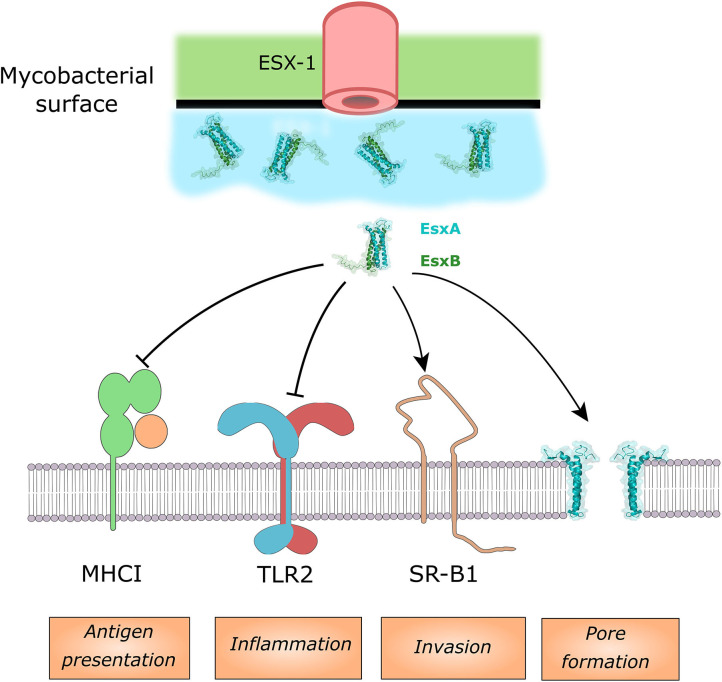
(Mtb) is a very successful pathogen, strictly adapted to humans and the cause of tuberculosis. Its success is associated with its ability to inhibit host cell intrinsic immune responses by using an arsenal of virulence factors of different nature. It has evolved to synthesize a series of complex lipids which form an outer membrane and may also be released to enter host cell membranes. In addition, secreted protein effectors of Mtb are entering the host cell cytosol to interact with host cell proteins. We briefly discuss the current model, involving the ESX-1 type seven secretion system and the Mtb lipid phthiocerol dimycoserosate (PDIM), of how Mtb creates pores in the phagosomal membrane to allow Mtb proteins to access to the host cell cytosol. We provide an exhaustive list of Mtb secreted proteins that have effector functions. They modify (mostly inhibit but sometimes activate) host cell pathways such as: phagosome maturation, cell death, cytokine response, xenophagy, reactive oxygen species (ROS) response via NADPH oxidase 2 (NOX2), nitric oxide (NO) response via NO Synthase 2 (NOS2) and antigen presentation via MHC class I and class II molecules. We discuss the host cell targets for each lipid and protein effector and the importance of the Mtb effector for virulence of the bacterium.
(结核分枝杆菌)是一种非常成功的病原体,严格适应于人类并导致结核病。它的成功与其通过使用多种不同性质的毒力因子抑制宿主细胞固有免疫反应的能力有关。它已经进化出一系列复杂的脂质,这些脂质形成外膜,也可能被释放进入宿主细胞膜。此外,结核分枝杆菌分泌的蛋白效应子进入宿主细胞质与宿主细胞蛋白相互作用。我们简要讨论了当前的模型,涉及 ESX-1 型七肽分泌系统和结核分枝杆菌的 phthiocerol dimycoserosate (PDIM),即结核分枝杆菌如何在吞噬体膜上创建孔,以使结核分枝杆菌蛋白进入宿主细胞细胞质。我们提供了结核分枝杆菌分泌的具有效应功能的蛋白的详尽列表。它们修饰(主要是抑制但有时激活)宿主细胞途径,如吞噬体成熟、细胞死亡、细胞因子反应、异源吞噬、通过 NADPH 氧化酶 2 (NOX2) 产生活性氧 (ROS) 反应、通过 NO 合酶 2 (NOS2) 产生一氧化氮 (NO) 反应和通过 MHC 类 I 和类 II 分子进行抗原呈递。我们讨论了每种脂质和蛋白效应子的宿主细胞靶标以及该细菌的毒力因子的重要性。